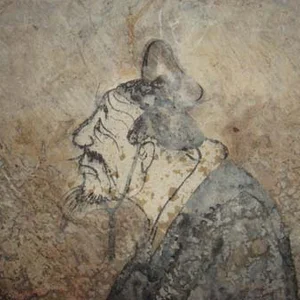

A Chinese thinker and philosopher of the 5th century BC, Confucius is the founder of Confucianism. His moral and political teachings, passed down by his disciples in the Analects, have profoundly influenced Chinese civilization and East Asia for more than two millennia.
Frequently asked questions
Famous Quotes
« Do not do to others what you do not want done to yourself.»
« The man who moves a mountain begins by carrying away small stones.»
« Choose a job you love, and you will never have to work a day in your life.»
« Our greatest glory is not in never falling, but in rising every time we fall.»
Key Facts
- Born around 551 BC in Qufu, in the state of Lu (present-day China)
- Founder of Confucianism, a major system of ethical and political thought
- His words are collected in the Analects (Lunyu), compiled by his disciples after his death in 479 BC
- A contemporary of Buddha and Pythagoras — a period known as the 'Axial Age'
- His ideas became the official state doctrine of China under the Han dynasty (206 BC)
Works & Achievements
A collection of Confucius's sayings and dialogues compiled by his disciples after his death. It is the founding text of Confucianism, translated worldwide and studied for more than two millennia across East Asia.
A historical chronicle of the state of Lu attributed to Confucius, covering 242 years of history. Every phrase carries an implicit moral judgment, making this work the earliest example of ethical historiography in China.
Confucius is said to have compiled and edited the five great texts of the Chinese tradition: the Book of Odes, the Book of Documents, the Book of Changes, the Book of Rites, and the Annals. This work of transmission made him the guardian of the scholarly culture of his era.
A text attributed to Confucius and his disciple Zengzi, outlining the moral progression of the individual toward the proper governance of the state. It would become one of the Four Books of the Confucian canon.
Attributed to Confucius's grandson Zisi, this text develops the central concept of moderation and moral sincerity. It is also part of the Four Books studied throughout imperial China.
Anecdotes
One day, a disciple asked Confucius whether a single rule could guide an entire life. Confucius replied: 'Is it not reciprocity? Do not do to others what you would not want done to yourself.' This formulation, known as the Golden Rule, is at the heart of his ethical teaching.
Confucius briefly held the position of Minister of Justice in the state of Lu around 500 BCE. According to the chronicles, his moral authority was such that the mere announcement of his appointment was enough to cause crime to drop. But political intrigues quickly forced him into exile.
For nearly thirteen years, Confucius wandered from court to court with his disciples, seeking a ruler who would agree to put his ideas of virtuous government into practice. He met with refusal after refusal, was even imprisoned once, yet never abandoned his mission.
Confucius attached extreme importance to funeral rites and mourning. At his mother's death, he observed three years of mourning, living in the strictest simplicity. He taught that honoring one's ancestors was the foundation of all filial piety and, by extension, of all social order.
Although recognized as China's first great educator, Confucius did not consider himself a sage but a 'transmitter': he did not claim to invent new wisdom, but to restore and pass on the values of the ancient kings of the Zhou dynasty.
Primary Sources
The Master said: 'Is it not a joy to learn and to practice what one has learned? Is it not a pleasure to have friends come from distant places?'
A historical chronicle of the State of Lu attributed to Confucius, covering the period 722–481 BC, written in a laconic style in which every word carries a moral judgment.
Confucius was born in Zou, in the State of Lu. His father's name was Shuliang He, his mother's Yan Zhengzai. At fifteen, his heart was set on learning.
The way of great learning consists in illuminating illustrious virtue, in renewing the people, and in resting in the highest good.
What Heaven has conferred is called human nature. Following one's nature is called the Way. Cultivating the Way is called teaching.
Key Places
Birthplace and burial site of Confucius, located in present-day Shandong Province. It is still home to the Temple of Confucius, the Kong Family Mansion, and the Confucius Cemetery, all listed as UNESCO World Heritage Sites.
Capital of the Zhou dynasty, which Confucius visited to study ancient rites. It was here that he is said to have met Laozi and deepened his knowledge of royal ceremonies.
A hill near Qufu where, according to tradition, Confucius was born following his parents' prayers. A temple was erected there in his honor as early as antiquity.
The state where Confucius spent the longest period during his exile, attempting to persuade Duke Ling to put his principles of virtuous governance into practice — without lasting success.
Founded in 478 BCE, one year after the philosopher's death, it is one of the oldest temples in China. A center of Confucian pilgrimage and celebration for twenty-five centuries.
Typical Objects

Texts were written on strips of bamboo bound together with cords. Confucius read and annotated the classics this way — so intensely, it is said, that he wore through the cords of the I Ching (Book of Changes) three times.

A central ritual and musical instrument in court ceremonies, the bell symbolized cosmic and social order. Confucius was an accomplished musician who placed great importance on music as a vehicle for virtue.

Confucius attached the utmost importance to proper dress during rituals. He wore specific robes for each occasion, believing that outward appearance reflects inner order.

A traditional Chinese instrument that Confucius both played and taught. For him, refined music was inseparable from the moral formation of the gentleman (junzi).

These bronze containers were used for offerings during ancestral ceremonies. Confucius knew their rules of use with great precision, as ritual propriety (li) was at the heart of his social teaching.

Archery was one of the six noble arts (liuyi) taught by Confucius, alongside chariot driving, calligraphy, arithmetic, music, and ritual. It symbolized self-mastery as much as physical skill.
School Curriculum
Vocabulary & Tags
Key Vocabulary
Daily Life
Morning
Confucius rose at dawn and began his day with ritual ablutions and offerings to his ancestors. He would then dress in attire appropriate to the occasion — he never wore the same outfit for teaching, presiding over a rite, or appearing at court.
Afternoon
Afternoons were devoted to teaching. Confucius received his disciples — as many as three thousand according to tradition — in a garden or study hall, conversing with each according to their level and personality. He also practiced music, particularly the guqin, which he considered essential to moral education.
Evening
In the evening, Confucius studied and annotated classical texts on bamboo tablets, or held intimate conversations with his closest disciples. He placed great importance on meals taken with proper ritual, refusing to eat if the food was not correctly prepared or served.
Food
Confucius paid close attention to the quality and presentation of food. He would not eat rice that was poorly cooked, meat that was improperly cut, or food that was out of season. He favored millet, rice, cooked vegetables, and ritual sauces, consuming meat in moderation and in accordance with the rules of carving.
Clothing
Confucius wore long robes of silk or hemp, with color and cut varying according to the ritual occasion. He avoided red and purple for everyday wear, reserving those for ceremonial garments. Proper dress was, for him, a visible expression of inner moral order.
Housing
Confucius lived in the city of Qufu, in a modest dwelling according to the sources, surrounded by a garden where he taught. During his years of wandering, he lodged with nobles or in inns, often in precarious conditions. Upon returning to Lu, he lived in a house that quickly became a place of teaching and gathering for his disciples.
Historical Timeline
Period Vocabulary
Visual Style
Esthétique de la peinture chinoise à l'encre de Chine : sobriété, espaces vides contemplatifs, architecture de bois laqué et robes de cérémonie aux tons profonds.
Sound Ambience
Atmosphère feutrée d'une cour lettrée de la Chine antique : musique rituelle du guqin, récitations de disciples, cloches de bronze et jardins de bambous.
Liens externes & ressources
Références
Œuvres
Lunyu — Les Entretiens
Ve–IVe siècle av. J.-C.
Chunqiu — Annales des Printemps et Automnes
Vers 480 av. J.-C.
Édition des cinq classiques (Wujing)
Vers 500–479 av. J.-C.
Daxue — La Grande Étude
Ve–IVe siècle av. J.-C.
Zhongyong — La Doctrine du Milieu
Ve–IVe siècle av. J.-C.
See also
Related Characters
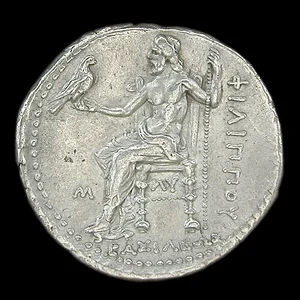
Alexander II of Macedon
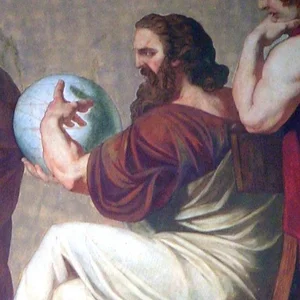
Anaxagoras of Clazomenae
499 av. J.-C. — 427 av. J.-C.
Anaximander
609 av. J.-C. — 545 av. J.-C.
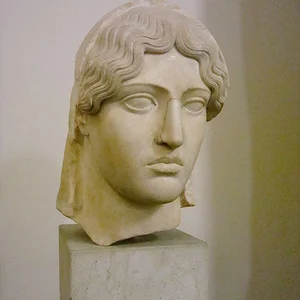
Aspasia
469 av. J.-C. — 399 av. J.-C.
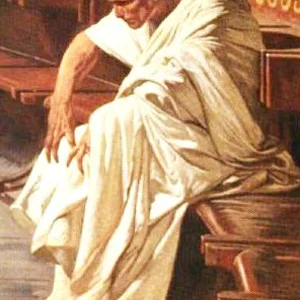
Catiline
107 av. J.-C. — 61 av. J.-C.
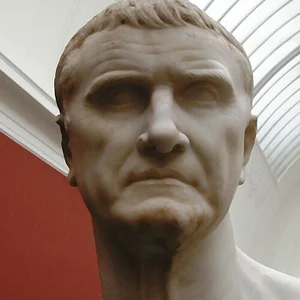
Crassus
114 av. J.-C. — 52 av. J.-C.