Imaginary interview with Eleanor Roosevelt
by Charactorium · Eleanor Roosevelt (1884 — 1962) · Politics · Society · 6 min read
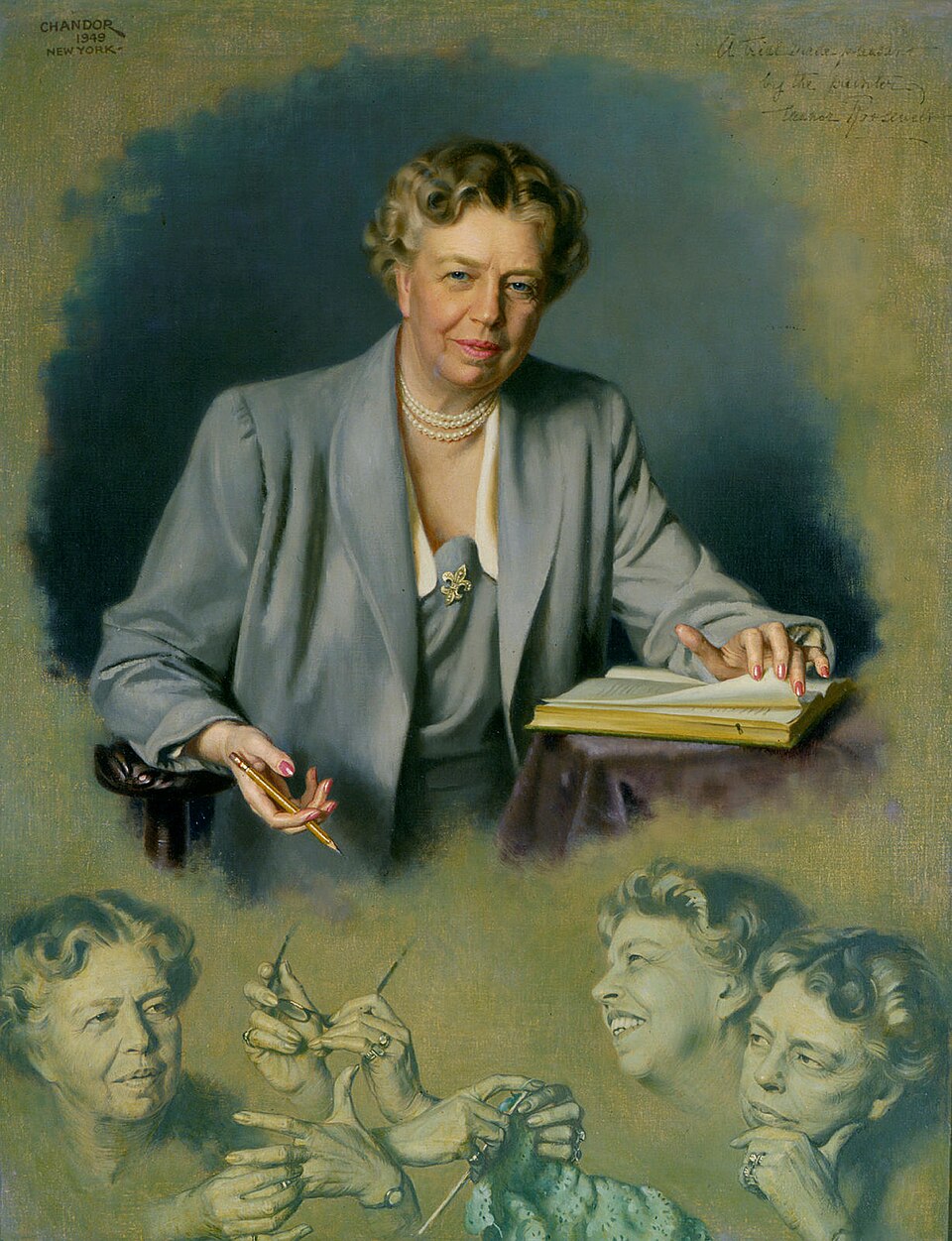
Val-Kill Cottage, an autumn afternoon in 1961. Far from the protocol of Washington, a seventy-six-year-old woman receives us in a house without servants, a cup of tea in hand, her glasses pushed up on her forehead. She has just finished her daily column and speaks with that direct frankness that so disconcerted so many presidents.
—Do you remember the child you were before becoming this public figure?
An orphan at ten, that's what I was. My mother called me 'Granny' because she found me solemn and graceless; in my own family, they did not hesitate to tell me I was ugly and awkward. I grew up convinced I was a disappointment, with the belief that I had to earn my right to exist. My father, whom I adored and who had instilled in me an exaggerated sense of duty, had set an ideal to which I believed I must always rise. I never denied that childhood suffering: it made me attentive to those who are humiliated, to the invisible. When later I went down into mines or slums, notebook in hand, I think I recognized something. You only truly comfort the wounds you have carried yourself.
You only truly comfort the wounds you have carried yourself.
—How did that shy child find the strength to assert herself?
Through a woman. In 1901, I was sent to Allenswood, near London, to Marie Souvestre, a French educator with a feminist spirit and fearlessly free mind. For the first time, someone looked at me as an intellect and not as a bothersome child. She made us debate, contradict, think against the herd. I discovered there that an opinion could be my own, defended at my table, without permission. I often say that you gain strength, courage, and confidence every time you stop to look fear in the face, and that you must do the thing you think you cannot do. I did not find that phrase in a book: I learned it at Allenswood, in an English classroom where an old lady taught me to no longer lower my eyes.
You must do the thing you think you cannot do.
—Why did you keep a daily column for twenty-seven years, day after day?
Because a First Lady, in people's minds, cut ribbons and smiled. I wanted to speak. Starting in 1935, I began My Day, six days a week, typed on my portable typewriter wherever I was — a train, a hotel room, the deck of a ship in the Pacific. I wrote about my encounters, my anger, my travels, with a freedom of tone that was hardly forgiven in a woman of my rank. More than ninety newspapers published it; millions of readers read me in the morning like listening to a chatty and stubborn neighbor. That column was my direct line to the American people, without intermediaries, without a minister to correct my sentence. My typewriter was my gentlest and most persistent weapon.
My typewriter was my gentlest and most persistent weapon.
—They say you received a tremendous amount of mail. How did you handle it?
Up to three hundred letters a day at the White House. Unemployed mothers, starving old people, black boys denied schooling — the America of the Great Depression wrote me its misery because it felt it would be read. I got up at seven-thirty, several newspapers spread out, pencil in hand to note what would need to be said that day. I tried to answer myself, to pass a grievance to a minister, to obtain help. I rarely went to bed before midnight, convinced that there was always one more letter to write. I was criticized for not staying in my place. But a letter that no one answers is a citizen being told they don't count — and that, I could not bear.
A letter without an answer is a citizen being told they don't count.
—In 1939, you resigned noisily from a prestigious association. What happened?
The Daughters of the American Revolution, of which I was a member, had refused Marian Anderson, one of the greatest voices of her time, the right to sing at Constitution Hall — because she was Black. I returned my membership card publicly, and I wrote it in black and white in my column. Some cried scandal: a First Lady does not slam the door on an institution of respectable ladies. But you cannot defend human rights in the salons of Geneva if you trample on them in a concert hall in Washington. I told President Truman later: we cannot speak to the world about human rights while denying them at home. That day, belonging to a respectable club mattered less to me than looking Marian Anderson in the eye.
You cannot defend human rights in Geneva if you trample on them in Washington.
—What does the concert that followed, at the Lincoln Memorial, mean to you?
On April 9, 1939, seventy-five thousand people gathered before the Lincoln Memorial to hear her sing in the open air, under the marble gaze of Abraham Lincoln. I did not go up on the stage — that day was hers, not mine. But I had helped make it happen, and from afar I measured what that mixed crowd of Black and white, silent, meant in an America still divided by racial segregation. A magnificent voice rose where a closed hall had tried to silence it. I understood that day that a refusal, turned around, can become a symbol more powerful than a thousand speeches. Shame had changed sides.
A refusal, turned around, can become a symbol more powerful than a thousand speeches.
—How did you experience the negotiations of the Universal Declaration against the Soviet delegates?
They were three years of attrition, from 1946 to 1948, as chair of the Human Rights Commission. The Soviet delegates argued over every comma, accused the West of imperialism, tried to drown the text in endless sessions. I presided, often late into the night, determined not to give in to exhaustion — because that was their tactic. We had to reconcile enemy worlds: capitalists and communists, colonizers and colonized, each entrenched in their definition of freedom. I had no illusions about my diplomatic charm; my only strength was obstinacy. No one, I often said, can make you feel inferior without your consent — and I refused to let anyone at that table have the power to make me give up.
No one can make you feel inferior without your consent.
—How do you feel looking back on December 10, 1948 in Paris?
At the Palais de Chaillot, that evening, the General Assembly adopted the Universal Declaration of Human Rights — thirty articles, no votes against. I had before me the text I had carried for two years in English, French, Russian, Spanish, Chinese. When the adoption was announced, the room stood and gave me an ovation, a rare thing in that assembly. I said that day that we stood at the threshold of a great event, and that this Declaration could become the international Magna Carta of all people, everywhere. I knew that a text feeds no one, frees no prisoner by its mere existence. But it finally gave the oppressed a common language to claim their due. It was, in all my life, the work I was most proud of.
A text frees no one by its mere existence — but it gives the oppressed a common language.
—Do you really believe that a simple text can change people's actual lives?
People often ask me that with a skeptical smile. Where, after all, do human rights live? In small places, close to home — so close and so small that they cannot be found on any map of the world. The factory, the school, the village court, the office where you are hired or fired. If these rights have no meaning there, they have no meaning anywhere. A text adopted at the Palais de Chaillot is only a promise until an ordinary citizen invokes it against the injustice that touches them. I spent my life going down into those small places, notebook in hand, precisely because that is where everything proclaimed on high is won or lost.
Human rights live in small places, so small they cannot be found on any map.
—This house, Val-Kill, resembles you. What does it represent for you?
It is the only property I have ever owned in my own name. We built it in 1926, a few steps from the family estate at Hyde Park, on land Franklin gave me by a stream. In the great Roosevelt mansion, my mother-in-law Sara ruled, running our lives down to the smallest details for a long time. Here, no one has ever told me when dinner is. A simple house, without permanent servants, where I receive activists, union leaders, friends, in a sweater and without ceremony. After Franklin's death in 1945, it became my true home and my headquarters. I write here, I think here, I breathe here. Every woman, I believe, needs a place where she is nobody's wife or daughter-in-law.
Every woman needs a place where she is nobody's wife or daughter-in-law.
—Your marriage was unusual, they say. How did you preserve your independence?
At the White House, from 1933 to 1945, I had my own apartments, separate from Franklin's. It caused gossip, but it was the tacit pact of a marriage that, after many trials, had turned into a political partnership rather than a tender home. When polio paralyzed him in 1921, I became his legs and his voice: I traveled, I spoke on his behalf, I reported what he could no longer go see. From this devotion, paradoxically, my freedom was born. My travel suitcase always ready, my notebook, my typewriter: that was my true domain. I learned that you can love, serve, and yet remain whole — as long as you keep, somewhere, a room and a path of your own.
You can love, serve, and remain whole — as long as you keep a path of your own.
This imaginary interview was generated by artificial intelligence from sources documented in Eleanor Roosevelt's profile. It dramatises what the figure might have said based on what we know about them, but does not constitute attested historical testimony. For primary sources and factual documentation, refer to the full profile.