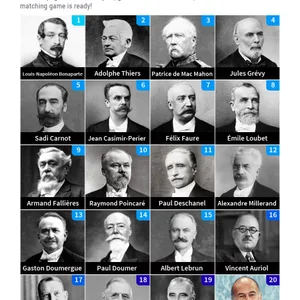

Since 1848, France has had 25 presidents. The role, largely ceremonial under the Third and Fourth Republics, became central under the Fifth Republic established by de Gaulle in 1958.
list of Presidents of the French Republic
list of Presidents of the French Republic
9 min read
Frequently asked questions
Key Facts
- 1848: Louis-Napoléon Bonaparte, first president elected by universal male suffrage
- 1875: founding of the Third Republic, a parliamentary system in which the president held limited powers
- 1958: Fifth Republic — de Gaulle significantly expanded presidential powers
- 1962: direct universal suffrage for presidential elections introduced by referendum
- 2000: presidential term reduced from seven years to five by referendum
Works & Achievements
Drafted under the impetus of General de Gaulle, it established a strong executive centered on the president. It remains in force today and has been amended more than twenty times.
Signed by de Gaulle and Chancellor Adenauer, it officially reconciled France and Germany after centuries of conflict. A cornerstone of European integration, it is still celebrated every year.
Enacted under the presidency of Giscard d'Estaing, this law decriminalized abortion in France. It illustrates the role of the president in the major social reforms of the Fifth Republic.
Enacted under the presidency of François Mitterrand and championed by Justice Minister Robert Badinter. France thus joined the European democracies that had already abandoned the practice.
Signed under Mitterrand's presidency, this treaty created the European Union and paved the way for a single currency. It reflects the commitment of the French presidency to European integration.
Under Chirac's presidency, the presidential term was reduced from 7 to 5 years by referendum. This reform aimed to reduce the risk of cohabitation by aligning presidential and parliamentary terms.
Presidents Sarkozy (2007) and Hollande (2012) each attempted, with mixed results, to redefine Franco-African relations inherited from the era of 'Françafrique.' These speeches highlight the president's role in post-colonial diplomacy.
Anecdotes
Louis-Napoléon Bonaparte, the first President of the French Republic elected by universal male suffrage in December 1848, won the election with 74% of the vote — carried almost entirely by his famous name. Three years later, on December 2, 1851, he overthrew the Republic in a coup d'état and proclaimed himself Emperor under the name Napoleon III, proving just how fragile the newly created office of president really was.
President Félix Faure died suddenly at the Élysée Palace on February 16, 1899, under circumstances so embarrassing that Senate President Émile Loubet had to rush over to ensure continuity of government. Georges Clemenceau reportedly quipped: 'He wanted to be Caesar; he died like Pompey.' The episode laid bare the very human vulnerability that comes with the office, no matter how grand.
On June 1, 1958, General de Gaulle — recalled to power during the Algerian crisis — delivered a twenty-minute address to the National Assembly that effectively ended the Fourth Republic. He negotiated emergency powers for six months and drafted a new Constitution that made the president the true head of the executive branch. In September, 79% of French voters approved the new text in a referendum.
In 1962, de Gaulle pushed through a referendum making the President of the Republic directly elected by universal suffrage, going against virtually every political party and the entire Parliament. The reform passed with 62% approval and fundamentally transformed the Fifth Republic: from that point on, the president drew his legitimacy directly from the people, dramatically strengthening the authority of the office.
In March 1986, France experienced its first 'cohabitation' in history: Socialist President François Mitterrand was forced to appoint his right-wing rival Jacques Chirac as Prime Minister after the right won the legislative elections. Mitterrand, nicknamed 'the old tortoise,' chose to confine himself to the reserved domains of defense and foreign policy — and survived politically, winning re-election in 1988.
Primary Sources
The President of the Republic shall ensure respect for the Constitution. He shall ensure, by his arbitration, the proper functioning of the public authorities and the continuity of the State. He shall be the guarantor of national independence, territorial integrity, and compliance with treaties.
I want to speak to all those who have suffered from the economic crisis, to all those who are without work, without housing, without hope: you have waited long enough. Your place is here, in the Republic.
The President of the Republic is elected by an absolute majority of votes by the Senate and the Chamber of Deputies meeting as a National Assembly. He is appointed for seven years. He is eligible for re-election.
The French people have answered Yes. In doing so, they have chosen that their president shall henceforth be directly elected by them, which further strengthens the functions and responsibilities of the head of state.
The term of office of the President of the Republic shall be five years. No one may serve more than two consecutive terms.
Key Places
The official residence and workplace of the President of the Republic since 1873. Located on Rue du Faubourg-Saint-Honoré, it houses the presidential offices, the Council of Ministers chamber, and the private apartments.
The meeting place of Parliament when convened as Congress, summoned by the President to amend the Constitution or address both chambers in a joint session. Steeped in monarchical history, it underscores the continuity of the French state.
A site of remembrance where each President rekindles the flame of memory on November 11th and during major national ceremonies. This ritual gesture roots the presidency in the memory of the twentieth century's conflicts.
The seat of the National Assembly, where the President promulgates laws and may dissolve the chamber. The relationship between the Élysée and the Palais Bourbon shapes the political life of the Fifth Republic.
A site of remembrance where more than 1,000 resistance fighters were executed during the Occupation; de Gaulle inaugurated the memorial here in 1960. Presidents gather here to pay tribute to the French Resistance.