Imaginary dialogue between Arrien de Nicomédie and Epictetus
by Charactorium · Epictetus (50 — 138) · Philosophy · 5 min read
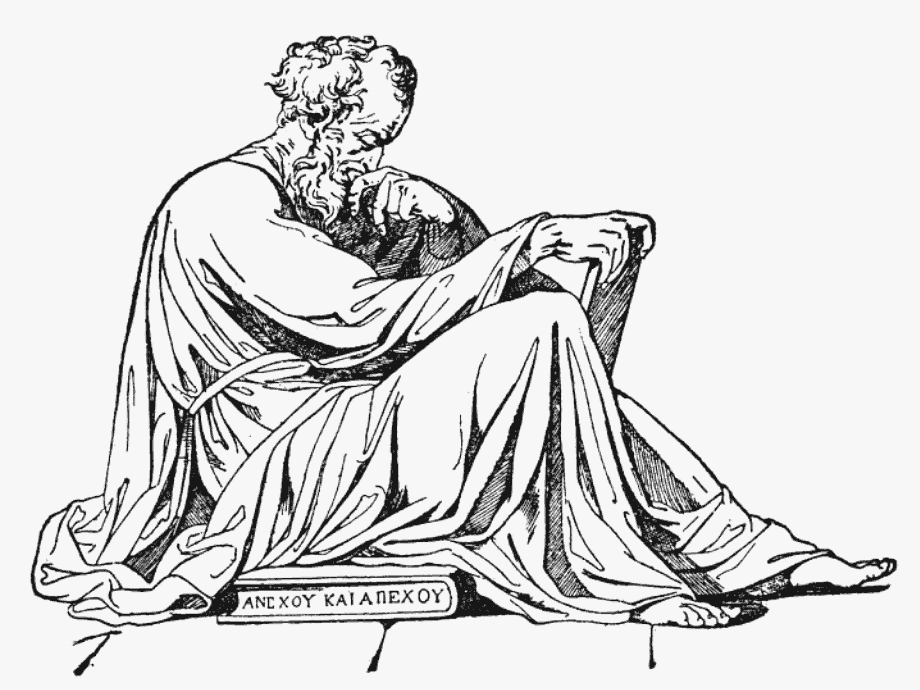
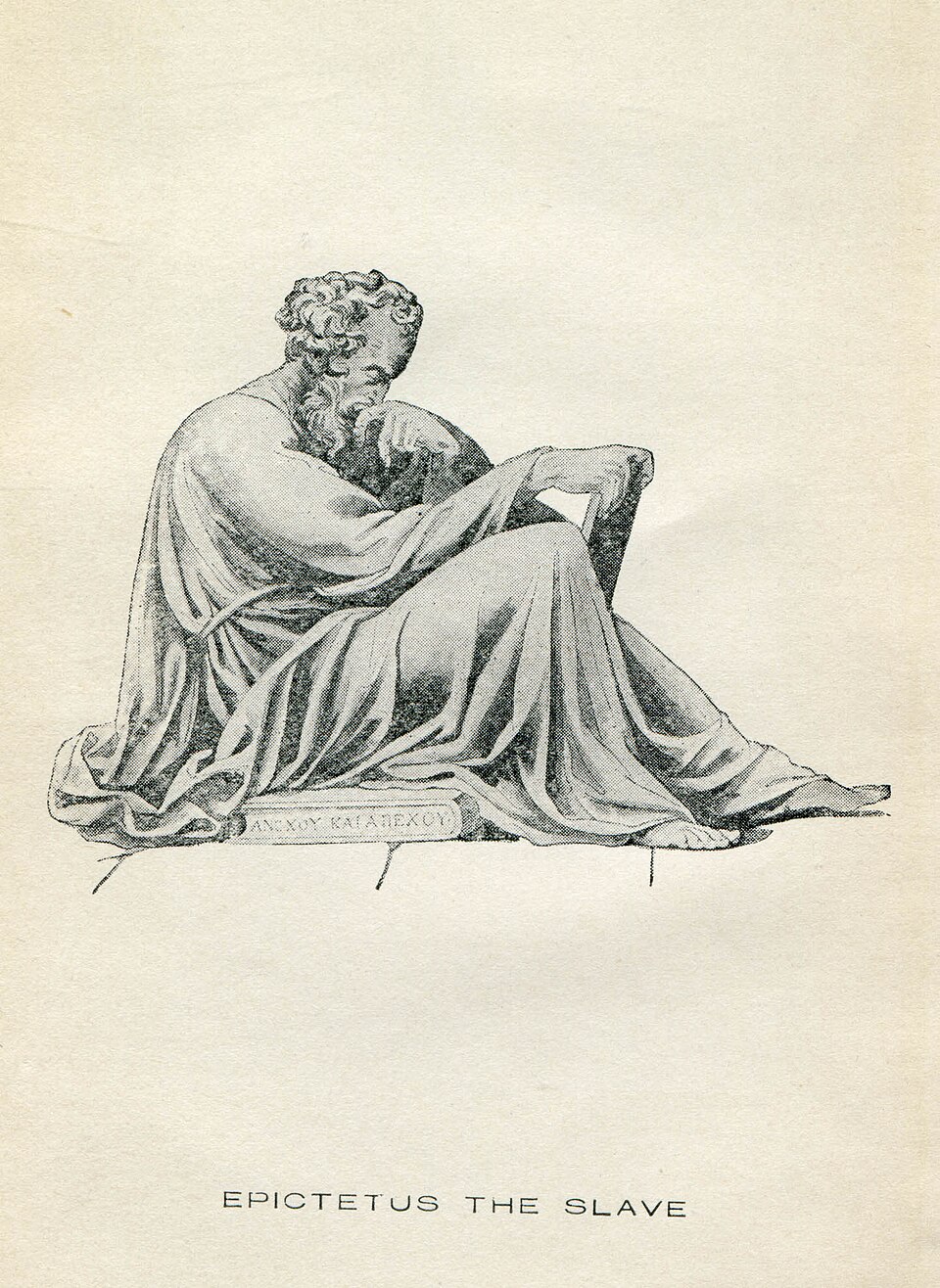
It is under the portico of the school of Nicopolis, in Epirus, that Arrian of Nicomedia lingers one evening, his wax tablets still warm from the day's lessons. The master's iron lamp casts a meager glow on the straw mat and the bare floor. Ever since he left Cappadocia to follow this lame former slave, the young notable has been recording every word; tonight, however, he sets down his stylus to question the man behind the teaching. Epictetus, leaning on his crutch, agrees to retrace the thread of his life.
—Master, you who instruct me here every day, I dare to ask: is it true that in Rome, your master Epaphroditus broke your leg?
So you want to know the origin of the crutch you see me lean on. Yes, Arrian, I was the slave of Epaphroditus, a freedman of Nero who became powerful at court. One day, while he was twisting my leg for his amusement, I calmly warned him that he would break it; when it gave way, I merely pointed out that I had warned him. That is not courage, it is simple consistency: the pain of the body did not depend on me, but my judgment about it did. They may chain my leg, but never my faculty of choice. It is this lesson, learned in servitude, that I strive to pass on to you as a free man.
They may chain my leg, but never my faculty of choice.
—Before Nicopolis, you knew Rome differently. How did you come to philosophy, and why did you flee it for this city in Epirus?
Freed after Nero's death, I first remained in Rome, where I studied under Musonius Rufus, a Stoic who did not spare his students. It was a dangerous time for lovers of wisdom: Seneca had been forced to suicide under Nero, and later Domitian banished all philosophers from the city. Rather than keep silent or flatter, I left. I settled here in Nicopolis, where you joined me. You see, I was driven out of a city, but no imperial edict can banish a man from himself. Exile took an address from me; it took nothing essential.
Exile took an address from me; it took nothing essential.
—You always begin your lessons with the same distinction. Why do you return to it constantly, as if everything depended on it?
Because everything does depend on it, Arrian, and you know it, you who jot down my first words each morning. Some things are up to us — our judgments, our desires, our aversions — and others are not: the body, wealth, reputation, power. All human unhappiness comes from confusing the two and clinging to what we do not control. What the Greeks call prohairesis, that moral choice which is our true domain, is the only impregnable citadel. The rest I leave to the gods and fortune. If you remember this, the day you become a governor, you will know where your power ends and where your freedom begins.
All human unhappiness comes from confusing what depends on us and what does not.
—You often repeat that it is not things that trouble us. Does this thought hold even in the face of death?
Especially in the face of death, my friend. It is not things that trouble men, but the judgments they hold about them. Death itself has nothing dreadful about it — otherwise Socrates would have judged it so; what is dreadful is our opinion that it is. See how we fear a word, a shadow. The man who has sorted out what depends on him looks at death as a change of nature, not as an evil. I grow old here, lame, on this mat; when my hour comes, I intend neither to curse it nor to flee it. Work on your judgments, Arrian, and you will have worked on the only thing that troubles you.
It is not things that trouble men, but the judgments they hold about them.
—That iron lamp beside you — I recall it replaced another. What did that theft teach you?
You have a good memory. I owned a clay lamp, and a thief stole it one night. The next day, I bought only an iron one. Why would I have grieved? I lost that lamp because I possessed something that could be stolen — the fault lies with what I held, not with the thief. Look at my house: no lock, no strong door, a mat, a water jar. I can only be robbed of what I consent to call mine. Detachment is not a privation I endure; it is a door I leave open on purpose. He who owns nothing stealable has already disarmed all thieves.
He who owns nothing stealable has already disarmed all thieves.
—You eat barley bread, drink water, wear that threadbare tribôn. Is this not unnecessary harshness toward yourself?
Harshness? Ask instead those who tremble at losing their lavish tables which of us is free. My barley bread, my olives, my figs, my water: these are what I depend on, and none of it can be taken from me without effort. The tribôn I wear is not a mortification; it is a uniform — it tells anyone who sees me that I do not serve my belly. Gluttony is a slavery of the body, and I have known servitude enough not to plunge back into it willingly. I do not despise pleasure; I simply refuse to make it my master. Frugality is not a chain I put on myself; it is one I spare myself.
Frugality is not a chain I put on myself; it is one I spare myself.
—Master, I cover my tablets with your words every day. Why do you yourself never write a single line?
Because philosophy is not a matter of scrolls, Arrian, but of souls that are stirred. Socrates also wrote nothing, and it is through dialogue, the question, the living objection that I can catch you in the flaw of your reasoning. A book does not blush, does not correct itself, does not look you in the eye when you contradict yourself. Under this portico, I challenge, I press, I draw examples from the street and the marketplace — that is a diatribè. Whether my words survive or not matters little to me: that does not depend on me. If something is to remain, it will be through your hand and your wax tablets, not through any care I might have taken for my own glory.
A book does not blush, does not correct itself, does not look you in the eye when you contradict yourself.
—And if, one day, my notes were all that remained of you? Does that thought not trouble you?
It troubles me no more than it flatters me, for posterity does not depend on me. If you transcribe faithfully, you serve less my name than those who, after us, will seek to live rightly. You take these notes to instruct yourself first — that is how I see it, and it is very good. A teacher who teaches so that people will talk about him has already corrupted everything. I want only that a man leave this portico a little freer than he entered it. Whether my teaching bears your name or mine, Arrian, what does it matter? Truth does not become poorer by changing mouths.
A teacher who teaches so that people will talk about him has already corrupted everything.
—They say that great men, even in the palace, read you. You, the former slave — what do you think of such an audience?
That my birth matters as little as theirs. A powerful man who follows my lessons is no more my student than the humblest of those who sit here; before prohairesis, purple and rags weigh the same. I was a slave in Hierapolis, lame, nameless; that made me neither less nor more capable of judging rightly. If one day a prince reads me, let him remember this: his crown belongs to what does not depend on him, and he will be stripped of it like a borrowed cloak. What will remain his own is only the quality of his judgments. There, and nowhere else, he will be truly emperor — or truly slave.
Before moral choice, purple and rags weigh the same.
—Before I take up my tablets again, master, tell me: what, for you, is a truly free man?
Free is he who lives as he wishes, who cannot be constrained, hindered, or forced; whose desires achieve their goal and whose aversions do not encounter what they sought to flee. Mark well: I am not speaking of doing everything that comes to mind, but of wanting only what depends on us. He who desires health, wealth, the favor of the powerful has given himself as many masters as he has desires. I, a former slave, am freer than my former master, for no one holds the reins of my assent. That, Arrian, is what I would like you to take away from Nicopolis, far more than my words: a soul that no tyrant can chain.
He who desires health, wealth, and favor has given himself as many masters as he has desires.
Read further
This imaginary interview was generated by artificial intelligence from sources documented in Epictetus's profile. It dramatises what the figure might have said based on what we know about them, but does not constitute attested historical testimony. For primary sources and factual documentation, refer to the full profile.