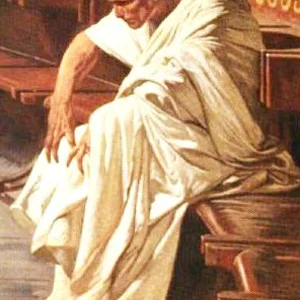

Lucius Sergius Catiline was a Roman patrician and politician, famous for plotting a conspiracy to seize power in 63 BC. Exposed by Cicero, he died fighting at the Battle of Pistoria in 62 BC.
Catiline(107 av. J.-C. — 61 av. J.-C.)
Catiline
Rome antique
7 min read
Frequently asked questions
Key Facts
- Born around 108 BC into the patrician family of the Sergii
- Served under Sulla during the proscriptions of the 80s BC
- Failed multiple times to be elected consul (66–63 BC)
- Catilinarian conspiracy exposed by Cicero in 63 BC (Catilinarian Orations)
- Died in battle at the Battle of Pistoria in 62 BC
Works & Achievements
A vast plot to seize power in Rome through an armed coup, combining a military uprising in Etruria with violent actions in the capital. Thwarted by Cicero, it remains one of the most famous and studied episodes of the crisis of the Roman Republic.
Catiline recruited about 10,000 men among Sulla's ruined veterans and insolvent debtors in Etruria. This military force constituted the armed wing of his attempt at social and political revolution.
Catiline went through the standard stages of the Roman *cursus honorum*, reaching the praetorship and a provincial governorship. His career was marred by accusations of extortion and dissolute morals, which blocked his access to the consulship.
Anecdotes
In the night of November 6–7, 63 BC, Catiline sent two men to assassinate Cicero at his home at dawn. But the consul had been warned by Fulvia, the mistress of the conspirator Quintus Curius. The next morning, Cicero summoned the Senate and confronted Catiline face-to-face in his First Catilinarian: "How long will you abuse our patience, Catiline?"
On November 8, 63 BC, Catiline dared to appear in the Senate despite Cicero's public accusations. The senators ostentatiously moved away from him, refusing to sit by his side. Humiliated but not arrested—for lack of formal evidence at that time—he left Rome two days later to join his troops in Etruria.
At the Battle of Pistoria in January 62 BC, Catiline's troops, surrounded by the republican armies, had no escape. Catiline chose to die fighting, throwing himself into the thick of the battle. His body was found in front of his soldiers' lines, which impressed even his enemies with this desperate courage.
Sallust reports that during a secret banquet where the conspirators sealed their pact, they allegedly drank human blood mixed with wine to seal their oath. This detail is probably a propagandistic invention by his opponents, but it illustrates the reputation of excess and immorality that Roman tradition durably attached to Catiline.
Primary Sources
“How long, Catiline, will you abuse our patience? How long will that madness of yours mock us?”
“Catiline was of noble family; he had remarkable vigor of body and mind, but a perverse and depraved nature.”
Cicero, defending Murena against Catiline, who contested his election to the consulship of 62 BC, paints a damning portrait of the man and denounces his dangerous alliances.
Cicero relates to his friend Atticus the unfolding of the conspiracy and his own decisions, notably the execution of the accomplices without a formal trial.
Key Places
Political heart of the Roman Republic, where electoral assemblies and oratorical contests took place. Catiline sought the consulship there several times and was publicly challenged by Cicero.
Meeting place of the Senate where Cicero delivered his four Catilinarian Orations. It was here that Catiline was publicly denounced, the senators turned away from him, and the execution of his accomplices was voted.
Ancient Etruscan town in Tuscany where the main military contingent of the conspirators was concentrated, commanded by Gaius Manlius, awaiting Catiline's orders.
Site of the final battle (January 62 BC) where Catiline's troops, surrounded by the consular armies, were annihilated. Catiline died fighting there.
Roman province of which Catiline was governor in 67-66 BC. He was accused of extortion (squeezing the provincials), a trial that temporarily blocked his political career.
Typical Objects

Garment bordered with purple reserved for Roman magistrates, which **Catiline** wore as a senator and former praetor, a visible symbol of his patrician rank and authority.

Common writing medium in Rome used for messages. The conspirators' coded letters, intercepted in December 63, were written on such tablets and became the decisive material evidence of the conspiracy.

Ring bearing a personal seal, used to authenticate letters and documents. The conspirator **Lentulus** was incriminated by letters bearing his recognizable seal, which were transmitted to the ambassadors of the Allobroges.

Short sword of Roman soldiers. **Catiline**, a man of action as much as politics, died with his gladius in hand at the battle of Pistoria, at the front of his troops.

Bundle of rods and an axe carried by lictors preceding magistrates, the supreme symbol of republican authority. **Catiline** aimed to seize these symbols of power by overthrowing the Republic.

Flat bowl used in ceremonies and ritual banquets. **Sallust** describes a secret banquet of the conspirators where a solemn oath, perhaps mixed with blood, was sworn around such a bowl.
School Curriculum
Vocabulary & Tags
Key Vocabulary
Daily Life
Morning
Catiline rose at dawn like any active Roman aristocrat. After a quick wash, he received his clients during the *salutatio*, a morning ceremony where lower-ranking men came to greet their patron in exchange for favors, money, or legal support. This clientele also provided him with informants and henchmen.
Afternoon
Afternoons were devoted to political business: attendance at the Senate, negotiations in the porticoes of the Forum, and discreet talks with allies. In 63 BC, these afternoons were mostly taken up by secret meetings with the conspirators in private houses to coordinate the coup.
Evening
Evenings, Catiline attended the banquets (*conviviae*) that Roman nobles organized. Hostile ancient sources describe dissolute evenings, awash with wine and plots. According to Sallust, it was during such a banquet that the conspirators swore their fatal oath.
Food
Like any Roman noble, Catiline ate spelt bread, vegetables (lentils, chickpeas), olives and olive oil, cheese, and meat (pork, poultry, game at banquets). Wine mixed with water was the daily drink, accompanying every meal according to Roman custom.
Clothing
Catiline wore the toga, the civic garment of Roman citizens, in its purple-bordered version (*toga praetexta*) for official ceremonies as a former praetor. In daily life, a woolen tunic and a white toga (*toga candida*), as a citizen seeking votes.
Housing
Catiline lived in a patrician *domus* in Rome, likely on the Palatine Hill. This house, organized around an atrium with an impluvium and an inner garden (*hortus*), reflected his senatorial rank, even though his financial situation, according to his contemporaries, was heavily burdened by debt.
Historical Timeline
Period Vocabulary
Visual Style
Contraste entre la grandeur de marbre de la Rome républicaine et les réunions secrètes à la torche ; une palette de rouges sombres, d'ocres et d'ombres profondes évoquant l'ambition, la trahison et la chute d'un patricien désespéré.
Sound Ambience
L'atmosphère sonore de la République romaine finissante : débats sénatoriaux tendus, tumulte du Forum, et en contrepoint, le secret des réunions nocturnes de conjurés à la torche et le fracas d'une bataille perdue d'avance sur les collines d'Étrurie.
Liens externes & ressources
Références
Œuvres
La Conjuration de Catilina
63 av. J.-C.
Levée d'une armée en Étrurie
63-62 av. J.-C.
Carrière politique (questure, prêture, gouvernorat d'Afrique)
vers 73-66 av. J.-C.