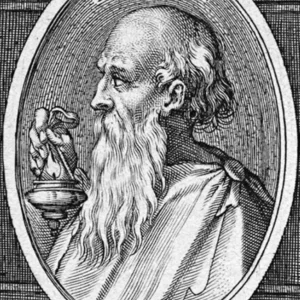

Greek Stoic philosopher of the 1st–2nd century CE, born a slave in Hierapolis in Phrygia. He founded a school of philosophy in Nicopolis in Epirus, where he taught that virtue lies in accepting what does not depend on us. His teachings, compiled by his disciple Arrian in the Enchiridion, became a major reference of late Stoicism.
Epictetus(50 — 138)
Epictetus
Rome antique
6 min read
Frequently asked questions
Famous Quotes
« Men are disturbed not by things, but by the opinions about things.»
« There is only one thing that is truly yours: your assent.»
« You cannot control external events, only your reaction to those events.»
Key Facts
- Born around 50 CE as a slave in Phrygia
- Received instruction from the Stoic philosopher Musonius Rufus in Rome
- Exiled from Rome around 94 CE by the emperor Domitian
- Founded and led a school of philosophy in Nicopolis in Epirus until his death around 138 CE
- His disciple Arrian compiled his teachings in the Enchiridion (Manual) and the Discourses (Diatribes)
Works & Achievements
A collection in eight books (four of which survive) of Epictetus's oral teachings, transcribed by his disciple Arrian. A foundational text of late Stoicism, blending dialogues, exhortations, and concrete examples.
A practical summary of Epictetus's philosophy compiled by Arrian. This small book, designed to be carried on one's person, distills the essential principles for living according to Stoic virtue.
A collection of maxims and passages attributed to Epictetus, preserved by various ancient authors such as Stobaeus and Aulus Gellius, supplementing the Discourses and the Handbook.
Epictetus taught exclusively orally, faithful to the Socratic tradition. His school trained many influential students, including Arrian, future governor of Cappadocia and historian of Alexander.
Anecdotes
Epictetus was a slave of Epaphroditus, a freedman of Nero who became an imperial secretary. According to tradition, his master would twist his leg as punishment. Epictetus reportedly said calmly: 'You are going to break it,' and when the leg gave way: 'I warned you.' This anecdote, reported by Celsus and Origen, illustrates his composure in the face of pain.
Emperor Marcus Aurelius, one of the most powerful men in the Roman world, regarded Epictetus as one of his guiding thinkers. In his Meditations, he cites him with admiration. A former lame slave thus became the spiritual guide of an emperor.
Epictetus lived in extreme austerity in Nicopolis. His home contained nothing but a straw mattress, a mat, and an earthenware lamp. When that lamp was stolen, he replaced it with an iron one, remarking that he had lost his lamp because he had owned something worth stealing.
Epictetus never wrote anything himself. Everything we know of his thought comes from his disciple Arrian of Nicomedia, who took faithful notes during his lectures. Without this transcription work, the teaching of one of antiquity's greatest philosophers would have been lost.
Primary Sources
Some things are in our control and others not. Things in our control are opinion, pursuit, desire, aversion, and, in a word, whatever are our own actions. Things not in our control are body, property, reputation, command.
Men are disturbed not by the things which happen, but by the opinions about the things. Thus death is nothing terrible, for if it were, Socrates would have thought it so. But the opinion that death is terrible — that is the terrible thing.
From Rusticus I received the impression that my character required improvement and discipline, and from him I first learned of Epictetus's teachings, of which he communicated to me a copy from his own tablets.
Free is the man who lives as he wishes, who cannot be compelled, nor hindered, nor forced, whose desires attain their end, whose aversions do not encounter what they would avoid.
Key Places
Epictetus's birthplace in present-day Turkey. A prosperous thermal city of the Roman Empire where he was born into slavery.
Capital of the Empire where Epictetus lived as a slave of Epaphroditus, then as a freedman studying under Musonius Rufus, before being banished.
Greek city founded by Augustus where Epictetus settled after his banishment from Rome. He founded his school of philosophy there and taught until his death.
Intellectual center of the Greek world where Stoicism was founded by Zeno of Citium at the Porch (Stoa Poikilè). The philosophical tradition of which Epictetus is an heir.
Typical Objects

Epictetus owned a simple clay oil lamp, a symbol of his frugal way of life. After it was stolen, he replaced it with an iron lamp, drawing a lesson on detachment.

Epictetus was lame, most likely as a result of mistreatment suffered during slavery. He walked with a crutch, which became an attribute of his image.

His bed was a simple mat laid on the ground, in keeping with the Stoic ideal of material austerity and mastery over the body's needs.

A common writing medium in Roman philosophical schools. Arrian used them to record Epictetus's lessons during class.

A short, coarse woolen cloak worn by Greek philosophers as a sign of their vocation. It distinguished the philosopher from the ordinary citizen.

A clay vessel used to store water. Epictetus advocated simple food and drink, with water being his primary beverage.
School Curriculum
Vocabulary & Tags
Key Vocabulary
Tags
Daily Life
Morning
Epictetus rises at dawn and begins with inner examination, meditating on the Stoic principles of the distinction between what depends on us and what does not. He washes briefly with cold water, dresses in his coarse wool tribôn, and prepares to welcome his students in the classroom of his school.
Afternoon
The afternoon is devoted to lessons and discussions with his students. Epictetus teaches through dialogue, addressing his listeners, asking questions in the Socratic manner, using examples drawn from daily life. He leans on his crutch and paces the portico as he lectures.
Evening
In the evening, Epictetus has a frugal meal and retires to his modest home. He practices the evening examination of conscience recommended by the Stoics: what have I done well today? In what way have I fallen short of virtue? He falls asleep on his straw mat, his iron lamp placed beside him.
Food
Epictetus eats very simply, in keeping with the Stoic ideal of frugality. His diet consists of barley bread, olives, figs, goat cheese, and vegetables. He drinks water and occasionally heavily watered wine. He regards gluttony as a form of bodily enslavement.
Clothing
He wears the tribôn, a short coarse wool cloak characteristic of Greek philosophers, over a simple tunic. He walks barefoot or in basic sandals. His austere appearance deliberately contrasts with the luxury of the Roman elites he mingles with.
Housing
Epictetus lives in a very modest house in Nicopolis, sometimes described as a simple hut. The furnishings amount to a straw mat serving as a bed, a lamp, and a few kitchen utensils. There is neither a solid door nor a lock, a sign of his detachment from material possessions.
Historical Timeline
Period Vocabulary
Visual Style
Style visuel austère et lumineux inspiré de l'architecture gréco-romaine d'Épire : pierre blanchie par le soleil, intérieurs dépouillés, collines méditerranéennes. Ambiance contemplative et digne, dépourvue de luxe.
Sound Ambience
L'ambiance sonore d'une école philosophique à Nicopolis : une voix enseignant sous un portique de pierre, le stylet grattant la cire, le vent dans les oliviers et les bruits lointains d'une cité portuaire grecque.
Liens externes & ressources
Références
Œuvres
Entretiens (Diatribai)
vers 108-115
Le Manuel (Encheiridion)
vers 125
Fragments
Ier-IIe siècle
Enseignement oral à Nicopolis
vers 90-138