Imaginary interview with Gayatri Spivak
by Charactorium · Gayatri Spivak (1942 —) · Philosophy · 7 min read
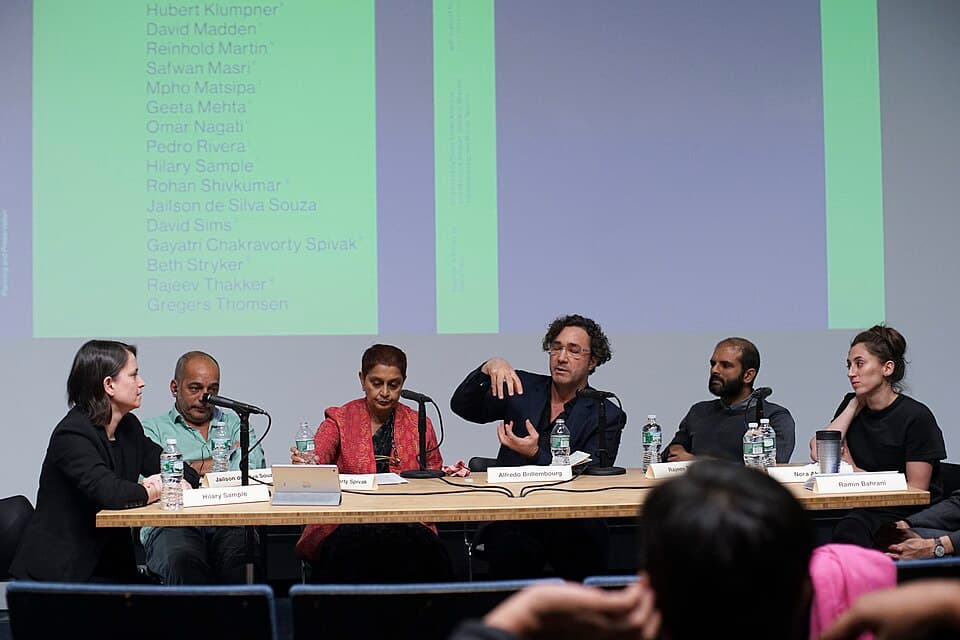
New York, late afternoon. In an office at Columbia University where books rise from floor to ceiling, in Bengali, English and French, Gayatri Spivak sets down a cup of spiced tea. A cotton sari over her shoulders, her voice measured and cutting, she agrees to look back on half a century spent unsettling the certainties of the West.
—How did a young doctoral student from Calcutta end up translating a text that everyone said was untranslatable?
Cornell, late sixties. I had arrived with a fellowship to write a thesis on the Irish poet Yeats, and then a publisher entrusted me with a French text reputed to be untranslatable: Of Grammatology. I didn't yet know what the word 'deconstruction' meant — no one really did. I spent months bent over the original, covering it with marginal notes, tracking every word of Derrida as one tracks a wary beast. My supervisor, Paul de Man, had whispered this work to me. I think I never learned to read so much as when I was trying to move a thought from one language to another without quite betraying it.
—Your preface to that translation became a famous text in its own right. Did you foresee such an impact?
People often ask me why that preface was eighty pages long, longer than Derrida's own introduction. The truth is, I could not deliver this text to English-speaking readers without building them a threshold. I wanted a door; it became a house. In those pages, I insisted on acknowledging my debt: I must here acknowledge my debt to Paul de Man, who first suggested this translation to me. Without him, I would have remained the Yeats specialist I thought I was destined to become. 1976: that translation tore me from the obscurity of a young Indian academic and threw me into the heart of a debate that believed itself purely European. A woman from Calcutta at the center of Western philosophy — already, that was a way of unsettling the order of things.
I wanted a door; it became a house.
—Your most famous essay asks a seemingly simple question. What were you really trying to ask?
It all starts from an almost childish question: can those who have been silenced speak? I use the word subaltern, which I borrow from Gramsci — not the poor in general, but the one who has no access to the lines where common sense is produced. In 1988, I wrote in black and white the sentence I have been so criticized for: The subaltern cannot speak. People thought I was condemning the dominated to muteness. I am saying the opposite: they speak constantly, but our ears, our institutions, our archives are built not to hear them. The problem is not their voice, it is our listening apparatus. That is why I distrust those who claim to 'give voice': you cannot give what you yourself have confiscated.
The problem is not their voice, it is our listening apparatus.
—You insist on a double effacement, specific to colonized women. Can you explain?
Take the Indian widow on the pyre. The British colonizer says: we save brown women from brown men. The nationalist retorts: but they wanted to die, it was their tradition. Between these two men's discourses, where is the woman herself? Nowhere. She is doubly effaced — by empire and by custom, and even by progressive intellectuals who think they defend her. In A Critique of Postcolonial Reason, I wrote that the subaltern woman is the object, not the subject, of the postcolonial discourse. Like the anthropologist's 'native informant', she is cited, measured, spoken about — never with. My work is to make visible this empty place, this hole in the text, rather than to plug it too quickly with my own well-fed academic voice.
—You joined a collective that wanted to rewrite Indian history from below, while also criticizing it. What was your critique?
In the early eighties, Ranajit Guha and his colleagues launched a magnificent project: rewriting Indian history from below, from the perspective of peasants and the voiceless, against the official history of colonial and nationalist elites. I joined them; I read and published in the Economic and Political Weekly, that old Indian journal where our debates circulated. But I brought a concern: in trying to restore subaltern consciousness, weren't we risking speaking in their place? The most benevolent historian remains an intellectual who sorts, classifies, interprets. I love this collective precisely because it allowed me to formulate this self-critique — not to sabotage it, but to keep it honest. A project that does not watch itself always ends up reproducing what it fights.
—Many read you as a seeker of the authentic voice of the oppressed. Is that a misunderstanding?
People ask me if I am looking for the 'true voice' of the oppressed, one that could finally be recorded, pure. No. I distrust this idea of authenticity like the plague — it is still a way for the West to demand an exotic, whole object. In an interview, I stated my position thus: I am not trying to find an authentic voice. I am trying to question the authority of the investigating subject without paralyzing that subject. In other words: I am not trying to abolish the investigator — me, the Columbia academic — but to prevent her from believing herself transparent, neutral, innocent. Thinking means holding this tension without dissolving it: acting while doubting one's own authority. Those who wait to be pure to speak never speak; those who believe themselves pure cause damage.
—Since 1997, you have funded village schools. Why does a world-renowned theorist concern herself with rural classrooms?
In 1997, I created a foundation for primary schools in the poorest villages of Purulia district, in West Bengal. I contribute a portion of my fees as a famous academic, and I go there — physically, in the dust, to sit with the teachers. Understand: you cannot write for thirty years about subalterns from a book-lined apartment in New York and never smell a classroom without electricity. These are not charity works; I am not bringing light to children in the dark. I learn from them a slowness, a patience, what I call the invisible work of the mind. A theory that never risks its body on a dirt road is merely an elegant way to stay clean.
A theory that never risks its body on a dirt road is merely an elegant way to stay clean.
—You record your field observations in a notebook. What relationship does it have with your most abstract philosophical work?
When I return from the villages, I always have on me a notebook where I record what I saw — a child who does not recognize a letter, a teacher who invents a method for lack of textbooks. This field notebook is the exact reverse of my annotated manuscript of Derrida. On one side the most abstract margin of European philosophy, on the other the concrete mud of a school in Bengal. I refuse to choose. My adversaries would like grand theory and social engagement to be two separate professions; I believe on the contrary that they illuminate each other. Reading Marx or Gramsci in the morning and discussing a school curriculum in the afternoon is not incoherence: it is the only honest way, for me, not to make thought a luxury of the privileged.
—You wear the sari at conferences governed by Western dress codes. Is it merely an attachment to your origins?
When I enter a seminar at Columbia or a conference in Paris, I wear a cotton or silk sari. It is not nostalgia, nor a folk costume to reassure those who want me as a picturesque Indian. It is a sentence I speak without speaking: a third-world woman occupies here a rightful place, and she will not disguise herself as a Western academic to be taken seriously. My office in New York is a library where Bengali, English and French sit side by side on the shelves — I am complete in none of these languages, and it is from this in-between that I think. The clothing says the same thing as the work: one can inhabit several worlds without renouncing any, and make of this discomfort a weapon.
One can inhabit several worlds without renouncing any, and make of this discomfort a weapon.
—You describe your identity as a perpetual in-between. How has this condition shaped your perspective?
People forget today what it was like to think while constantly moving between three continents. In my early years, I lugged a portable typewriter from plane to plane, between Calcutta, Paris and Ithaca. My identity was forged in those airport lounges, in that discomfort of never being quite at home. Born into an educated Bengali family, trained in colonial English, conquered by French philosophy, settled in America — I belong fully to none of these worlds. For a long time I experienced this as a lack. I understood that it was on the contrary my observation post: from the threshold, you see what people settled inside no longer see. The uprooted person is not a diminished human being; it is someone from whom the luxury of believing one's home is the center of the world has been removed.
—To finish: do you think the subaltern will one day finally be heard?
You ask me for a prophecy, and I have none — beware of intellectuals who promise bright tomorrows. What I know is that representation has not vanished: as long as there are archives, curricula, universities, someone will decide who deserves to be cited and who will remain a footnote. My wager, from Can the Subaltern Speak? to the schools of Purulia, is to learn to read otherwise — patiently, against my own certainties. If I am still read in a century, I hope it will not be to repeat my sentences like slogans, but to continue this thankless work: to uncover, in every text that believes itself generous, the voice it silenced without even noticing.

This imaginary interview was generated by artificial intelligence from sources documented in Gayatri Spivak's profile. It dramatises what the figure might have said based on what we know about them, but does not constitute attested historical testimony. For primary sources and factual documentation, refer to the full profile.