Kids interview Gayatri Spivak
by Charactorium · Gayatri Spivak (1942 —) · Philosophy · 5 min read
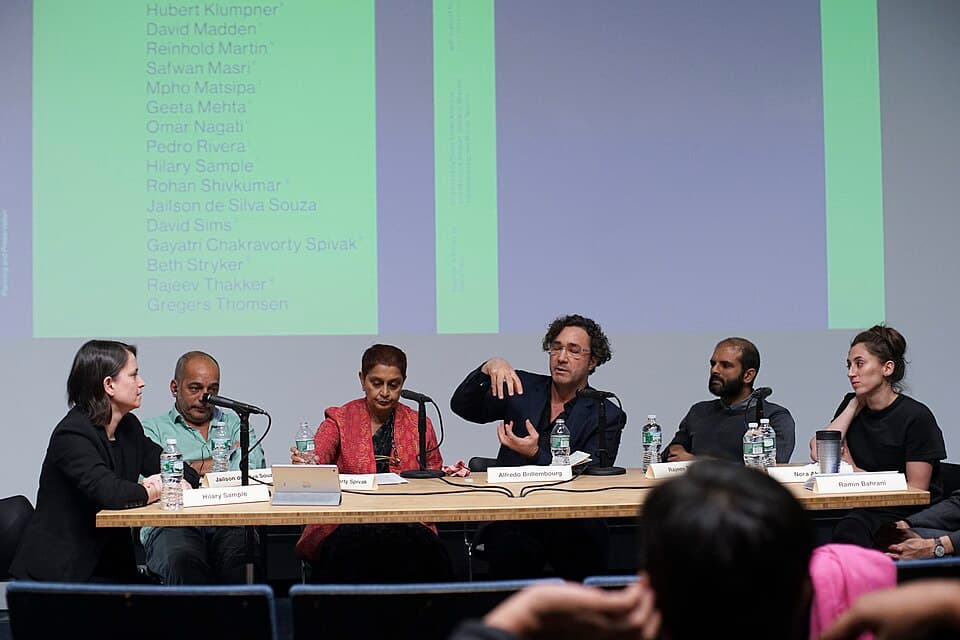
Two twelve-year-old students visit the university where Gayatri Spivak teaches. Intimidated, they clutch their notebooks. The old lady in a sari invites them to sit and smiles: 'Ask me anything you want.'
—Where were you born, and what was it like at home when you were little?
You know, my child, I was born in Calcutta, India, in 1942. Imagine a big city full of noise, markets, people speaking Bengali, my language. In the morning, I drank spiced tea, very sweet, and ate rice. Our house overflowed with books: in Bengali, and also in English, the language of those who ruled my country at the time. As a child, I already felt something strange. I learned to love English poems, even as the English ruled over us. You can grow up between two worlds, you know. And sometimes, that teaches you to see both with fresh eyes.
You can grow up between two worlds, and that teaches you to see both with fresh eyes.
—How old were you when you left your family far behind?
I was nineteen. It was 1961. I got a scholarship to cross the ocean to Cornell, an American university, very far from home. Imagine: no fast boat, a long journey, and no family waiting at the other end. My heart was heavy. There, I studied an Irish poet named Yeats. It was curious: a young Indian woman crossing the world to study an Irish poet at an American school. You see, I was no longer quite Indian, not quite American. That in-between sometimes made me sad. But it became my strength for understanding others.
I no longer fully belonged to any world, and that became my strength.
—What was the book that first made you famous?
It wasn't really a book of mine, you see. It was a translation. In 1976, I translated into English a text by a French philosopher, Derrida, that people said was impossible to translate. Do you know what translating means? Carrying words from one language to another without losing the meaning. It was like moving a sandcastle without breaking it. I spent years on the original text, covering it with tiny notes in the margins. And then I wrote a long preface, eighty pages, longer than the book's own introduction. That preface made me famous everywhere. An Indian woman, at the heart of a great Western debate.
Translating was like moving a sandcastle without breaking it.
—How did it feel to succeed at something everyone thought impossible?
My child, I was afraid, I admit it. People said: this text by Derrida is too difficult, no one can make it clear. And I, a young woman from India, went ahead anyway. A professor friend, Paul de Man, had encouraged me and reviewed my work word by word. You know, when you doubt, it helps to have someone who believes in you. When the book came out, generations of students read it thanks to me. I understood something important. People often want to say 'this isn't for me, it's too hard.' But sometimes, it's precisely you who must do it.
People often say 'it's too hard for me' — sometimes, it's precisely you who must do it.
—What is a 'subaltern'? The word is strange.
You're right, it's a funny word! A subaltern is someone at the very bottom, who is never listened to. Imagine a very poor little girl in a distant village. No one asks for her opinion. No one tells her story. When the powerful speak about her, they speak for her, without her. In 1988, I wrote a text that asked a very simple question: Can the Subaltern Speak? — 'Can the subaltern speak?' And my sad answer was: they are not heard. They are silenced twice. Once because they are poor. Another time because even well-meaning people think they speak for them.
The weakest are silenced twice: by poverty, then by others speaking for them.
—Why do you say even good people can do harm?
Ah, that's my favorite question, and the hardest! You see, there were scholars who really wanted to help the poor. But in telling their stories, they decided for them what they felt. Imagine an adult telling your day without ever asking how you experienced it. Even if they love you, they might be wrong. That's what I meant. Representing someone, speaking in their name, is dangerous. You think you're helping, but you cover their real voice. I'm not saying we should stay silent. I'm saying we must be very careful. And always leave room for the one who isn't used to speaking.
Speaking for others risks covering their real voice.
—Did you really want to rewrite your country's history?
Yes, with friends! In the 1980s, I joined a group of historians, the Subaltern Studies, founded by a man named Ranajit Guha. You know how history is often told? Through kings, leaders, the powerful. We wanted to tell it 'from below': through peasants, women, ordinary people who are always forgotten. Imagine a big history book where, finally, the voiceless are spoken about. It was beautiful. But I also warned my friends about one thing. Even we, in telling those lives, risked speaking for them. You must always be a little suspicious of yourself, my child.
History is told through kings — we wanted to tell it through the forgotten.
—Is it hard to always question whether you're right?
Yes, it's tiring! But it's important. You know, many people want to be right all the time. I learned to question my own ideas. When I wrote with the Subaltern Studies group, I constantly asked myself: am I really speaking about the peasants, or am I speaking about myself? Imagine defending a classmate without ever asking what they want. You think you're doing good, and you're wrong. Criticizing yourself isn't being weak. It's staying honest. It's the hardest and most precious thing I've learned in my long life.
Criticizing yourself isn't being weak: it's staying honest.
—Is it true you built schools in villages?
It's true, my child, and I'm proud of it. In 1997, I created a foundation to open small schools in very poor villages, in a region called Purulia, in Bengal. With the money I earned from giving famous lectures, I paid teachers for rural children. I went there myself. I took a notebook and wrote everything down: how many children, what was missing, what worked. Imagine classrooms made of earth, with almost nothing, but full of children wanting to learn. I told myself: what's the use of talking about the poor in my books if I don't do anything for them in real life?
What's the use of talking about the poor in my books if I don't do anything for them?
—Why do you always wear a sari, even far from India?
You're observant! Yes, even in America's great universities, I wear my sari, that long Indian cloth. Around me, everyone dresses Western. And I keep my clothes from home. It's not by chance, you know. It's a way of saying: I am here, I come from India, and I am not ashamed. Imagine walking into a big room where no one looks like you. Keeping who you are is a form of courage. My spiced morning tea, my Bengali language, my sari: these are my roots. You can travel everywhere without ever forgetting where you come from.
You can travel everywhere without ever forgetting where you come from.
—If we remember one thing about you, what should it be?
What a beautiful question to end with. If you remember only one thing, my child, remember this: listen to those who are never listened to. In your class, on your street, there is always someone quieter than the others. Someone forgotten. All my life, from Calcutta to my village schools, I have tried to hear those voices. I haven't always succeeded, I admit. It's very hard. But trying is already a lot. You don't need to be a great professor for that. You just need to pay attention, and let the other speak before speaking for them.
Listen to those who are never listened to: there is always one near you.

This imaginary interview was generated by artificial intelligence from sources documented in Gayatri Spivak's profile. It dramatises what the figure might have said based on what we know about them, but does not constitute attested historical testimony. For primary sources and factual documentation, refer to the full profile.