Character Catalog

Historical Library

CollectionGalaxy
G

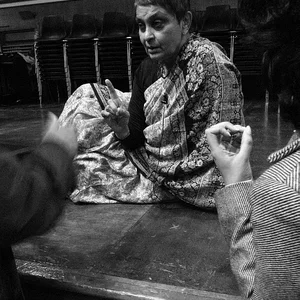
Gayatri Spivak

Gayatri Spivak

1942 —

Inde

PhilosophyPhilosophe20th Century

Émotions disponibles (6)

N

Neutre

par défaut

I

Inspirée

P

Pensive

S

Surprise

T

Triste

F

Fière

Key Facts

    Works & Achievements

    Translation of Derrida's 'Of Grammatology' (1976)

    First English translation of Derrida's foundational work. Spivak's lengthy preface became a standalone introduction to deconstruction, read by generations of anglophone students.

    Can the Subaltern Speak? (1988)

    Founding essay of postcolonial and feminist studies, translated into some twenty languages. Spivak demonstrates that the subaltern woman is doubly erased: by colonialism and by the representations made of her even by progressive intellectuals.

    In Other Worlds: Essays in Cultural Politics (1987)

    Collection of essays blending feminism, Marxism, and deconstruction. Spivak establishes her original critical method, which refuses to choose between these theoretical traditions.

    The Post-Colonial Critic: Interviews, Strategies, Dialogues (1990)

    Collection of interviews in which Spivak presents her thought in a more accessible manner. These dialogues offer insight into the intellectual journey of an unclassifiable thinker.

    A Critique of Postcolonial Reason: Toward a History of the Vanishing Present (1999)

    A major, synthetic work that revisits Kant, Hegel, and Marx through a postcolonial lens. Spivak shows how the great Western philosophical texts systematically erase the colonized subject.

    Death of a Discipline (2003)

    Essay on the future of comparative literary studies. Spivak advocates for a renewed discipline that integrates literatures from around the world, beyond the European canon.

    An Aesthetic Education in the Era of Globalization (2012)

    Wide-ranging collection of essays on humanistic education in a globalized era. Spivak defends literary training as a tool of resistance against the commodification of knowledge.

    Anecdotes

    In 1976, Gayatri Chakravorty Spivak translated Jacques Derrida's 'Of Grammatology' into English, a philosophical text considered virtually untranslatable. Her 80-page preface exceeded the original introduction in length and became a landmark reference text in its own right. This translation launched her international career and proved that an Indian woman could establish herself at the heart of Western philosophical debate.

    Her essay 'Can the Subaltern Speak?' (1988) opens with a deceptively simple question: can dominated and marginalized people truly make their voices heard? Spivak demonstrates that not only is their speech suppressed, but that even progressive Western intellectuals sometimes contribute to that silence without realizing it. This text of a few dozen pages transformed postcolonial studies and continues to be read in universities around the world.

    Born in Calcutta in 1942, Spivak grew up in an educated Bengali middle-class family. She studied at the University of Calcutta before receiving a scholarship to Cornell University in the United States, where she wrote her thesis on the Irish poet Yeats. This trajectory between East and West shaped her entire intellectual outlook: she belonged fully to neither, which allowed her to critique both.

    Spivak co-founded the Subaltern Studies group with Ranajit Guha, a collective of historians and theorists who rewrote the history of India 'from below', from the perspective of peasants, women, and the voiceless. She nonetheless introduced a critical nuance: even this project risked speaking 'for' the subaltern rather than letting them speak. This constant self-critique is a defining mark of her work.

    In 1997, Spivak established a foundation to fund rural schools in the poorest regions of West Bengal. She devoted a portion of her earnings as a celebrated academic to this cause, arguing that a postcolonial intellectual bears a concrete responsibility toward the populations she writes about. This commitment illustrates her refusal to separate abstract theory from practical engagement.

    Primary Sources

    Can the Subaltern Speak? (1988)
    The subaltern cannot speak. There is no virtue in global laundry lists with 'woman' as a pious item. Representation has not withered away.
    Translator's Preface — Of Grammatology (Derrida) (1976)
    I must here acknowledge my debt to Paul de Man, who first suggested this translation to me and whose painstaking reading of the manuscript has greatly aided me.
    A Critique of Postcolonial Reason: Toward a History of the Vanishing Present (1999)
    Like the 'native informant' in anthropology, the subaltern woman is the object, not the subject, of the postcolonial discourse.
    Interview in 'The Post-Colonial Critic: Interviews, Strategies, Dialogues' (1990)
    I am not trying to find an authentic voice. I am trying to question the authority of the investigating subject without paralyzing that subject.
    Death of a Discipline (2003)
    Comparative literature as a discipline has always had a strong implicit politics: the 'great' languages of Europe were the object of its attention.

    Key Places

    Calcutta (Kolkata), India

    Spivak's birthplace, the intellectual and cultural capital of Bengal. It is here that she receives her first literary education and develops a keen awareness of the social inequalities inherited from colonization.

    Cornell University, Ithaca, New York

    American university where Spivak prepares her doctoral thesis on Yeats under the supervision of Paul de Man. It is here that she discovers deconstruction and begins her translation of Derrida.

    Columbia University, New York

    Institution where Spivak has taught since the 1990s as University Professor, the most prestigious title at the university. Her seminar is attended by doctoral students from around the world.

    Purulia, West Bengal, India

    A poor rural district where Spivak funds and oversees primary schools through her Pares Chandra and Sivani Chakravorty foundation. This place embodies her concrete commitment to the subaltern populations whose condition she theorizes.

    Paris, France

    The city where Derrida taught and where deconstruction developed during the 1960s–1970s. Spivak maintains close ties with this Parisian intellectual milieu, which has profoundly influenced her thinking.

    Typical Objects

    Derrida's Annotated Manuscript

    Spivak spent several years working on Derrida's original French text, covering it with marginal notes. This practice of dense annotation is at the heart of her deconstructive reading method.

    Portable Typewriter

    In the 1960s–1970s, intellectuals traveling between continents used a portable typewriter to draft articles and lectures. For Spivak, constantly moving between India, Europe, and America, this tool represented the continuity of thought in transit.

    'Economic and Political Weekly' Journal

    This Indian social science journal published many works from the Subaltern Studies group. Spivak read and published in it, maintaining an intellectual connection to Indian academic debate despite her residence in the United States.

    Bilingual Bengali-English Library

    Spivak's office blends works in Bengali, English, and French. This library symbolizes her hybrid intellectual identity and her ability to think from within multiple literary and philosophical traditions.

    Field Notebook from Bengali Villages

    As part of her educational foundation work, Spivak regularly visits rural villages and records her observations. This notebook illustrates the connection she maintains between academic theory and the concrete reality of marginalized populations.

    International Conference Proceedings

    Thick volumes of academic conference proceedings circulated throughout the university world from the 1980s to 2000s. Spivak contributed to them and found herself cited within them, a sign of the growing influence of postcolonial theory in global intellectual debates.

    School Curriculum

    LycéePhilosophie

    Vocabulary & Tags

    Key Vocabulary

    Tags

    Gayatri SpivakphilosophiephilosophePenseurdecolonisationDécolonisationfeminismeFéminisme, droits des femmes

    Daily Life

    Morning

    Spivak rises early and dedicates the first hours to reading and annotating philosophical or literary texts. She has a simple breakfast — spiced Bengali tea with rice or toast — before preparing her courses or returning to an article in progress.

    Afternoon

    Her afternoons at Columbia University are spent in intense doctoral seminars where she challenges her students with difficult texts by Derrida, Marx, or Gramsci. During her stays in India, she visits the schools of her foundation in the villages of the Purulia district, discussing with teachers and observing learning conditions.

    Evening

    Evenings are often devoted to writing: Spivak works late, revising translations or drafting complex essays. She also takes part in intellectual dinners or conferences, engaging in dialogue with philosophers, historians, and feminist activists from around the world.

    Food

    Her diet reflects her two worlds: in India, she enjoys traditional Bengali cuisine — rice, dal, river fish, spiced vegetables. In the United States, she adopts a simpler diet but keeps the daily tea ritual that recalls her childhood in Calcutta.

    Clothing

    In Western professional settings, Spivak often wears a cotton or silk sari, thereby asserting a cultural identity in spaces dominated by European dress codes. This choice is itself a political statement about the visibility of Third World women in academia.

    Housing

    In New York, Spivak lives in an apartment lined floor to ceiling with books, with stacks of manuscripts and academic journals. She also has a family home in Calcutta where she retreats during her stays in India, a space for renewal between transatlantic comings and goings.

    Historical Timeline

    1942Naissance de Gayatri Chakravorty Ă  Calcutta, dans le Bengale sous domination britannique
    1947Indépendance de l'Inde et partition entre Inde et Pakistan — contexte fondateur pour les études postcoloniales
    1957Spivak entre à l'université de Calcutta pour des études de littérature anglaise
    1961Elle obtient une bourse pour Cornell University (États-Unis) et quitte l'Inde
    1967Publication de 'De la grammatologie' de Derrida en France — texte fondateur de la déconstruction
    1973Publication du 'Orientalism' de Said (1978) qui fonde les études postcoloniales comme discipline académique
    1976Spivak publie sa traduction anglaise de Derrida et s'impose dans le monde académique anglophone
    1982Fondation du collectif Subaltern Studies par Ranajit Guha et ses collègues, auquel Spivak se joint
    1988Publication de 'Can the Subaltern Speak?' — essai qui révolutionne les études postcoloniales et féministes
    1991Fin de la Guerre froide : les débats sur le tiers-monde et le néo-colonialisme économique s'intensifient
    1999Publication de 'A Critique of Postcolonial Reason', synthèse majeure de sa pensée
    2007Spivak reçoit le Kyoto Prize for Arts and Philosophy, l'une des distinctions académiques les plus prestigieuses du monde
    2012Elle reçoit le Padma Bhushan, haute distinction civile indienne, reconnaissant sa contribution intellectuelle
    2023Toujours professeure à Columbia University, son œuvre est étudiée dans les cursus de philosophie et lettres du monde entier

    Period Vocabulary

    Subaltern — A term borrowed from Gramsci referring to dominated and marginalized social groups, unable to make their voices heard in the public sphere. Spivak applies it particularly to colonized women from the Global South.
    Deconstruction — A philosophical method developed by Derrida that consists of dismantling the implicit oppositions and hierarchies within a text. Spivak uses it to analyze how Western texts erase or distort non-European voices.
    Postcolonialism — An intellectual current of the 1980s–1990s that analyzes the lasting effects of colonization on cultures, identities, and knowledge. It questions both the former colonial powers and the independent states that inherited their structures.
    Epistemology — The branch of philosophy that studies the foundations, methods, and validity of knowledge. For Spivak, colonialism imposed a European epistemology that invalidated other forms of knowledge.
    Representation — In both the political sense (speaking on someone's behalf) and the aesthetic sense (depicting someone). Spivak shows that the two are linked: those who have the power to represent subalterns in art and literature also have the power to speak on their behalf in politics.
    Third World — A term coined in the 1950s to designate countries that were neither capitalist nor Soviet, often former colonies. In the 1980s–1990s, the term was challenged as reductive but remained central to debates on development and global inequality.
    Cultural hegemony — A concept by Gramsci referring to domination exercised not by force but through the imposition of values, norms, and cultural representations. Spivak applies it to the way Western culture established itself as universal during colonization.
    Intersectionality — A notion theorized in the 1980s–1990s to describe how multiple forms of domination (race, gender, class) combine and amplify one another. Spivak is one of the pioneers of this approach, even before the term was popularized.
    Orientalism — A concept coined by Edward Said (1978) to describe the way the West constructed a false and condescending image of the Orient. Spivak takes it up and deepens it by showing how this vision erases colonized women.
    Agency — The capacity of an individual or group to act on their own and to be recognized as an active subject rather than a mere object of others' actions. Spivak questions whether and how subaltern women can exercise their agency within systems that render them invisible.
    Subaltern Studies — A collective of historians and theorists founded in the 1980s that rewrites the history of South Asia from the perspective of dominated groups — peasants, women, workers — rather than nationalist or colonial elites.
    Logocentrism — A term by Derrida designating the tendency of Western philosophy to privilege speech over writing and to believe in a Truth accessible through language. Spivak uses it to critique the claim of European philosophy to universality.

    Gallery

    Housing the Majority (17030634757)

    Housing the Majority (17030634757)

    Housing the Majority (17050518050)

    Housing the Majority (17050518050)

    Housing the Majority (17030635097)

    Housing the Majority (17030635097)

    Housing the Majority (17050300588)

    Housing the Majority (17050300588)

    World Literatures

    World Literatures

    
Antiindividualistic Individuality

    Antiindividualistic Individuality

    Cartografias do Armário - um Teatro Queer em Belém do Pará

    Cartografias do Armário - um Teatro Queer em Belém do Pará

    Feminoabjeções, lgbticídios e mariellecídios - pós-categorias para tensionar realidades

    Feminoabjeções, lgbticídios e mariellecídios - pós-categorias para tensionar realidades

    Performatividade Pajubá

    Performatividade Pajubá

    Visual Style

    Style visuel ancré entre la rigueur sobre du monde académique américain et la chaleur colorée du Bengale — ocres, indigo et blanc ivoire des pages manuscrites.

    #8B4513
    #2C3E7A
    #D4A96A
    #F5F0E8
    #3D6B4F
    AI Prompt
    Intellectual portrait in the style of 1980s-2000s academic photography: warm sepia and terracotta tones with deep indigo shadows, a thoughtful South Asian woman in a sari or academic dress surrounded by stacked books and papers, bookshelves lined with French theory and Bengali literature, handwritten annotations visible on manuscripts, contrast between the ordered university office and the open rural landscape of West Bengal, influence of Bengali modernist painting and poststructuralist graphic design, soft natural light through a window, elegant and composed atmosphere

    Sound Ambience

    Ambiance mêlant l'atmosphère feutrée des amphithéâtres universitaires américains et le bruit vivant des salles de classe rurales du Bengale — deux mondes entre lesquels Spivak a constamment circulé.

    AI Prompt
    Academic lecture hall ambiance in New York or Calcutta, 1980s-2000s: chalk on blackboard, rustling pages of dense theoretical books, quiet hum of university corridors, distant street noise of Manhattan or Kolkata, whirring ceiling fans in a Bengal classroom, students murmuring and taking notes, typewriter keys in the background, the occasional ringing of a campus bell, birds outside an open window in a rural Bengali school, rain on the roof of a village building

    Portrait Source