Imaginary interview with Hans Christian Andersen
by Charactorium · Hans Christian Andersen (1805 — 1875) · Literature · 6 min read
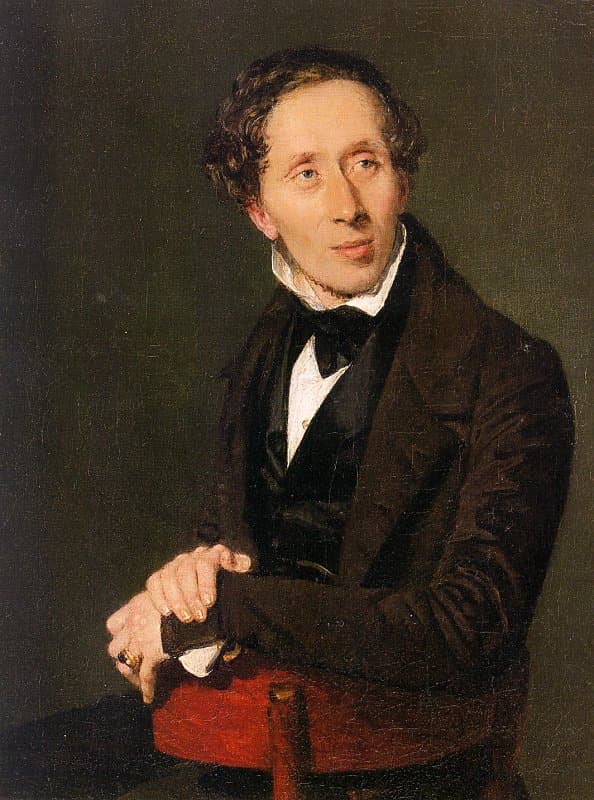
Copenhagen, a winter evening. In a hotel room cluttered with notebooks and scraps of black paper, a very tall man stands near the window, scissors in hand. Hans Christian Andersen receives with the anxious courtesy of someone who never quite believed in his own fame, and begins to speak of his life as if telling its tale.
—It is said that you recognized yourself in one of your own characters. Which one, and why?
The grey chick, of course, the one chased from the farmyard because he is too big, too awkward, poorly shaped. When I wrote The Ugly Duckling in 1843, I invented nothing: I described the child I was, that boy from Odense with the too-long nose, the huge feet, who walked like a wading bird and was mocked. All my youth, I was made to feel I was not of the right brood. But you see, I did not mean to write a complaint. I meant to say that one can be born in a duck yard and discover oneself a swan, not out of pride, but because one has finally found the water that carries you. This tale is the most honest mirror I ever held up, and it still frightens me a little to see myself so naked.
One can be born in a duck yard and discover oneself a swan, not out of pride, but because one has finally found the water that carries you.
—How does a shoemaker's son from Odense come to frequent the royal courts of Europe?
Through a stubbornness that I then took for hope. I left Odense at fourteen, in 1819, with a few coins and the crazy idea of becoming a singer or actor in Copenhagen. The capital first laughed in my face, like the farmyard. Then protectors came: the Collin family, and later the king himself, who received me in 1844. Understand me: a man of my birth does not lift himself alone; he is carried. I kept all my life the acute awareness of that first poverty, the low house where my father stitched shoes. That is why I never owned a home of my own: I lived in hotel rooms and with my hosts, as if putting down roots would have presumed too much on my right to stay.
—Your tales made you immortal. Did you initially consider them your major work?
Not in the least, and that still confounds me. In 1835, I published that first slim collection of Fairy Tales Told for Children almost shamefully, as a diversion slipped into the margin of my true ambition, which was poetry and the novel. I believed my The Improvisatore, born from my journey to Italy, would bring me glory. In the preface, I simply admitted to having taken up the stories heard as a child and told them in my own way, adding what the world had taught me. And lo, these trifles gradually ate up all the rest! It took me years to admit that my immortality, if it exists, slept in those pages I deemed light. The writer does not always choose the door through which he will enter the future.
It took me years to admit that my immortality slept in those pages I deemed light.
—It is said that you read your tales aloud in salons. What were you seeking in these readings?
To find the voice before the book. My tales were not born on paper but in the mouth, like the stories told to me as a child. So in the salons of Copenhagen, I did not merely read: I acted, I changed my tone, I became the wind and the old woman, I mimed the sea or death with a gesture. My long, awkward body suddenly became useful. The children laughed, the ladies fell silent, and I felt the tale live in the air before it froze in ink. Often I would finish by taking my scissors to cut, before their eyes, a silhouette of a castle or a dancer. For me, writing and telling are inseparable: a tale dead on the page is a stuffed bird.
—Travel held an immense place in your life. What did it represent for you?
My true home, since I never had another. As early as 1833, a royal travel grant allowed me to head south, and Rome seized me like a revelation: the light, the ruins, the crowd in the streets, everything nourished my hungry imagination. From that stay came my The Improvisatore. Since then, I never stopped roaming Europe and even the Orient, my large leather trunk strapped with a sturdy rope, for I had a child's terror of losing my luggage. In my notebook, I noted everything: a face, a roof, a phrase overheard, and these sketches later became tales. You see, I believe I only wrote well when uprooted. The sedentary man always looks at the same wall; the traveler, however, sees the world renew itself each morning through the window of a stagecoach.
I believe I only wrote well when uprooted.
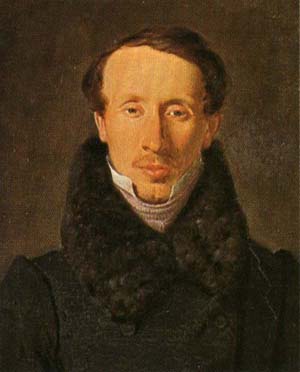
—Your contemporaries spoke of you as a virtuoso with scissors. Where did this art of paper cutting come from?
From a need to make the image emerge at the same time as the story. While I spoke, my fingers folded and cut a black sheet, and out came swans, sylphs, miniature theaters, trees peopled with faces. I did not draw the cutout in advance: I let it be born like the tale, in a single impulse, and it was always a little mystery to unfold the paper to see what the scissors had decided. I offered these silhouettes to my hosts as one offers a part of oneself; some, it is said, are now kept preciously. Theater had fascinated me since childhood — I had dreamed of going on stage — and paper cutting was perhaps my pocket stage, the only theater where I played all the roles without being chased from the boards.
—You dedicated tales to the singer Jenny Lind. What was she to you?
A voice that I loved more than reason, and that never loved me in return. She was called the Swedish Nightingale, and the nickname was apt: hearing her sing was like hearing living art itself, the kind that springs from the heart and not from a mechanism. I believe my tale The Nightingale, in 1843, was born from that — from the opposition between the real bird, fragile and free, and the jewel-studded automaton that the court prefers because it never disappoints. Jenny treated me as a brother, a dear friend, never a lover. I carried that unrequited tenderness like a sustained note that never resolves. Many of my tales, deep down, speak of that: of a love that gives itself entirely and receives, as its only answer, the polite silence of the other.
I carried that unrequited tenderness like a sustained note that never resolves.
—Your letters reveal a heart of burning intensity. How did you live with this fervor of feelings?
Like a fever from which I did not recover. I once wrote to my friend Edvard Collin words that I might not dare repeat today: that I loved him as I had never loved any human being, and that my affection for him had something feminine in its gentleness. See my frankness — or my clumsiness, for it often cost me. I loved too much, too quickly, too strongly, both men and women, and this excess frightened those I loved. Shyness rendered me mute in society, but the pen loosened me to the point of imprudence. Perhaps that is why I took refuge in tales: there, a mermaid can turn into foam for a prince who ignores her, and no one reproaches you for having too large a heart.
—Your stay with Charles Dickens in 1857 ended in discomfort. What happened?
I had dreamed so much of that friendship, and I ruined it by my mere presence. Dickens had received me at his home in England, and I, in my naive happiness, stayed five weeks — far beyond what English politeness could endure. I felt something harden around me without understanding the cause: my awkward tongue, my strange habits, my way of lingering. I noted in my diary that I felt like one guest too many in that house buzzing with life, with no more room for me. After my departure, his letters became fewer, then stopped. It took me a long time to admit that the man who had opened his door to me was relieved to close it again. It is, of all my sorrows, one that still stings.
It took me a long time to admit that the man who had opened his door to me was relieved to close it again.
—At the end of such a life, how do you view the path traveled since the shoemaker's house?
As a man who struggles to believe his own tale. I wrote, at the opening of the story of my life, that my existence was a beautiful fairy tale, rich and happy; that if a benevolent fairy had crossed the poor, unsupported child I was and promised him her protection, my destiny could not have been sweeter. And it is true — from the low room in Odense to the dinners of kings, from the mocked chick to the honorary citizen they made me in 1867. Yet, beneath the wonder, I have always felt the cold of the little match girl, that fear of being only an impostor who will finally be sent back to the duck yard. A happy tale, yes — but told by someone who never stopped being afraid of the dark.
This imaginary interview was generated by artificial intelligence from sources documented in Hans Christian Andersen's profile. It dramatises what the figure might have said based on what we know about them, but does not constitute attested historical testimony. For primary sources and factual documentation, refer to the full profile.