Character Catalog

Historical Library

CollectionGalaxy
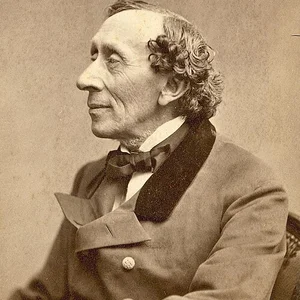
Portrait de Hans Christian Andersen

Hans Christian Andersen

Hans Christian Andersen

1805 — 1875

Royaume de Danemark

LiteratureÉcrivain(e)Poète(sse)19th Century19th century (1805-1875)

Danish writer (1805-1875) world-renowned for his fairy tales. Creator of timeless stories such as The Little Mermaid and The Ugly Duckling, blending poetry, moral lessons, and fantastical imagination.

Émotions disponibles (6)

N

Neutre

par défaut

I

Inspiré

P

Pensif

S

Surpris

T

Triste

F

Fier

Key Facts

  • 1805: Born in Odense, Denmark
  • 1835: Publication of his first fairy tales, which brought him fame across Europe
  • 1837: Publication of 'The Ugly Duckling', one of his most celebrated tales
  • 1843: Publication of 'The Little Mermaid', a tale that has inspired countless adaptations and artistic works
  • 1875: Death in Copenhagen after a prolific career spanning more than 40 years

Works & Achievements

The Little Mermaid (Den lille Havfrue) (1837)

A melancholic tale of a mermaid who sacrifices her voice for the love of a human prince. Considered one of Andersen's most beautiful stories, it explores the themes of sacrifice, unrequited love, and the immortal soul.

The Ugly Duckling (Den grimme Ælling) (1843)

A disguised autobiographical account of a chick different from the others who turns out to be a magnificent swan. A universal symbol of transformation and the rejection of difference.

The Snow Queen (Snedronningen) (1845)

A long tale in seven stories narrating a little girl's quest to save her friend bewitched by the Snow Queen. One of Andersen's most ambitious works, which inspired Disney's film Frozen.

The Little Match Girl (Den lille Pige med Svovlstikkerne) (1845)

A poignant tale of a poor little girl who freezes to death on New Year's Eve while dreaming of warmth. A veiled social critique of child poverty in 19th-century Denmark.

The Nightingale (Nattergalen) (1843)

An allegorical tale contrasting authentic, living art with mechanical artifice. Andersen celebrates the power of true creation over superficial imitations.

Tales Told for Children, First Collection (Eventyr fortalte for Børn) (1835)

The first published collection, including The Tinderbox, Little Claus and Big Claus, The Princess and the Pea, and Little Ida's Flowers. Marks the official birth of Andersen's work as a storyteller.

The Story of My Life (Mit Livs Eventyr) (1855)

An autobiography in which Andersen presents his own life as a wonderful fairy tale. An essential document for understanding the personality and journey of the storyteller.

Anecdotes

Hans Christian Andersen suffered from pathological shyness and was deeply self-conscious about his physical appearance: very tall, with a prominent nose and large feet, he saw himself in the character of the Ugly Duckling. This autobiographical tale mirrors his own transformation from a mocked child into a celebrated artist.

Andersen was terrified of being buried alive, an obsessive fear common in the nineteenth century. Every evening he left a note on his bedside table stating that he was only apparently dead, and asked his loved ones to check his vital signs before any burial.

Despite his worldwide fame, Andersen never won the romantic affections he longed for. He was desperately in love with the Swedish soprano Jenny Lind, nicknamed 'the Swedish Nightingale', to whom he dedicated several of his tales. She never returned his feelings, which likely inspired The Nightingale.

Andersen travelled across Europe throughout his life, meeting Victor Hugo, Charles Dickens, and the Brothers Grimm. His friendship with Dickens was intense but ended abruptly: Andersen stayed five weeks at Dickens's home in London in 1857, so long that the English writer no longer concealed his irritation and stopped replying to his letters.

Andersen published his first collection of fairy tales in 1835 almost discreetly, treating it as a side project compared to his poetry, which he considered more serious work. Only gradually did he come to realise that his Tales would eclipse everything else he had written and secure him worldwide literary immortality.

Primary Sources

The Fairy Tale of My Life (Mit Livs Eventyr) (1855)
My life is a lovely fairy tale, so rich and happy. If, when I was a child setting out into the wide world, poor and without support, a kind fairy had met me and said: 'Choose your path and your purpose, and according to the strength of your desire and your wisdom, I will protect you', my destiny could not have been a happier one.
Letter to Edvard Collin (1835)
I love you as I have never loved any human being. When you are far from me, I will see how precious you are to me. My love for you has something feminine in its tenderness.
Private Diary (Dagbøger) (1857)
At Dickens's. He is happy with his family, but there is something unspoken between us. I feel like one guest too many in this buzzing household.
Preface to Tales Told for Children (Eventyr fortalte for Børn) (1835)
In writing these stories, I recalled the ones I heard as a child. I told them in my own way, adding what the world had taught me.

Key Places

Odense, Denmark

Andersen's birthplace, where he grew up in poverty. His childhood home is now a museum recreating the modest world of the future storyteller.

Copenhagen, Denmark

The capital where Andersen settled at age 14 to pursue his artistic ambitions. He spent most of his adult life there and died there in 1875.

Hotel d'Angleterre, Copenhagen

Luxury hotel where Andersen stayed during his visits to the Danish capital, once his fame allowed him to afford it. A meeting place with the European cultural elite.

Rome, Italy

Andersen made his first grand journey to Italy in 1833–1834, funded by a royal grant. This transformative stay gave birth to his novel The Improvisatore and long nourished his imagination.

Glorup Castle, Funen

A Danish aristocratic estate where Andersen regularly stayed in summer, hosted by Count Moltke. This bucolic and aristocratic setting inspired several of his tales.

Typical Objects

Scissors and paper cutting

Andersen was a virtuoso of paper silhouette cutting, which he performed in front of his audiences to illustrate his tales. He offered these delicate works as gifts to his hosts; some are preserved in Danish museums.

Travel notebook

An indefatigable traveller, Andersen recorded his impressions, sketches and story ideas in notebooks. His many journeys across Europe, the Orient and North Africa directly fed his imagination.

Leather travel trunk

Andersen travelled with a bulky trunk that he carried with him all across Europe. He had a panicked fear of losing his luggage and always tied his bags with a sturdy rope.

Quill pen and inkwell

Andersen wrote his tales with a quill pen, crossing out very little and writing in one flow, as if reciting aloud. His handwriting was reputed to be difficult to decipher by his publishers.

Lutheran prayer book

Raised in the Lutheran faith, Andersen kept a prayer book and a sincere belief throughout his life, which shows through in the moral and spiritual dimension of his tales.

Theatre opera glasses

Passionate about theatre from childhood, Andersen frequently attended performances in Copenhagen and during his travels. The opera glasses symbolise his fascination with live performance and his failed attempt to become an actor.

School Curriculum

Cycle 3 (CM1-6e)Français
Cycle 3 (CM1-6e)Français — Étude des contes de fées et du merveilleux
Cycle 3 (CM1-6e)Français — Analyse des personnages et des valeurs morales dans les contes
Cycle 3 (CM1-6e)Français — Comparaison entre contes traditionnels et créations d'Andersen
Cycle 3 (CM1-6e)Français — Littérature de jeunesse et adaptation des histoires
Cycle 3 (CM1-6e)Français — Influence de la littérature scandinave en France

Vocabulary & Tags

Key Vocabulary

fairy talethe marvelousmoralfantastical characterplotcoming of agetransformationsymbol

Tags

Mouvement

Hans Christian Andersenconte de féesmerveilleuxmoralepersonnage fantastiqueintrigueapprentissagetransformationsymboleXIXe siècle (1805-1875)

Daily Life

Morning

Andersen rose early and began his day with a walk through the streets of Copenhagen or through the Danish countryside, observing people and landscapes. He would jot down his impressions in his notebook before settling at his desk to write.

Afternoon

The afternoon was devoted to writing or reading in his room or in a bourgeois drawing room. He often visited his patrons, the Collin family, and took part in the literary and musical discussions of Copenhagen's cultivated circles.

Evening

Andersen was a regular at dinner parties and salon gatherings where he would read his tales aloud, improvising gestures and expressions. He loved the theatre and opera, and never missed major premieres in Copenhagen.

Food

Nineteenth-century Danish cuisine made up the bulk of his diet: rye bread, herrings, potatoes, soups, and slow-cooked meats. During his travels across Europe, he would discover foreign cuisines with curiosity, particularly Italian and French.

Clothing

Andersen dressed as a bourgeois of his era: dark frock coat, waistcoat, cravat, and top hat — an outfit that contrasted with his humble origins and reflected his social ascent. His tall frame and sartorial awkwardness made him easily recognisable.

Housing

Andersen never owned a permanent home, living in hotels, at his patrons' residences, or in rented rooms. His quarters were modest, furnished with a writing table, his books, and his paper-cutting materials. He preferred mobility to settling down and regarded travel as his true home.

Historical Timeline

1805Naissance d'Andersen à Odense, Danemark, dans une famille modeste ; son père est cordonnier.
1814Défaite de Napoléon ; le Danemark, allié français, cède la Norvège à la Suède par le traité de Kiel.
1819Andersen quitte Odense à 14 ans pour Copenhague, espérant devenir acteur ou chanteur.
1829Publication de sa première œuvre littéraire notable, la nouvelle fantastique 'Promenade du canal de Holmen à la pointe orientale d'Amager'.
1835Publication du premier recueil de Contes pour enfants ; parution également de son roman Improvisatoren, qui le rend célèbre en Europe.
1837Publication de La Petite Sirène et du Seigneur des Neiges dans le troisième fascicule des Contes.
1843Publication du Vilain Petit Canard et du Rossignol.
1844Andersen rencontre le roi Christian VIII du Danemark qui le protège ; il est reçu dans les cours royales européennes.
1848Vague de révolutions en Europe ; au Danemark, instauration d'une monarchie constitutionnelle.
1857Séjour prolongé et désastreux chez Charles Dickens en Angleterre, mettant fin à leur amitié.
1864Guerre des Duchés : la Prusse et l'Autriche envahissent le Danemark ; Andersen est profondément affecté par cette défaite nationale.
1867Andersen est nommé citoyen d'honneur de sa ville natale d'Odense.
1875Mort d'Andersen à Copenhague ; il est enterré au cimetière d'Assistens, déjà considéré comme un génie mondial de la littérature.

Period Vocabulary

Fairy tale — A wondrous narrative featuring supernatural beings and magical events. Andersen transformed the traditional oral genre into a personal literary art form, infusing it with modern poetry and melancholy.
Romanticism — A 19th-century artistic and literary movement that valued emotions, imagination, nature, and popular folklore. Andersen belonged to this movement while transcending it toward a more individually modern sensibility.
Patron (benefactor) — A wealthy or noble figure who provides financial support to an artist. Andersen benefited throughout his life from patrons such as the King of Denmark and the Collin family, without whom his career could not have flourished.
Installment — A partial issue of a work published in successive parts. Andersen's Tales were first published as inexpensive installments, which allowed them to circulate widely across all social classes.
Literary salon — A regular gathering at a cultivated host's home for discussion of literature, art, and ideas. Andersen was a frequent presence in these bourgeois and aristocratic circles, where he would read his tales aloud.
Paper cutting — A folk art consisting of cutting shapes from black or colored paper. Andersen was a master of this craft and created intricate cuttings as entertainment at social gatherings.
Grand Tour — An educational journey across Europe undertaken by cultured young people of the 19th century. Andersen made many European trips that directly nourished his storytelling imagination and allowed him to meet the great authors of his time.
Moral — A life lesson or ethical teaching drawn from a story. Andersen's tales always carry an implicit moral dimension, often more complex and melancholic than that of traditional fairy tales.
Royal grant — A stipend awarded by the king or the state to a promising artist. Andersen received a Danish royal grant in 1833, which allowed him to travel across Europe and develop his work.
Serial — A literary text published in episodes in a newspaper or journal. A common mode of publication in the 19th century that allowed many authors, including Andersen's contemporaries, to reach a wide audience.

Gallery


Porträt des Hans Christian Andersenlabel QS:Len,"Porträt des Hans Christian Andersen"

Porträt des Hans Christian Andersenlabel QS:Len,"Porträt des Hans Christian Andersen"

Hans Christian Andersen (1834 painting)

Hans Christian Andersen (1834 painting)

Grahl-hca-1846

Grahl-hca-1846

Mural painting - Rua de Santa Maria - Funchal 02

Mural painting - Rua de Santa Maria - Funchal 02

Charles de Chamisso or Hippolyte de Chamisso - Portrait of a Gentleman, possibly the artist's brother Adalbert

Charles de Chamisso or Hippolyte de Chamisso - Portrait of a Gentleman, possibly the artist's brother Adalbert


The freebooters; a story [of the Texan war]

The freebooters; a story [of the Texan war]


The Drama; its history, literature and influence on civilization

The Drama; its history, literature and influence on civilization


The American history and encyclopedia of music

The American history and encyclopedia of music


The World's story : a history of the world in story, song, and art

The World's story : a history of the world in story, song, and art

Visual Style

Un style romantique nordique aux aquarelles froides et dorées, mêlant silhouettes découpées, intérieurs chaleureux en clair-obscur et paysages hivernaux danois enneigés, entre poésie mélancolique et merveilleux.

#B8D4E8
#F2E4C4
#4A6FA5
#D4E8D4
#8B6F5C
AI Prompt
Romantic and melancholic illustration style evoking mid-19th century Denmark. Soft watercolor washes in icy blues, pale golds, and winter grays. Delicate ink lines reminiscent of paper silhouette cutouts. Nordic winter landscapes with frozen fjords, snow-covered tiled rooftops, warm candlelit interiors contrasting with cold blue exteriors. Influenced by Romantic painting and early Victorian book illustration. Fairy-tale atmosphere blending the magical and the poignant, with translucent figures, moonlit skies, and intricate natural details — feathers, snowflakes, sea foam.

Sound Ambience

L'univers sonore d'Andersen mêle le Copenhague animé du XIXe siècle — port, carrosses, cloches — à l'intimité de son cabinet de travail où naissent ses contes, ponctué de musique de salon et du bruit de ses découpages de papier.

AI Prompt
Ambient sounds of mid-19th century Copenhagen: horse-drawn carriages on cobblestone streets, the ringing of church bells from old Danish churches, the creaking of wooden sailing ships in the harbor, seagulls over the Sound, the murmur of a bourgeois salon with piano music in the background, the scratching of a quill on paper in a quiet writer's room, distant children's voices in a courtyard, the crackling of a wood fire in a tiled stove, wind whistling through narrow alleyways in winter, the soft sound of scissors cutting paper silhouettes.

Portrait Source

Wikimedia Commons — domaine public — Thora Hallager — 1869