Kids interview Hans Christian Andersen
by Charactorium · Hans Christian Andersen (1805 — 1875) · Literature · 5 min read
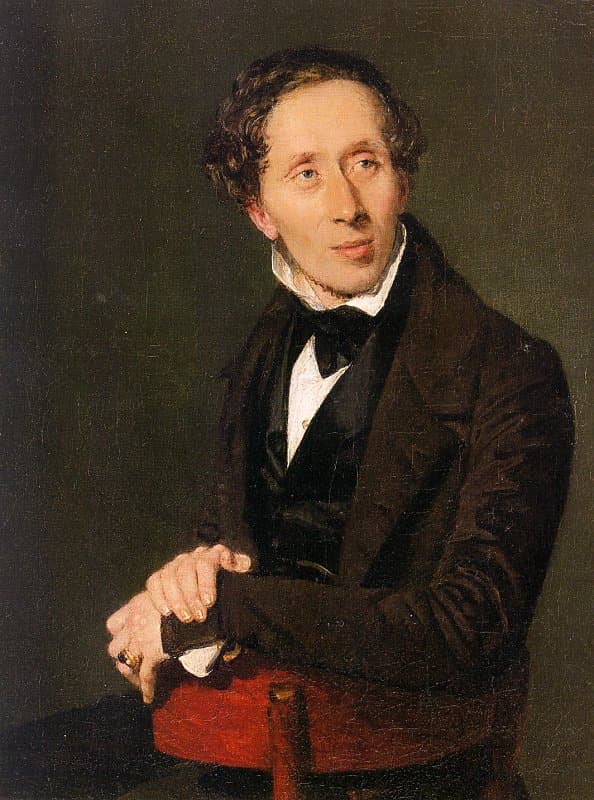
Two young visitors of twelve push open the door of a museum in Odense, Denmark. That morning, a very tall old gentleman with a prominent nose awaits them to answer their questions. It is Hans Christian Andersen in person.
—Is it true that when you were little, the others made fun of you?
Oh yes, my child. I was a boy too tall for my age, with a nose much too long and enormous feet. Imagine an awkward chick in the middle of a tidy barnyard: everyone finds him ugly. That was me. I was born in Odense in 1805, in a tiny house. My father was a shoemaker, we were very poor. Later, I wrote The Ugly Duckling. You know, that mocked chick who becomes a beautiful swan? That was my own story, disguised. I had just put feathers on my childhood tears.
I had just put feathers on my childhood tears.
—And did you really believe you would become someone important one day?
I believed it with all my might, even when no one bet on me. At 14, I left my town for Copenhagen, all alone, without money, to become an actor or singer. Imagine a lanky tall boy knocking on theater doors and being sent away with laughter. And yet! Later, in the book of my life, I wrote that my existence was a beautiful fairy tale, rich and happy. The ugly duckling did not yet know he was a swan. But the river already knew.
The ugly duckling did not know he was a swan.
—We were told you could do magical things with scissors. What is that?
Ah, you have guessed my little secret! When I told my stories in the evenings, in the salons, I would take a sheet of paper and scissors. And there, before people's eyes, I would cut out silhouettes: dancers, swans, entire castles. Imagine that my stories came out of my hands at the same time as from my mouth. I never drew a plan, I cut in one go, as I wrote my tales. I gave these cuttings as gifts to my hosts. Some are still preserved in Danish museums, fragile as snowflakes.
My stories came out of my hands at the same time as from my mouth.
—Did you travel a lot? Were you afraid of losing your belongings?
You don't know how right you are! I traveled all over Europe with a big leather travel trunk. But I had a panic fear of losing my luggage. So I always tied my bags with a strong rope, tightly. I had other fears, stranger still. At night, I would leave a note on my table: 'I am not really dead, I am only sleeping.' In my time, many feared being buried alive by mistake. Imagine that fright, each evening before closing my eyes. The great storyteller that I was also had his little childhood terrors.
The great storyteller also had his little childhood terrors.
—Were you ever truly in love?
Often, my child, and always unrequited. I loved a Swedish singer, Jenny Lind, whom they called 'the Nightingale of the North.' Her voice was so pure that I trembled listening to her. But she never loved me as I loved her. You know, I wrote a tale called The Nightingale, where a little gray bird sings better than all the mechanical jewels of an emperor. When you love without being loved, you learn a strange thing: the heart continues to sing anyway. It is sad, but that is also where the most beautiful stories come from.
The heart continues to sing even when you are not loved.
—And did it make you sad, never being loved in return?
Very sad, I won't lie to you. But that sadness, I poured it into my tales. Think of The Little Mermaid, written in 1837: she gives her voice, she suffers, she loves a prince who does not see her. Do you understand where that story came from now? I wrote letters full of tenderness to people I loved, never receiving the same warmth. So I transformed my grief into mermaids, nightingales, snowflakes. Imagine someone crying and, from their tears, making pearls. That was my secret craft.
From my tears, I made pearls.
—Did you know other famous writers of your time?
Oh yes! I met the greatest: Victor Hugo, the Brothers Grimm, and especially the Englishman Charles Dickens, whom I admired enormously. Imagine your joy if you could visit the person you admire most in the world. In 1857, I went to his home in London. I was so happy that I stayed… five whole weeks! Do you see the problem? I was so shy and so awkward that I did not know when to leave. In my diary, I noted that I felt like a guest too many in that house.
I was a guest too many, and I did not know how to leave.
—And after those five weeks, did you remain friends with Dickens?
Alas, no. And that grieved me greatly. You know, when you stay too long at someone's home, even a friend grows tired. After my departure, Dickens stopped answering my letters. Imagine writing again and again to a friend, and silence answers you. That was it. I was famous worldwide, received by kings, and yet so awkward with people. That is my great lesson, my child: one can enchant a thousand readers and not know when to leave a salon. Talent does not cure shyness.
One can enchant a thousand readers and not know when to leave a salon.
—At first, did you want to write tales for children or something else?
Something else, believe it or not! I thought of myself as a very serious poet. My poems, my novels: that is what I was proud of. My first tales, I published them in 1835 almost in secret, as an unimportant sideline. In my preface, I explained that I remembered stories heard as a child, and that I told them in my own way. Imagine a gardener planting a forgotten little bulb in a corner, thinking of his grand roses. And it is that little bulb that later blooms the strongest. I did not know it yet.
The little forgotten bulb in the corner bloomed the strongest.
—And when did you realize that it was your tales that people loved?
Little by little, my child, almost despite myself. I saw that everywhere in Europe, people asked for my tales, not my poems. The Ugly Duckling, The Nightingale in 1843, then The Snow Queen: people read them, children demanded them. I finally understood that these stories I judged small would eclipse everything else. You see, I wanted to be a great oak and I became a river of tales. Deep down, it was much better. One never writes as well as when one tells stories as one speaks to a child.
I wanted to be a great oak, I became a river of tales.
—If we met you on the street today, what would we notice first?
My height, without a doubt! I was immense, lanky, with that famous nose and very large feet. You would have recognized me from afar. I dressed like a bourgeois: dark frock coat, waistcoat, top hat straight on my head. Imagine a tall heron dressed as an elegant gentleman, a bit awkward in his gestures. I, who was born so poor in Odense, son of a shoemaker, I wore the clothes of important people. But under the fine hat, there was always the little duckling of old. One never fully leaves the child one was.
One never fully leaves the child one was.
This imaginary interview was generated by artificial intelligence from sources documented in Hans Christian Andersen's profile. It dramatises what the figure might have said based on what we know about them, but does not constitute attested historical testimony. For primary sources and factual documentation, refer to the full profile.