Imaginary interview with Hegel
by Charactorium · Hegel (1770 — 1831) · Philosophy · 6 min read
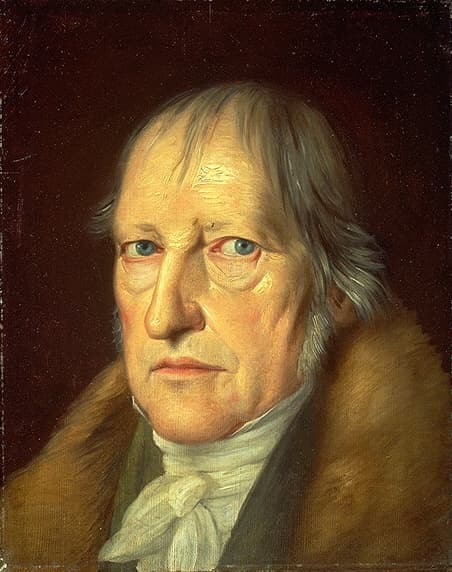
Berlin, autumn 1830. In a study lined with books and manuscripts, not far from the university whose rector he has just been elected, a man in a black frock coat sets down his quill. Rhine wine waits on the table; outside, news from Paris disturbs the order of things. Georg Wilhelm Friedrich Hegel agrees to look back, for us, on the long path of Spirit.
—How was writing your first major work in a besieged city?
It was in Jena, in October 1806. I was finishing the manuscript of my Phenomenology of Spirit while Napoleon's cannons thundered at the city gates. Imagine the absurdity: a man bent over his pages, tracing the path of consciousness toward absolute knowledge, while History itself shattered the walls a few streets away. I had no leisure to tremble; I had to save the pages before everything burned. And the next day, on the great square, I saw him — the Emperor crossing the city on horseback. I wrote to my friend Niethammer what I felt then: 'I saw the Emperor – this world-soul – ride out of the city on reconnaissance.' Never had History seemed so close to the tip of my pen.
A man bent over his pages while History shattered the walls.
—What did you mean by calling that man on horseback the world-soul?
Understand me well: I was not celebrating the conqueror, but what passed through him. I call it the Weltgeist, the World Spirit, that universal Reason that forges its way through History and sometimes chooses a single individual as its instrument. This man 'concentrated here at a single point, astride a horse, reaches out over the world and dominates it' — that is what I felt as I watched him. Napoleon knew nothing of my system, and yet he was accomplishing, without knowing it, a necessary moment in the unfolding of freedom. Great men are never masters of what they serve; they believe they are pursuing their own ambition, and Spirit uses them and then discards them, once their task is done. That is what I called the cunning of Reason.
Great men believe they are pursuing their own ambition, and Spirit uses them and then discards them.
—Why does your thought place so much importance on contradiction?
Because nothing living advances otherwise. Most people believe that thinking means avoiding contradiction; I say we must go through it. An idea posits its opposite, and from this conflict a third term arises that surpasses them both — that is the Dialektik. I devoted three volumes of my Science of Logic, between 1812 and 1816, to following this movement from the doctrine of Being to that of the Concept. The French have no word for what I call Aufhebung: to cancel, preserve, and elevate all at once. When the bud disappears into the flower, one would not say the flower destroyed it — it fulfilled it. That is why I write in the preface to my Phenomenology that 'the true is the whole.' The true is never a starting point; it is a result.
The true is never a starting point; it is a result.
—You are criticized for the extreme difficulty of this logic. How do you justify it?
I am criticized for making obscure what could be simple. But the simplicity people demand is often that of laziness. In my Encyclopedia of the Philosophical Sciences, published in 1817, I defined philosophy as 'the thinking science of things,' as opposed to immediate, sensory, representational grasp. Now, thinking the thing in its movement, and not in the frozen image one forms of it, requires a language that matches that movement. My quill has blackened thousands of pages because the concept does not let itself be caught in a single stroke. People would like me to serve up truth like a ripe fruit; but the labor of the Concept is precisely the patience of the negative. Whoever wants to understand must consent to be led step by step, without skipping the stage that disconcerts them.
—Do you remember your student years and the friendships you formed?
How could I forget them? I was eighteen when I entered the Tübingen Stift, that Protestant seminary where we were trained in theology. I shared a room with two hotheads: the poet Hölderlin and young Schelling, more precocious than all of us. We were intoxicated by what was coming from Paris. The French Revolution seemed to us the dawn of a world where Reason would finally govern. They say that one morning, around 1793, we planted a liberty tree together in a nearby meadow, as one plants a hope. I was far from foreseeing then what this idea of freedom would cost Europe — nor the long detour needed for it to become something more than a cry.
We planted a liberty tree as one plants a hope.
—What remains, in the mature man you are, of that youthful revolutionary enthusiasm?
The enthusiasm remains, but it has learned patience. At twenty, I believed it was enough to tear down the old for the rational to spring forth fully armed. Since then I have seen how abstract freedom, when it rises without institutions to support it, falls back into terror and devours its own children. That is the error I later analyzed in my Phenomenology: a freedom that is only pure negation produces nothing but death. The tree we planted at Tübingen was a beautiful image, but a tree needs soil, roots, a state to grow. The Revolution taught me that Spirit does not progress in a straight line: it advances through ruptures, and what we take for setbacks are often the necessary detours of Reason.
A freedom that is only pure negation produces nothing but death.
—Your lectures have a reputation for being the most baffling in Berlin. How do they proceed?
I know what is said in the corridors. In the afternoon, before a often-packed auditorium, I read my notes in a low voice, my eyes on my scribble-covered notebooks. I sometimes stop in the middle of a sentence — not out of weakness, but because a formulation still seems to betray the thought, and I search, in silence, for the right word. My students feverishly take notes and admit they only understand me after long hours of rereading. That does not bother me. The concept does not yield itself at first hearing; it demands that one return to it. These transcriptions, moreover, will one day form my Vorlesungen, those lectures that my listeners will preserve better than I could have myself. I am a poor speaker, no doubt; but I prefer to hesitate over the true than to speak fluently in the false.
I prefer to hesitate over the true than to speak fluently in the false.
—Before Berlin, you directed a high school. What did this educator's job teach you?
People readily forget that I was, from 1808 to 1816, director of the Gymnasium of Nuremberg. Before holding a chair, I knew the precarious status of Privatdozent in Jena, living on the meager fees of my listeners. In Nuremberg, I had charge of younger souls, and I wrote the annual speeches myself that I addressed to the students to exhort them to effort and discipline. There I acquired a conviction that never left me: education is the path by which Spirit tears itself away from the immediacy of nature to become itself. A child is not a little man already made; he must become alien to himself, go through the seriousness of study, to return to himself enriched. This is, in miniature, the whole movement of my philosophy.
—Your political philosophy makes the state a central figure. Why this importance?
Because freedom exists nowhere outside the institutions that give it body. In my Elements of the Philosophy of Right, published in 1821, I describe three moments: the family, where love reigns; civil society, where each pursues their own interest; and the state, where these oppositions are reconciled in a common life. I call Sittlichkeit this concrete ethics, lived in the customs of a community — something quite different from Kant's pure abstract injunction, which commands without being able to become incarnate. Much has been said about my formula in the preface: 'What is rational is actual, and what is actual is rational.' People have seen it as a servile praise of the established order. That is to misread me. I do not say that everything that exists is just, but that Reason does not hover in the clouds: it wants to realize itself in the world.
Reason does not hover in the clouds: it wants to realize itself in the world.
—Does your own family life reflect these ideals you set out in your books?
I flatter myself that it does, at least. I married Marie von Tucher in 1811, and in Berlin I keep an orderly home, in an apartment near the university, my study at the heart of the house. I do not believe that a philosopher should preach ethical community and live as a grumpy hermit. When evening comes, I like to receive guests, offer a glass of Rhine wine, play cards, discuss late into the night — conviviality is not the opposite of thought, it is its soil. The family, as I describe it in my Philosophy of Right, is not an abstraction I conceived from afar: I know it through the shared table and the peaceful order of days. The system has value only if it illuminates even the way one inhabits one's own house.
This imaginary interview was generated by artificial intelligence from sources documented in Hegel's profile. It dramatises what the figure might have said based on what we know about them, but does not constitute attested historical testimony. For primary sources and factual documentation, refer to the full profile.