Kids interview Hegel
by Charactorium · Hegel (1770 — 1831) · Philosophy · 5 min read
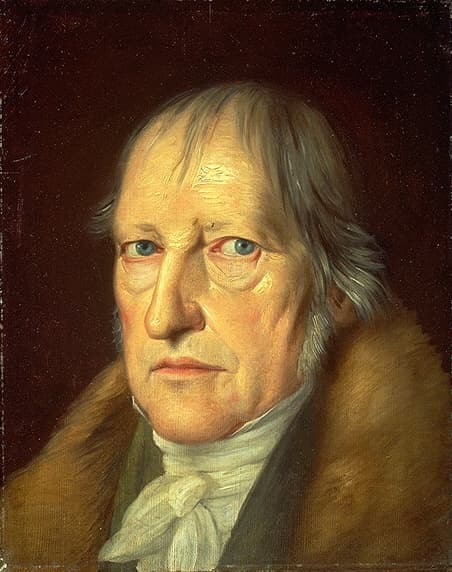
Two twelve-year-old students push open the door of an old study cluttered with books and manuscripts. A gentleman in a black frock coat greets them, a quill in his hand. He sets down his newspaper, smiles, and motions for them to sit: he has so many things to tell them.
—How old were you when you left home to study?
I was eighteen, my child. I was born in Stuttgart, in the Swabian region, into a quiet Protestant family. And then, in 1788, I was sent to the Stift in Tübingen. A Stift is a very strict religious boarding school where future pastors were trained. Imagine long cold hallways, morning prayers, rules everywhere. But I gained a treasure there: two roommates. One was named Hölderlin, who would become a great poet. The other, Schelling, a philosopher. We talked whole nights away, we dreamed the world. You don't always choose your home, but you choose your friends.
You don't always choose your home, but you choose your friends.
—Is it true you planted a tree with your buddies?
It's said, yes! That was around 1793. Over there, in France, the people had just risen up and overthrown their king. For us young students, it was overwhelming. Imagine: we had been told forever that nothing would ever change, and suddenly everything was moving. With Hölderlin and Schelling, our hearts pounding, we supposedly went and planted a little tree in a meadow. We called it a liberty tree. A tiny gesture, almost nothing. But we wanted to say we were on the side of those who hoped for a fairer world. You see, a tree grows slowly — like ideas.
A tree grows slowly — like ideas.
—What was it like writing a book while there was a war outside?
Terrifying and magnificent at the same time. I was teaching at Jena then, and finishing my first major book, the Phenomenology of Spirit. And at the same time, in October 1806, Napoleon's army was arriving. Picture the scene: I was finishing my last pages at night, by candlelight, while cannons rumbled in the distance and the city trembled. Soldiers were entering houses. My manuscript, I protected it like a child. You know, I feared for my pages more than for myself. When you've spent years on a work, you care for it more than for your own peace.
—Did you really see Napoleon in person, with your own eyes?
Yes! And I will never forget it. The day after I finished my book, I saw him ride through the city on horseback, going on reconnaissance. I wrote to my friend Niethammer these words, which really are mine: "I saw the Emperor – this world-soul". Does that surprise you? For me, certain men carry within them something greater than themselves. I called it the Weltgeist, the 'World-Spirit' — the great force of history that advances through the ages. That day, I felt that this entire force was sitting on a single horse, before my eyes. Imagine that vertigo.
Certain men carry within them something greater than themselves.
—What is your big idea in philosophy?
Good question, and a difficult one! I'll make it simple for you. I thought that ideas advance by arguing. An idea appears. Then another comes to contradict it. And instead of one winning over the other, they blend and give a richer idea. I called this movement dialectics. Imagine an argument between two friends: if each listens to the other, they often end up smarter than before. I even had a German word almost impossible to translate, Aufhebung: it means to cancel, to preserve, and to elevate all at once. You overcome something without throwing it all away. That is how the world thinks, my child. Slowly, step by step.
Ideas advance by arguing, like two friends who listen to each other.
—What does your phrase 'the true is the whole' mean?
You remembered it! That's good. Those words are truly mine: "The true is the whole". I'll explain with an image. Imagine I show you a single branch of a great oak and say: here is the tree. You would laugh! A branch is not the tree. To truly understand something, you must see it whole, with its roots, its trunk, its history, how it grew. An idea alone, torn from the rest, does not tell the truth. The truth is the whole, and the path that leads to it. That's why my books were so thick!
A branch is not the tree: the true is the whole.
—They say your students understood nothing of your lectures, is that true?
Ah... I must admit, that's not entirely false! I taught at the University of Berlin, before a hall packed to bursting. But I spoke in a low voice, my nose in my notes, searching for my words. And sometimes — it's true — I would stop in the middle of a sentence. I remained silent for long minutes, my gaze lost, while my students dared not breathe. Then I would resume, as if nothing had happened! My thoughts were heavy, slow to come. My students would reread their notebooks for hours to understand me. I was not a brilliant talker. I was a miner digging.
—What did it smell like, what was your home like in the evening?
Oh, a warm place! I lived in a bourgeois apartment in the heart of Berlin, near the university, filled with books and papers up to the ceiling. In the evening, it smelled of tobacco: I liked to smoke my pipe while thinking. And I also liked good Rhine wine, which I offered to my guests. I lived with my wife, Marie, and our children, in a well-ordered home. Imagine evenings with no sound of machines — just horses outside, the crackling fire, and friends discussing everything late into the night. For me, sharing a meal and ideas was almost sacred.
—Were you strict when you ran a school?
Demanding, yes! In 1808, I became director of the Gymnasium of Nuremberg — a school for boys about your age. I took it very seriously. Each year, I gave them a speech, written in my own hand, to push them toward effort and work. I asked a lot of them. But it wasn't to punish them, you see. It was because I respected them. Imagine a gardener pruning a young tree: he seems harsh, but it's so it grows straight and strong. I believed that a child who learns becomes freer, not less.
A child who learns becomes freer, not less.
—Why is it so important to you that people learn things?
Because it is everything, my child. Truly everything. I believed that all of humanity grows, slowly, from century to century — like a vast spirit gradually awakening. I called it the Spirit, the Geist. And do you know how it grows? Through every head that learns, that asks questions, that understands the world a little better. You, there, listening to me, thinking, you are advancing this great thing. When I see two curious children like you come through my door, I am moved. For books die in the dust if no one opens them. It is you who keep ideas alive after us.
Books die in the dust if no one opens them.
This imaginary interview was generated by artificial intelligence from sources documented in Hegel's profile. It dramatises what the figure might have said based on what we know about them, but does not constitute attested historical testimony. For primary sources and factual documentation, refer to the full profile.