Imaginary dialogue between Friedrich Wilhelm Joseph Schelling and Hegel
by Charactorium · Hegel (1770 — 1831) · Philosophy · 5 min read
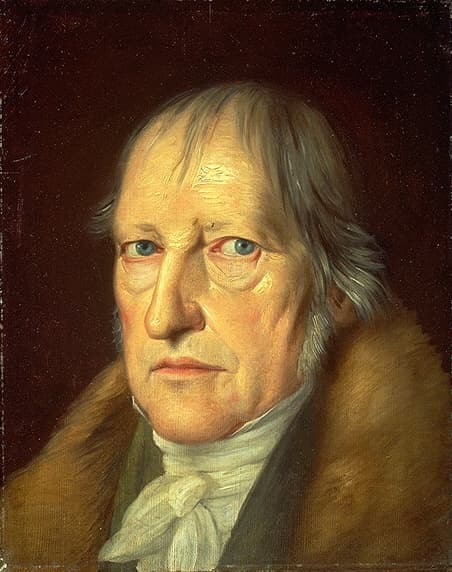
It is in Hegel's study, in Berlin, on an autumn evening in 1829, that Schelling comes to see him after many years of silence. A bottle of Rhine wine waits on the cluttered table of manuscripts, and the oil lamp dimly lights the aligned bindings. The two men have known each other since the seminary in Tübingen, where they shared a room with Hölderlin; the former rival comes to press his old comrade to explain the system that devours him. The conversation quickly grows tense, friendly and sharp.
—Do you remember, Wilhelm, our room at the Stift? We planted that tree of liberty in the meadow, exhilarated by Paris. What remains of it in you?
How could I forget it, you who held the spade with me? We were three kids — Hölderlin, you and I — drunk on 1789, convinced the world was beginning anew. That tree, you see, I never really uprooted it. What we called liberty when planting a young oak, I have since understood as the patient work of Reason in history. The Revolution was a magnificent sunrise, but a sun is not enough: Spirit must also pass through terror and night to become knowledge. Our twenty-year-old selves believed in the instant; my old age believes in the journey. But the fire of Tübingen, my friend, it still burns beneath every one of my pages.
The Revolution was a magnificent sunrise, but a sun is not enough.
—They say that in Jena, in 1806, you were finishing your manuscript while Napoleon's cannons thundered. Is it true, or has legend already caught up with you?
It is true, and stranger than the legend. I was putting the final sheets on the Phenomenology of Spirit while Prussia crumbled beneath my windows. I even feared for the manuscript, which I sent by mail in the midst of chaos. And then I saw him, riding through town on horseback to reconnoiter. I wrote to Niethammer that I beheld the world-soul concentrated in a single man. Understand me well: I did not admire the conqueror, I admired the moment when an individual bears on his shoulders what the entire age demands. The cannon destroyed an old world; my pen tried to think its meaning. The two gestures, that evening, responded to each other.
The cannon destroyed an old world; my pen tried to think its meaning.
—You know how much your Phenomenology struck me. Explain to me, who speaks your language, what exactly you call this Aufhebung you make your weapon.
To you I will say it without detour, for no one else would grasp this word. Aufheben, in our language, means to cancel, to preserve, and to elevate — three senses in a single breath. When a thought meets its contradiction, it does not die: it is negated, but saved, and raised to a higher level. That is dialectic: not a trick of the reasoner, but the very movement of the real. Spirit progresses only by tearing itself apart and stitching itself back together higher. You will object that my Absolute starts like a night where all cows are black — I know your arrow. But the true is not a starting point; the true is the whole, and the whole is only essence that completes itself through its own development.
A negated thought is not a dead thought: it is saved and raised higher.
—What you call Geist, this Spirit that would unfold in history — is it not a disguised god you make walk on the roads of men?
The question is harsh, and that is why it comes from you. Geist is not a hidden god pulling strings from the clouds. It is Reason itself, but a Reason that exists only in its work: in peoples, institutions, works, wars. I hold that Reason governs the world, and that universal history has consequently unfolded rationally — not that everything in it is good, but that nothing in it is pure absurdity. Men's passions, their ambitions, even their crimes, Spirit uses them as cunning uses its instruments. You seek the Absolute in nature and intuition; I track it in the long calvary of consciousness. We hunt the same prey, Wilhelm, from two opposite sides of the mountain.
We hunt the same prey, from two opposite sides of the mountain.
—After Jena, you left the university to direct the Gymnasium of Nuremberg, starting in 1808. Why this detour through school, you who were said to be destined for the heights?
The detour, my friend, was first a necessity: Jena ruined, without a chair or income, I even ran a gazette in Bamberg for a time. But Nuremberg was not an exile, it was a lesson. Directing those young people, giving them a speech each year to exhort them to effort, correcting their Latin — this taught me that Spirit does not fall from heaven fully formed. It is cultivated, slowly, through discipline. I also wrote a good part of my Science of Logic there, in the mornings before classes. I am convinced that education is the true path by which a people rises above its immediate nature. Forming a child in rigor is to advance the World-Spirit by one step — modest, but real.
Spirit does not fall from heaven fully formed: it is cultivated, slowly, through discipline.
—You have always held the State to be a high, almost sacred reality. Does this trust come already from the rector you were in Nuremberg?
You aim true, as often when you attack me. Yes, it is in forming children that I saw how much the individual alone is nothing, and how much he becomes free only within institutions that surpass him. The family, civil society, then the State: these are the degrees by which abstract freedom becomes concrete freedom, what I call Sittlichkeit, lived ethicality. I know I am reproached for divinizing the Prussian State. But I do not celebrate this or that government: I say that what is rational is real, and what is real is rational. Not to bless the existing fact, but to seek in it the reason that works itself out. A state without reason is only force; a rational state is the place where man finally becomes a citizen of himself.
The individual becomes free only within institutions that surpass him.
—They say that in Berlin your lectures disconcert: you stop, you fall silent for long minutes, then you resume. Is it contempt for the public, or something else?
Neither contempt nor coquetry — believe me, I suffer from this slowness as much as my students. Thought does not unroll like a ribbon; it seeks itself, it stumbles, it recovers. When I stop in the middle of a sentence, it is because the concept resists, and I refuse to betray it by a convenient formula. My listeners take frantic notes and understand, they tell me, only on rereading. So be it! I prefer a knowledge conquered in pain to a clarity that would be only laziness. You who speak with such ease will judge me laborious. But truth, you see, does not give itself to those who want it easy. It is that painful result at the end of which only one has the right to say: now, I know.
I prefer a knowledge conquered in pain to a clarity that would be only laziness.
—And in the evening, this Rhine wine, these salons, these card games — how does the austere thinker of the Concept accommodate such a bourgeois life?
You catch me at table, and I admit it without shame. The morning belongs to newspapers and the desk; the afternoon to lectures; but the evening, I become a man among men. I love this Rhine wine, I love to entertain, discuss politics late into the night, play cards even. See no contradiction here: convivium, this sharing around a table, is also a place where spirit is exchanged and invigorated. A philosophy that would despise concrete life, home, friendship, would be worthless. Marie keeps an orderly household, and I find in it the peaceful image of what I write about the family. Do you remember the tormented young man of Tübingen? He has become, in Berlin, a bourgeois who sleeps well — and who thinks all the better for having made peace with his time.
A philosophy that would despise home and friendship would be worthless.
—Last arrow, old brother: your Logic claims to deduce the whole of nature from the pure Concept. Are you not afraid of having built a system that closes in on itself?
Fear, no — but the demand, yes, every day. My Encyclopedia starts from logic, passes to the philosophy of nature, and returns to Spirit: three moments of a single circle. You see a prison; I see the only way to think the whole without leaving an irrational outside. Philosophy, I have written, is the thinking science of things, opposed to sensory apprehension that is content with appearances. If my system closes, it closes like a circle: not to imprison, but so that no point escapes reason. You will reproach me for wanting everything. It is true. But I believe that a thought that renounces the whole renounces truth itself. If that condemns me in the eyes of prudent minds — I accept it, as you accept your intuition of the Absolute.
A thought that renounces the whole renounces truth itself.
This imaginary interview was generated by artificial intelligence from sources documented in Hegel's profile. It dramatises what the figure might have said based on what we know about them, but does not constitute attested historical testimony. For primary sources and factual documentation, refer to the full profile.