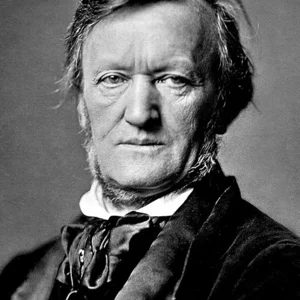

German composer (1813–1883), Wagner revolutionized opera by creating the concept of the total work of art (Gesamtkunstwerk). His music dramas, including the Ring Cycle and Tristan und Isolde, remain towering monuments of Romanticism.
Richard Wagner(1813 — 1883)
Richard Wagner
royaume de Saxe
10 min read
Frequently asked questions
Famous Quotes
« Music begins where the power of words ends.»
« The art of tomorrow will be the art of all people in common.»
Key Facts
- 1813: Born in Leipzig on May 22
- 1849: Exiled to Switzerland after taking part in the Dresden uprising
- 1876: Opening of the Bayreuth Festival with the first complete staging of The Ring of the Nibelung
- 1865: Premiere of Tristan und Isolde, a foundational work of modern harmony
- 1883: Died in Venice on February 13
Works & Achievements
A Romantic opera about a cursed captain condemned to sail the seas for eternity, who can only be saved by the love of a faithful woman. Wagner's first fully mature work, it introduces his great theme of redemption through love.
A music drama weaving together sacred and earthly love, inspired by medieval legends of the German knight-poets. Its notorious Paris premiere in 1861 — booed off the stage by members of the Jockey Club — remains one of the most turbulent evenings in opera history.
A Romantic opera about a mysterious knight of the White Swan, an emissary of the Holy Grail forbidden from revealing his identity. King Ludwig II's favorite opera, it directly inspired the décor and the very name of Neuschwanstein Castle.
The supreme masterpiece of musical Romanticism, revolutionary in its chromatic harmony that pushes tonality to its breaking point. The Tristan chord, heard in the very first bars, foreshadows the dissolution of classical tonality and paves the way for the modern music of the 20th century.
Wagner's only comic opera, celebrating the guild of artisan-singers of 16th-century Nuremberg. A radiant tribute to German art, popular creativity, and artistic renewal, it stands as the most melodically rich work in his entire output.
A cycle of four music dramas drawn from Germanic and Norse mythology: Das Rheingold, Die Walküre, Siegfried, and Götterdämmerung. Running approximately sixteen hours across four evenings, it is the most monumental work ever composed in the history of Western music.
Wagner's final sacred drama, inspired by the medieval legend of the Holy Grail and the power of compassionate suffering to bring about redemption. For years Wagner refused to allow it to be performed anywhere other than Bayreuth, considering it a spiritual consecration rather than an ordinary theatrical spectacle.
Anecdotes
Wagner took part in the 1848–1849 revolutions in Germany and was forced into exile for thirteen years. He lived primarily in Zurich, where he wrote his major theoretical essays on music and theater while composing masterworks such as Tristan und Isolde. This painful exile forged his vision of a total art form in service of the people.
The young King Ludwig II of Bavaria, just 18 years old, developed an absolute admiration for Wagner and rescued him from financial ruin in 1864. He funded his operas, offered him a luxurious villa, and had Neuschwanstein Castle built, directly inspired by the sets of Wagner's dramatic works. This passionate friendship was one of the most extraordinary relationships between an artist and his patron in the entire history of music.
Wagner had a secret and costly obsession with silk fabrics and luxurious indoor garments. He would order yards of velvet and satin to line his walls and have embroidered dressing gowns made to measure, even when he was drowning in debt. His suppliers sent him desperate letters demanding payment for these extravagant indulgences.
For the Bayreuth Festival, inaugurated in 1876, Wagner designed a revolutionary concert hall featuring an orchestra pit entirely concealed beneath the stage, which he called the "mystischer Abgrund" — the mystic abyss. This innovation allowed the sound to envelop the audience without the musicians distracting from the stage action. The Bayreuth Festival still exists today and remains one of the most prestigious musical events in the world.
Unlike all his contemporaries, Wagner wrote his own opera libretti in alliterative verse inspired by medieval Germanic poetry. He spent years studying the Norse Eddas and the Nibelung Saga to build the world of the Ring Cycle. This unique fusion of poetic epic and orchestral music was at the heart of his concept of Gesamtkunstwerk — the total work of art.
Primary Sources
The essence of drama is love. Music is a woman; her generative moment is the poet. What music cannot speak, drama speaks; what drama cannot say, music sings.
The man of the future will create the perfect work of art only when he unites all the arts — dance, music, and poetry — into a single and unified expression, as the Greeks once did.
I remember hearing Beethoven's Symphony in C minor for the first time — that work opened an entirely new world to me and taught me that music could express what words cannot say.
I cannot live like a dog, I cannot sleep on straw and drink spirits. I must be pampered in one way or another if my mind is to accomplish the immensely difficult task of creating a world that does not yet exist.
Everything I am, I am solely out of absolute necessity; everything I do, I do because I cannot do otherwise. This is how the true work of art is born.
Key Places
Wagner's birthplace, where he was born on May 22, 1813. Leipzig was then a major German intellectual and musical hub, where the young Richard discovered Beethoven and received his first lessons in harmony.
Wagner served as musical director here from 1843 to 1849, premiering The Flying Dutchman and Tannhäuser. It was here that he took part in the 1849 uprising, which earned him an arrest warrant and thirteen years of exile.
A lakeside residence where Wagner lived from 1866 to 1872 with Cosima von Bülow. There he composed The Mastersingers of Nuremberg and a large part of the Ring Cycle, in an idyllic setting overlooking the Swiss Alps.
A unique theater designed by Wagner himself, inaugurated in 1876 with its hidden orchestra pit. It hosts the Bayreuth Festival every summer, one of the most important musical pilgrimages in the world.
A Gothic Venetian palace on the Grand Canal where Wagner died on February 13, 1883, struck down by a heart attack. Venice, a city he adored for its melancholic beauty, was the setting for his final weeks.
Typical Objects

Wagner was one of the first modern conductors to impose an expressionist and authoritative style of direction. His technique revolutionized musical interpretation and made him a model for the great conductors of the 20th century.

Wagner devoted twenty-six years to composing The Ring of the Nibelung, producing thousands of pages of orchestral scores of extreme complexity. These manuscripts, preserved in Bayreuth, bear witness to an artistic ambition unparalleled in the history of music.

Wagner wrote all his own librettos in old-style alliterative verse — a medieval poetic form he revived for his music dramas. His quill served him as much for composing epic poetry as for jotting down musical motifs that came to him during his walks.

Wagner had a famous obsession with luxurious indoor clothing that he wore while composing — embroidered velvet, pink satin, oriental perfumes. This costly eccentricity bewildered his contemporaries and left him drowning in debt.

The horn is the emblematic instrument of the Wagnerian world, embodying Germanic forests, heroes, and the call of fate in Siegfried and The Valkyrie. Wagner demanded the creation of new low-pitched instruments — the Wagner tubas — to enrich the tonal palette of his orchestra.

Wagner drew heavily on the Edda and the Nibelungenlied to build the universe of his Ring Cycle. These medieval texts provided him with gods, heroes, cosmology, and the dramatic thread of his great mythological cycle.
School Curriculum
Vocabulary & Tags
Key Vocabulary
Daily Life
Morning
Wagner rarely rose before nine or ten in the morning, having worked or read well into the night. He would take a late, light breakfast — tea, fruit, a few slices of bread — before working through his monumental correspondence, where letters from patrons, unpaid bills, and declarations of admiration all jostled for attention.
Afternoon
His afternoons were devoted to composition in a study draped in silk and cluttered with scores and books of mythology. Wagner often composed at the piano, improvising at length before writing down his themes, and he liked to break his work with long walks in the forest, letting his musical ideas ripen as he went.
Evening
Wagner's evenings were often social affairs — lively dinners with admirers, orchestral rehearsals, or passionate philosophical discussions with friends such as Nietzsche or Liszt. An avid reader, he would devour Shakespeare, Schopenhauer's philosophy, and medieval epics well into the early hours of the morning.
Food
Wagner had a taste for fine French and German cuisine: roasted meats, Viennese pastries, and Rhine wines graced his table whenever his finances allowed. He suffered, however, from chronic digestive problems that required him to follow prescribed diets — a constraint he submitted to with notoriously poor grace.
Clothing
At home, Wagner was famous for his embroidered velvet dressing gowns, often in shades of purple or burgundy, and for his heavy use of oriental perfumes — an eccentricity that both fascinated and scandalized his visitors. For outings and performances, he dressed as a prosperous bourgeois: top hat, dark frock coat, and an elaborate waistcoat, embodying the respectability he so keenly aspired to.
Housing
Wagner lived in vastly different circumstances over the course of his life, moving from squalid rooms during his years in Paris to luxurious villas provided by wealthy patrons. His final home, the Villa Wahnfried in Bayreuth — whose name means 'where my illusions find peace' — was decorated entirely to his taste: silk hangings, heavy furniture, and busts of Beethoven and Schiller presiding over the drawing room.
Historical Timeline
Period Vocabulary
Visual Style
Le style visuel wagnérien évoque la peinture romantique allemande — forêts brumeuses, héros mythologiques en armures médiévales, lumières dramatiques et atmosphères crépusculaires entre ombre profonde et éclats dorés.
Sound Ambience
L'univers sonore de Wagner mêle la grandeur d'un orchestre romantique porté à son maximum de puissance, les appels de cor dans les forêts nordiques et les murmures de coulisses d'un théâtre du XIXe siècle avant la levée du rideau.