Imaginary interview with Henri IV
by Charactorium · Henri IV (1553 — 1610) · Politics · 6 min read
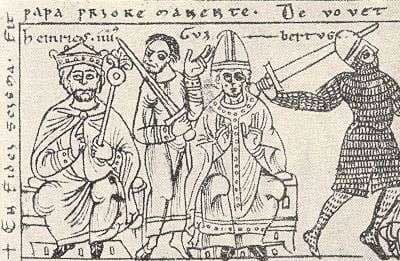
Winter 1105. In a bare room of a palace in Liège, far from the splendor of Goslar, a man stripped of his crown agrees to speak. He ruled the Holy Roman Empire for half a century, defied two popes and made his own; now he awaits a burial that the Church still denies him.
—It all began with a question of gestures and objects: who places the ring and crozier on a bishop's shoulder. Why did this ceremony matter so much to you?
Because a bishop in my Empire is not only a shepherd of souls: he holds lands, cities, men-at-arms, so many fiefs that he receives from my hand. When I gave him the sceptre and episcopal ring, I was not giving him God, I was entrusting him with a portion of my kingdom. My Salian fathers had always done it, and it was by this gesture that the Empire stood firm. Hildebrand wanted to tear that hand from me, on the pretext that sacred things cannot be sold or invested by a layman. But take away the emperor's right to appoint his bishops, and you leave him only a hollow crown. That is what many have called a quarrel of symbols. It was a quarrel over a kingdom.
Take away the emperor's right to appoint his bishops, and you leave him only a hollow crown.
—In 1075, Pope Gregory VII circulated a text, the Dictatus papae, which reordered the entire Christian world. How did you receive it?
As an unprecedented challenge. It stated, point by point, that the pope alone could depose bishops, summon a council, and — it still takes my breath away — depose emperors. Imagine the audacity: a monk from Rome decreeing that he could release my subjects from their oath and drive me from my throne with a stroke of his pen. My ancestors had made and unmade popes; now a pope claimed to make and unmake me. What he called the freedom of the Church, I called a theocracy where the temporal sword bows before the crozier. I never denied that God had placed me above men; I denied that a man from Rome could place himself above God and Caesar at once.
—Your first riposte was not an army, but a letter. What did you want to make him understand?
That he was not pope in my eyes. In 1076, from the Synod of Worms, I wrote to Hildebrand a letter that all Christendom repeated. I called myself 'king not by usurpation but by the holy ordination of God', and I addressed him as 'not pope but false monk'. And I ended with that word that still echoes: 'Descend, descend, you who are damned for all ages.' I believed that a king was enough to undo a monk. I was wrong about the weapon he wielded. To my deposition pronounced at Worms, he replied with excommunication, and then my own princes, those patient wolves, saw an opportunity to break away from me. A letter had sufficed to light the fire; it took much more to put it out.
I believed that a king was enough to undo a monk.
—Do you remember those three days in January 1077 before the gates of Canossa?
Every hour remains in my bones. The pope had taken refuge in the fortress of Countess Matilda in Italy, and there, in the snow, I presented myself — not as emperor, but as a penitent. I had cast off purple mantle and ermine for a simple woolen garment, barefoot on the ice. Three days I waited before the closed gate, fasting, while inside they deliberated my fate. The chronicler Lambert of Hersfeld reports that I stood there, stripped of all royal insignia, awaiting the pontiff's pleasure. Some saw my humiliation. I saw a desperate calculation: as long as the excommunication weighed, my German princes had a pretext to abandon me. I came to seek absolution as one comes to reclaim a weapon.
I came to seek absolution as one comes to reclaim a weapon.
—How does a man accustomed to purple and sceptre experience showing himself thus, in coarse wool and barefoot, before all eyes?
You think the imperial crown weighs heavy? The penitent's garb weighs more. All my life, clothing had told who I was: silk, ermine, the globe carried in hand on ceremonial days. At Canossa, I laid it all aside at once, and the cold of the stone entered to the soul. Public penance is a codified ritual: one must appear broken to be raised up. But whoever has worn the purple knows what it costs to shed it under the gaze of Lombard counts and monks. I bent my body without bending my purpose. The pope lifted his sentence; he thought he had vanquished an emperor, he had only warmed a penitent who left to resume his war.
—A few years later, you no longer beg: you create your own pope. How did it come to that?
Because one bends only once. When Gregory excommunicated me a second time in 1080, I understood there would be no peace as long as he sat. So I summoned a council at Brixen, and there we elected Guibert of Ravenna under the name Clement III — a pope who was mine, an antipope my enemies would say, but in my eyes the only one who did not claim to dethrone me. Then I marched on Rome, took it in 1084, and from Clement's hand I received the imperial crown. Behold the reversal: at Canossa, a pope had humiliated me; at Rome, I made the pope who crowned me. Hildebrand died soon after, in exile at Salerno. I did not forget Canossa; I answered it at Rome.
At Canossa, a pope had humiliated me; at Rome, I made the pope who crowned me.
—While you warred against Rome, you raised stones at Speyer. Why this construction amid the turmoil?
Because councils pass and stone endures. From 1082, I had the Speyer Cathedral enlarged and rebuilt on the Rhine, where my Salian fathers rest. I wanted the largest Romanesque vessel in Christendom: vaults as high as an assertion, a crypt worthy of a dynasty. A pope can excommunicate me, tear away my princes, incite my sons; he cannot erase a building that says, to all who enter, that the Salians reign by blood and by God. While my enemies argued over my right to appoint a bishop, I carved my legitimacy into the red sandstone of the Rhine. Rome's words fly away; the stones of Speyer stand for centuries.
Rome's words fly away; the stones of Speyer stand for centuries.
—That cathedral was not just a monument: it is also the necropolis of your lineage. What did you want it to say about you, after you?
That a Salian does not die entirely. Speyer is our dynastic necropolis: my grandfather Conrad, my father Henry III, sleep under the choir. In enlarging this church, I prepared my own final dwelling, but above all I tied my memory to that of my kin, so that none could separate me from my race. Consider the irony I dread: I risk dying under the weight of Church sanctions, my body refused consecrated ground. And yet it is there, at Speyer, that I wish to rest one day, near the emperors from whom I descend. A dynasty that engraves itself in Romanesque stone cannot be entirely undone by a leaden bull. The cathedral is my final argument in the quarrel.
—Your two sons rose against you, one after the other. How does one bear such betrayal?
It is a wound that no excommunication equals. First the eldest, Conrad, went over to the papacy; I consoled myself by disinheriting him. But the second, Henry, the one I had designated to succeed me, the one who was to close my eyes — he conspired with the princes and the pope, offered me the hand of reconciliation, and betrayed me. In 1105, at Ingelheim, I was forced to abdicate, to hand over the crown, the sceptre, and even my royal seal, without which an emperor is but a voiceless old man. I fought popes, anti-kings, rebellious counts; I did not know one could be deposed by one's own blood. A father stripped by his son has no enemy left to hate: he has only grief.
I did not know one could be deposed by one's own blood.
—Here you are in Liège, without an empire and soon, you say, without a tomb. What weighs most heavily on you, at the end of it all?
That the Church pursues me even into death. Here I am in Liège, taken in by a few faithful, and I know what awaits me: as long as the sanctions weigh, no one will dare lay me in consecrated ground. My body will remain in an unblessed chapel, waiting, like an outlaw even as a corpse. I wore the purple and made popes, and they haggle over six feet of holy earth. If I could imagine being read in a century, I would want this said: not that I won — I did not win — but that I never ceased to seek peace with the Church that rejected me. Let me one day be brought back to Speyer, near my own. The rest I leave to God, who judges better than popes.
I wore the purple and made popes, and they haggle over six feet of holy earth.
This imaginary interview was generated by artificial intelligence from sources documented in Henri IV's profile. It dramatises what the figure might have said based on what we know about them, but does not constitute attested historical testimony. For primary sources and factual documentation, refer to the full profile.