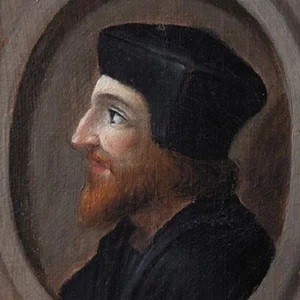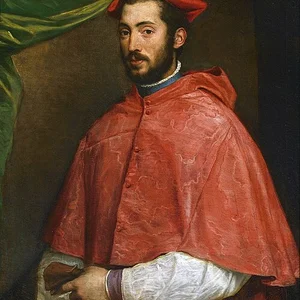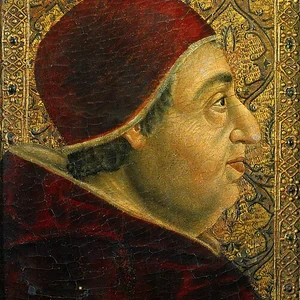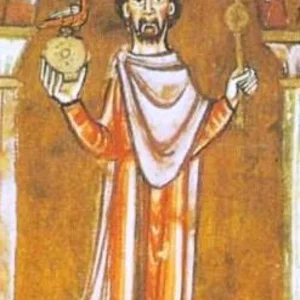

Henry IV (1050–1106) was Holy Roman Emperor from 1084 to 1105. He is best known for his power struggle with the papacy, particularly the Investiture Controversy, which pitted imperial authority against that of Pope Gregory VII.
Frequently asked questions
Key Facts
- 1050: Born in Goslar
- 1084: Crowned Holy Roman Emperor
- 1076–1085: Investiture Controversy against Pope Gregory VII, including the humiliation at Canossa (1077)
- 1122: Concordat of Worms ending the Investiture Controversy (signed after his death by his son)
- 1106: Forced abdication and death
Works & Achievements
Corpus of official documents (charters, letters, privileges) that bear witness to the administration of the Holy Roman Empire and imperial policy toward the papacy, including the famous letter 'Come down!' addressed to Gregory VII in 1076.
Henry IV had Speyer Cathedral — the dynastic necropolis of the Salian dynasty — enlarged and rebuilt into a monumental Romanesque edifice, thereby asserting the power and legitimacy of his lineage.
Henry IV convened a council at Brixen which elected Guibert of Ravenna as antipope under the name Clement III — an attempt to create an alternative papacy favourable to the empire in the conflict with Gregory VII.
Following his penance, Henry IV obtained the lifting of his excommunication by Gregory VII — a diplomatic act that, though presented as a symbolic defeat, allowed him to regain the support of the German princes.
Henry IV proclaimed a territorial peace (Landfriede) in 1103, aimed at limiting private warfare between lords and stabilising the kingdom — an early initiative to regulate feudal violence.
Anecdotes
In January 1077, Henry IV performed one of the most spectacular acts of penance in medieval history: he walked barefoot through the snow to the castle of Canossa, in Italy, dressed in a simple penitent's garb, to beg Pope Gregory VII to lift his excommunication. He waited three days in the cold before being received. This episode, known as the 'Walk to Canossa', has remained in collective memory as the symbol of a powerful king's submission to spiritual authority.
Despite his penance at Canossa, Henry IV did not abandon his struggle against the papacy. A few years later, he convened a council at Brixen in 1080 and had an antipope elected — Clement III — to challenge Gregory VII. He then marched on Rome and, in 1084, had this antipope crowned and was himself crowned emperor by him — a resounding act of defiance against the papacy.
Henry IV endured a particularly tragic end to his life: his own son, Henry V, turned against him with the support of German princes and the pope. In 1105, Henry IV was forced to abdicate in favor of his rebellious son at an assembly in Ingelheim. Humiliated and stripped of all power, he died the following year in Liège, in 1106, without having reconciled with his son.
Henry IV was excommunicated not once, but twice by the papacy. This fearsome sanction in the Middle Ages meant he was excluded from the Christian community: his subjects were theoretically released from their oaths of allegiance, which encouraged the princes to revolt against him. These excommunications perfectly illustrate the power of the spiritual weapon against temporal power.
After his death, Henry IV was not buried in consecrated ground, as he was still subject to ecclesiastical sanctions. His remains were temporarily placed in an unconsecrated chapel in Liège for five years, before his son Henry V obtained his posthumous rehabilitation and had the body transferred to Speyer Cathedral, the dynastic necropolis of the Salian emperors.
Primary Sources
That the pope alone can depose or reconcile bishops [...] That he alone can convene a general council [...] That he alone can depose emperors.
Henry, king not by usurpation but by the holy ordination of God, to Hildebrand, not pope but false monk [...] Come down, come down, you who are condemned for all ages.
The king presented himself at the gate of the castle, stripped of all royal insignia, barefoot and dressed in wool, and remained there for three days in penance, awaiting the goodwill of the Roman pontiff.
We declare Henry, king of the Germans [...] bound by the bonds of anathema, and we deprive him of the government of the entire kingdom of Germany and Italy.
He bore with admirable patience the sufferings inflicted upon him by his enemies, and never did he cease to seek peace with the Church, even when it rejected him.
Key Places
Fortress of Countess Matilda of Tuscany where Henry IV performed his penance in January 1077, waiting three days in the snow to obtain the lifting of his excommunication by Gregory VII.
City where Henry IV convened in 1076 the synod that attempted to depose Gregory VII, and where the Concordat of Worms was later signed in 1122, ending the Investiture Controversy.
Necropolis of the Salian emperors and one of the largest Romanesque cathedrals in Europe, built under the emperors of Henry IV's dynasty. Henry IV was ultimately buried there following posthumous rehabilitation.
Birthplace of Henry IV and favorite imperial residence of his father Henry III, endowed with an imperial palace (Kaiserpfalz) that was a center of power in the 11th century.
Capital of Christendom that Henry IV seized in 1084 after a long siege in order to install Antipope Clement III and have himself crowned emperor, openly defying papal authority.
City where Henry IV took refuge after his forced abdication in 1105 and where he died in 1106, abandoned by almost everyone, his remains lying for several years without burial in consecrated ground.
Typical Objects

The supreme insignia of imperial power, the crown was at the heart of the Investiture Controversy. Henry IV wore it at his coronation by antipope Clement III in 1084, a powerful symbolic act in his struggle against Gregory VII.

Symbols of lay investiture, these objects were handed by the emperor to bishops and abbots upon their appointment. It was precisely the right to bestow them that the pope disputed with Henry IV, triggering the Investiture Controversy.

At Canossa in 1077, Henry IV donned a simple wool penitent's robe and presented himself barefoot in the snow. This voluntary stripping of all royal insignia was a codified ritual act of submission and public humiliation.

An essential instrument of medieval governance, Henry IV's seal authenticated his diplomas and charters. After his forced abdication in 1105, his son Henry V seized it, depriving the former emperor of any means of exercising legitimate authority.

Official papal documents, notably bulls of excommunication, were sealed with a lead bull bearing the pontiff's effigy. Henry IV received two during his lifetime, acts that upended his reign.

An imperial relic that Holy Roman Emperors carried into battle as a sign of divine legitimacy. Henry IV used it to assert his legitimacy against his rivals, intertwining the sacred and the political.
School Curriculum
Vocabulary & Tags
Key Vocabulary
Daily Life
Morning
Henry IV began his days with the morning liturgical office, assisted by the chaplains of the imperial court. After Mass, he held council with his close advisors, bishops, and nobles to handle the affairs of the kingdom. Diplomatic audiences and the reading of letters received from princes and papal legates occupied a large part of the morning.
Afternoon
The afternoon was devoted to audiences, adjudicating disputes between lords, and dictating imperial charters and diplomas to the chancery scribes. During military campaigns, Henry IV oversaw army preparations, inspected troops, and consulted his knights. Frequent travels between imperial palaces (Goslar, Worms, Regensburg) also punctuated his daily life.
Evening
In the evening, the court gathered for the main meal, served in the great hall of the imperial palace. Musicians and jesters sometimes enlivened the banquets, but the atmosphere often remained tense due to ongoing political conflicts. Henry IV then withdrew for vespers and compline prayers before retiring for the night.
Food
The imperial table was richly supplied: game meats (venison, wild boar, wildfowl), fish for the fast days prescribed by the Church, white wheat bread, vegetables, cheeses, and Rhenish wines. Imported spices (pepper, cinnamon, ginger) were a sign of wealth and prestige. During periods of penance or excommunication, Henry IV could be forced to an austere diet of bread and water.
Clothing
Henry IV wore the insignia of his imperial dignity: a purple mantle trimmed with ermine, an embroidered silk tunic, hose, and fine leather boots. The imperial crown, scepter, and orb were carried during official ceremonies. At Canossa, he set all of this aside to don a simple penitent's woolen garment, barefoot in the snow — a striking contrast with his usual sartorial splendor.
Housing
Henry IV resided in the Kaiserpfalzen (itinerant imperial palaces) scattered throughout the Holy Roman Empire, notably at Goslar, Worms, and Regensburg. These massive stone buildings, with their great hall (aula regia) and palatine chapel, served simultaneously as residences, administrative centers, and symbols of imperial power. On campaign, he slept in tents erected for the court.
Historical Timeline
Period Vocabulary
Visual Style
Style enluminure romane du XIe siècle, avec des tons grenat, or impérial et bleu outremer sur parchemin, des figures hiératiques à l'influence byzantine et une iconographie impériale et pénitentielle.
Sound Ambience
Une atmosphère médiévale grave et solennelle, mêlant chants grégoriens, cloches de cathédrales romanes et bruits de la cour impériale germanique du XIe siècle.
Liens externes & ressources
Références
Œuvres
Lettres et diplômes impériaux d'Henri IV
1056-1105
Reconstruction et extension de la cathédrale de Spire
à partir de 1082
Concile de Brixen et élection de l'antipape Clément III
1080
Accord de Canossa (Concordat de Canossa)
1077
Politique de paix en Allemagne (Landfriede)
1103