Imaginary dialogue between Lambert de Hersfeld and Henri IV
by Charactorium · Henri IV (1553 — 1610) · Politics · 5 min read
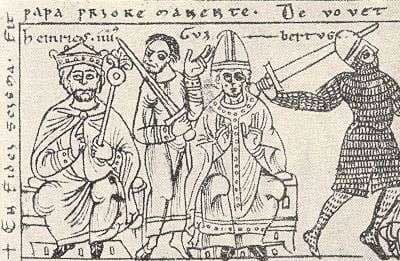
It is in Goslar, in the great hall of the imperial palace buffeted by the winter winds of 1085, that Lambert of Hersfeld meets Emperor Henry IV. A smell of wax and burnt wood lingers near the fireplace, while a scribe files the day's charters. The monk and chronicler has known this reign since its beginning; he has gathered, from the mouths of witnesses, the account of the penance in the snow. He comes this evening to press the sovereign to recount, in his own words, the choices that pitted him against Rome.
—Sire, I have recorded in my Annals what was reported to me of Canossa: three days barefoot in the snow. What did you feel, at that closed gate?
You who have gathered so many accounts, Lambert, you know how rumor magnifies the cold and thins the calculation. Yes, I laid down my insignia, donned the hairshirt, waited under the snow at the castle of Matilda of Tuscany, in that month of January 1077. But do not think I was merely a broken penitent. I needed Gregory to lift my excommunication, for my German princes threatened to elect another king if I remained cut off from the Church. To humble myself three days to take that pretext away from them was to pay a small price. I emerged from Canossa free of the anathema, and my adversaries deprived of their weapon. They saw only a king on his knees; I knew what I was reclaiming as I rose.
They saw only a king on his knees; I knew what I was reclaiming as I rose.
—You speak of calculation, but beneath the hairshirt, in that cold, was there nothing of a man who doubted his right?
The cold bites the body, Lambert, it does not judge the soul. I shivered as any pilgrim would shiver, and the hunger of fasting gnawed at my belly. But doubt my right? Never. I was made king by the holy anointing of God, not by the favor of a monk. What I begged to obtain was not forgiveness for a sovereign's fault, but the lifting of a sentence that released my subjects from their oath. The penitent and the king coexisted under the same woolen habit: one implored the priest, the other abdicated nothing of his crown. That is what chroniclers, you excepted perhaps, hardly distinguish.
The cold bites the body, it does not judge the soul.
—The year before Canossa, at Worms, you wrote terrible words to the pope. Will you allow me to recall them, Sire?
Recall them, Lambert, I do not deny them. In 1076, after this Hildebrand had published his Dictatus papae where he arrogated the right to depose emperors, I gathered my bishops in synod at Worms. I wrote to him as a king writes to a false monk who usurps the seat of Peter: that he descend. Understand my anger: he claimed that he alone appointed and deposed, that the power of kings was only a revocable loan. Yet the emperor holds his sword directly from God, not from the hand of the pontiff. My letter was not an outburst, but a doctrine: two powers, each sovereign in its order. Let the pope keep souls; let him leave to Caesar the earth.
Let the pope keep souls; let him leave to Caesar the earth.
—But this investiture of bishops by ring and staff, which Rome reproached you for, why did you cling to it so?
Because a bishop in my empire is not merely a shepherd of souls, Lambert: he holds fiefs, raises men, administers cities. If I lose the right to invest him with ring and staff, I lose the loyalty of half my lands to Rome. The Dictatus papae aimed at that, and Gregory knew it. To yield investiture would have been to hand over the framework of the Empire to a pontiff who believed himself above crowns. I defended not a whim, but the very structure of government that my father Henry III had bequeathed to me. A king who no longer chooses his bishops reigns only in appearance.
A king who no longer chooses his bishops reigns only in appearance.
—After Canossa, many believed you subdued. Yet at Brixen, in 1080, you struck a great blow. What was in your mind?
That an absolution wrung in the snow is not peace, Lambert. Gregory excommunicated me a second time, supported my rivals: I understood that he would stop only at my ruin. So I carried the war to his own ground. At the Council of Brixen, my bishops declared Hildebrand deposed and elected Guibert of Ravenna, who took the name Clement III. Then I marched on Rome, took it after a long siege, and in 1084 my antipope crowned me with the imperial crown in the very city of Peter. To him who claimed to make and unmake emperors, I responded by making and unmaking popes. It was returning to him, blow for blow, the weapon he had forged against me.
To him who claimed to make and unmake emperors, I responded by making and unmaking popes.
—When you received me here before, at Goslar, I saw the chancellery at work. How does one govern an empire always on the move?
You saw it with your own eyes, Lambert: one does not govern the Holy Empire seated on a fixed throne. I go from palace to palace — Goslar, Worms, Regensburg — and where I stop, the court, chancellery, and justice settle. In the morning, mass, then council with my bishops and nobles; in the afternoon, judgments and dictation of diplomas that my scribes seal with my seal. To reign is to show oneself, to settle lords' disputes, to appear strong enough that none dare rebel. In 1103, I proclaimed a territorial peace, a Landfriede, to curb those private wars that bleed the kingdom. An absent emperor is an emperor challenged: I learned that at my expense.
An absent emperor is an emperor challenged: I learned that at my expense.
—You also had an immense cathedral built at Speyer. Why so much stone for a necropolis, Sire?
Because stone speaks longer than charters, Lambert. From 1082, I had Speyer Cathedral enlarged and rebuilt, where the emperors of my lineage, the Salians, rest. When your legitimacy is contested, when antipopes and rebellious princes dispute your crown, you respond by raising an edifice that no one can deny: a vessel of Romanesque stone, the largest in Christendom, which tells the centuries that the Salians reigned by the will of God. My enemies could excommunicate me; they could not raze Speyer. There I built my most lasting defense, one that speaks when the king's voice has fallen silent.
Stone speaks longer than charters.
—Sire, I must ask you, even if the question is harsh: your own sons rose against you. How do you bear that wound?
You touch where no balm heals, Lambert. First Conrad, my eldest, whom the papacy turned against me; then Henry, whom I had designated to succeed me and who betrayed me in turn. An enemy who fights you, you understand; a son who despoils you, you never understand. They allied the princes, invoked the Church, made my old age their step to the throne. A father can forgive many offenses, but the child who raises his hand against his father's crown breaks something that neither consecration nor penance repairs. I fought popes without trembling; it is the face of my own blood that made me falter.
An enemy who fights you, you understand; a son who despoils you, you never understand.
—They say that at Ingelheim they forced you to abdicate, and that they even took back your seal. Is that true, Sire?
True, alas. My son and his allies lured me with promises, then at Ingelheim they wrung the abdication from me and seized my insignia — the crown, and that royal seal without which no charter is valid. Do you know what it is, Lambert, for an emperor to have his seal taken away? It is a voice without a mouth. I could still command: no one was any longer bound to obey, for my word could no longer be sealed. They had left me the title in humiliation and confiscated all the instruments of power. Stripped thus, I sought refuge at Liège, faithful among the few cities still mine. It is there that I feel the end approaching, still under the weight of the anathema.
Do you know what it is, for an emperor to have his seal taken away? It is a voice without a mouth.
—And if, after you, consecrated ground is refused you because of excommunication, what would you say, you who fought so much?
That men may keep my body far from the altar; they will not keep my soul far from God, who made me king. If I am left without burial in blessed ground, it will be Rome's final revenge on a sovereign who never bowed his back to her. But look, Lambert: I have endured two excommunications, the betrayal of my sons, the loss of my seal, and I have never ceased to seek peace with the Church without renouncing my right. Whether I am buried late, or elsewhere, or at Speyer one day among my kin, matters little in the end. I loved my crown more than my tranquility, and I do not ask posterity to absolve me — only to understand why I fought.
Men may keep my body far from the altar; they will not keep my soul far from God.
This imaginary interview was generated by artificial intelligence from sources documented in Henri IV's profile. It dramatises what the figure might have said based on what we know about them, but does not constitute attested historical testimony. For primary sources and factual documentation, refer to the full profile.