Kids interview Henri IV
by Charactorium · Henri IV (1553 — 1610) · Politics · 5 min read
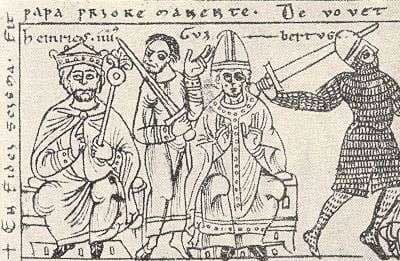
That morning, two young visitors on a school field trip push open the door of a great stone hall. An old emperor waits for them, his gaze tired but gentle. His name is Henry IV, and he has many battles to tell — especially those he fought without a sword.
—Is it true that you waited three days barefoot in the snow?
Yes, my child, it is quite true. It was January 1077, and the cold was terrible. Pope Gregory VII had excommunicated me — that means he had cast me out of the Church, so my princes could disobey me without shame. To obtain his forgiveness, I climbed up to the castle of Canossa, in the Italian mountains. I had left my cloak, my crown, my fine boots. I was barefoot, dressed in simple wool penitent's garb. And I waited at the gate. One day. Two days. Three days. Imagine a king shivering outside like a beggar, while everyone watched.
I waited three days barefoot for a man to deign to forgive me.
—What was it like, being so cold, when you were emperor?
You know, it wasn't the cold feet that hurt the most. It was the cold inside. Usually, I wore a purple cloak trimmed with ermine, a silk tunic, fine leather boots. And then, nothing. Just a coarse woolen cloth that scratched the skin, like a sack. That was what they called the penitent's garment. Imagine taking off everything that makes you someone important, and staying there, very small, under the eyes of others. That's what it was. The body trembled, but pride suffered much more.
The cold of the feet is nothing compared to the cold of humiliated pride.
—Why did you want to choose bishops yourself?
Good question, my child. In my time, bishops were not only men of the Church. They owned lands, castles, soldiers. A bishop was almost a prince. So I, the emperor, wanted to appoint them and hand them the ring and staff — that was the ceremony called investiture. Imagine giving someone the keys to a city: you want him to be loyal to you, right? But Pope Gregory VII said: no, these men belong to God, it is for me alone to choose them. And from that dispute all our war was born.
—Who was this Pope Gregory who bothered you so much?
Ah, Gregory VII! A man of iron, believe me. In 1075, he wrote a text in which he claimed that he, the pope, could do anything: depose bishops, and even depose emperors like me. Can you imagine that? A king dismissed with a snap of the fingers? So I answered him with an angry letter. I wrote to him: "Descend, descend", because I considered him a false monk, not a true pope. I was young and hot-headed. He was craftier. He excommunicated me, and suddenly my princes abandoned me. That is how I had to go crawling to Canossa.
—After Canossa, what did you do to respond to the pope?
Do you think I gave up? Never! Canossa had only allowed me to regain my strength. In 1080, I gathered my loyal bishops at Brixen, and we elected our own pope: Guibert of Ravenna, whom we called Clement III. They called him an antipope — a replacement pope, against the one in Rome. Then I marched on Rome with my army. In 1084, I took the city, and that antipope placed the imperial crown on my head. Do you see the audacity? The pope who had humiliated me, I answered by making another one.
They humiliated me on my knees; I rose again by having myself crowned emperor.
—A false pope really existed? How is that possible?
Yes, my child, that happened. When two sides disagreed, each could proclaim its own pope. The one that the other side considered illegitimate, they called an antipope. My Clement III, I thought he was perfectly valid! For me, it was Gregory who was the impostor. You see, in my time, the crown and the altar went together. The one who blessed you gave you the right to reign. So if the pope in Rome refused to bless me, well, I took another who was willing to do it. It wasn't a game: it was a battle to decide whether heaven or earth commanded the highest.
—Why did you build such a great cathedral at Speyer?
Ah, Speyer! That was my pride, and a permitted pride at that. From 1082 onward, I had that cathedral enlarged into an immense stone vessel, one of the largest in all the land. Why? Because it was the necropolis of my family, the Salians — the place where my imperial ancestors rested. By building so high, so solid, I told everyone: my lineage is legitimate, it comes from far back, it will endure. Imagine a mountain of pink stone visible from far across the plain. A church, yes, but also a message carved for the centuries: here reigns a true dynasty.
—Apart from quarreling with the pope, what was your job as king?
You know, people think a king only makes war. But my real job was to dispense justice and protect the weak. In my time, lords were constantly at war with each other, burning peasants' crops. So in 1103, I proclaimed what was called a Landfriede, a peace of the land: I forbade these private little wars. Every morning, I held council with my bishops and nobles; in the afternoon, I judged disputes and dictated my charters to scribes. Imagine a man always on the road, from palace to palace, trying to keep an armed people calm.
The true power of a king is not to make war, but to impose peace.
—Is it true that your own sons turned against you?
Yes... and that is the wound from which I never recovered. First my eldest son, Conrad, rebelled, supported by my enemies in Rome. And then, even worse, my second son, Henry V, the one to whom I wanted to leave everything. In 1105, he allied with the princes against me and forced me to abdicate — to renounce the throne — at an assembly in Ingelheim. Imagine the person you love most taking your crown and telling you: it's over. I had fought popes, armies, princes. But to be betrayed by your own child, that, no king prepares for.
I survived two popes and a thousand princes, but not the betrayal of my son.
—And after your death, what happened to your body?
That is a very sad story, my child. I died in 1106 in Liège, almost alone. And because I was still under the Church's sanctions, I could not be buried in consecrated ground. My remains stayed in a small unconsecrated chapel for five long years. Imagine: an emperor who wore the crown, and whose body waits, as if forgotten, for someone to accept it. It was finally my son Henry V — the very one who had betrayed me — who obtained my pardon and had me laid to rest in Speyer, near my ancestors. Peace, I found only after my death.
I had to wait five years, even dead, for someone to accept me in consecrated ground.
This imaginary interview was generated by artificial intelligence from sources documented in Henri IV's profile. It dramatises what the figure might have said based on what we know about them, but does not constitute attested historical testimony. For primary sources and factual documentation, refer to the full profile.