Imaginary dialogue between Takai Kozan and Hokusai
by Charactorium · Hokusai (1760 — 1849) · Visual Arts · 5 min read
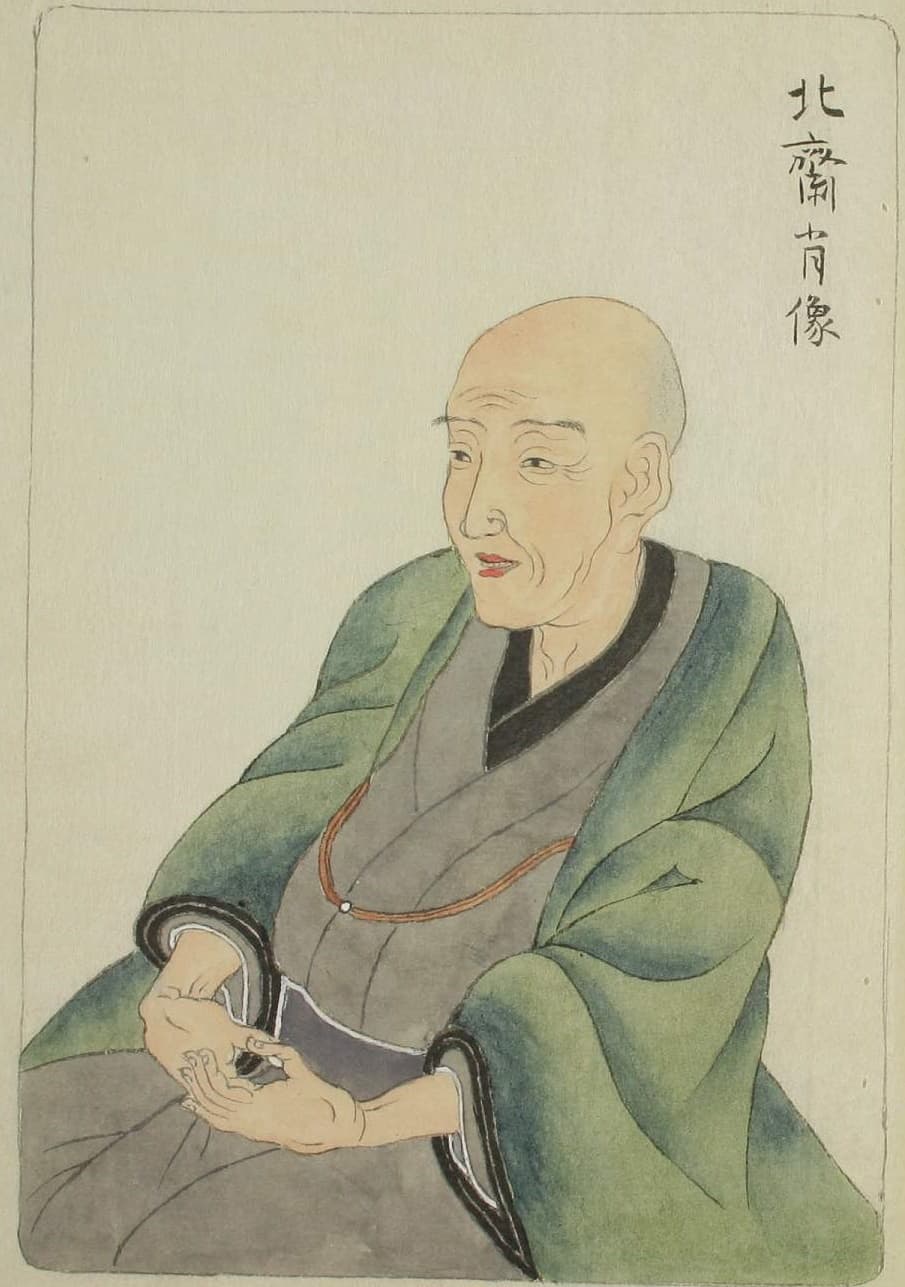
In a borrowed room of his home in Obuse, at the foot of the Shinano mountains, Takai Kozan comes to sit beside the old master in this autumn of 1843. The smell of sumi ink and ground pigments still lingers under the beams where the great Phoenix dries, destined for the ceiling of a festival float. Kozan has known Hokusai since he took him in, far from the tumult of Edo, and he comes today not to commission a work, but to hear the man behind the hand. Outside, a fine rain falls on the rice paddies; inside, the brush almost never stops.
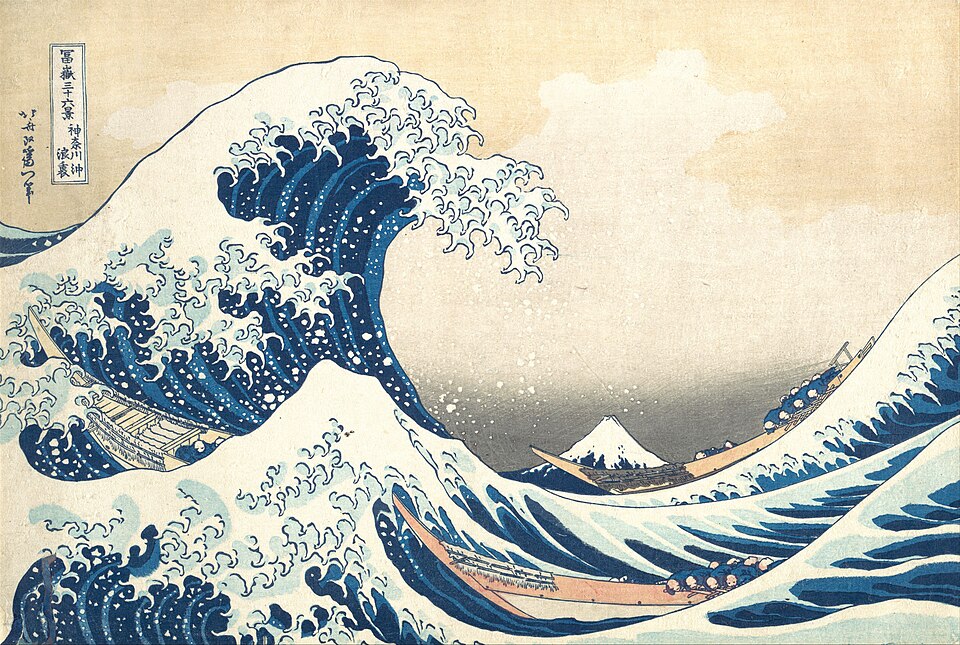
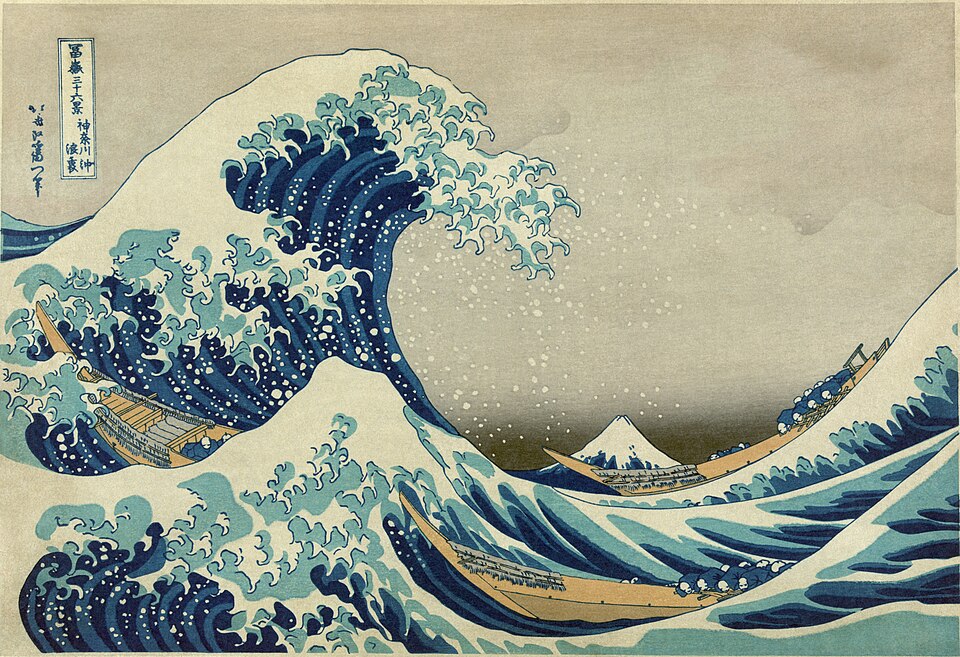
—Master, before coming to my home in Obuse, you had already given the world your Great Wave. What kept you so captivated by Mount Fuji?
Fuji, Kozan, is the only thing that does not move when everything else floats and falls apart. The boats pass, the fishermen struggle, the wave rises and falls — but the mountain remains, calm, behind the noise. In my Thirty-six Views, I wanted to capture it under every light, every season, from every angle from which a man can look at it. And when that new blue from the continent, bero-ai, came into my hands, I could finally paint the water and sky as I saw them in dreams. That wave of Sagami Bay, I redrew it a hundred times before it agreed to curve just as it should.
Fuji is the only thing that does not move when everything else floats and falls apart.
—That deep blue you use, it resembles nothing the ancients did. Where does such a taste for it come from?
That blue is brought from very far away, by the merchants who reach Nagasaki. Our old indigo blues paled, turned gray over time; this one holds, it sings, it does not fade. As soon as I could get it, I wanted it everywhere: in the hollow of the wave, in the shadow of the waves, in the sky above Fuji. The publishers were pleased, because the public demanded this new color. But I saw it not as a fashion: I finally saw the means to render the sea as it is, moving and alive. A pigment can change a whole lifetime of work, believe me.
A pigment can change a whole lifetime of work, believe me.
—You once told me you call yourself Gakyo Rojin Manji, the old man mad about painting. Why that name, at your age?
Because it is the truth, Kozan, and truth no longer frightens me. I have changed my name more than thirty times, each time I felt a new man born at the tip of my brush. But this one sums it all up: I am an old man driven mad by drawing, and I will not recover. Since I was six, I have had the mania of tracing the form of things. At fifty, I had already published an infinity of drawings, but everything I produced before age seventy is worthless. It is only now, under your roof, that I am beginning to understand the bones of birds and the life of grasses.
I am an old man driven mad by drawing, and I will not recover.
—You are over eighty, you paint my ceiling from morning to night. What remains for you to conquer, my friend?
Everything, Kozan, everything remains. Do not laugh: the older I get, the more I see how clumsy my line still is. Each passing year, my dots resemble life a little more, my lines begin to breathe. If heaven granted me ten more years — no, five years — I could become a true painter. That is what I repeat to myself while painting your Phoenix. People think old Hokusai has given everything; they do not know he has only been preparing. You who see me work every day here, you know well that I am never satisfied with what yesterday left me.
If heaven granted me five more years, I could become a true painter.
—They still tell, even in our provinces, of your demonstration before the shogun in 1804. Is the legend true?
It is true, and even beyond the truth. I was challenged to paint large, before the crowd and before authority. I had an immense sheet spread on the ground, as wide as a courtyard, then I dipped a broom into a bucket of ink and traced the entire body of a Buddhist monk. When you take a broom, you must think with your whole arm, your whole back, not just with your fingers. Then I took a fine brush for the eyes, the mouth, the folds of the robe. People laughed, then fell silent. I have always loved those days when painting becomes a spectacle, when the gesture counts as much as the image that remains.
When you take a broom, you must think with your whole arm, your whole back.
—Here, you paint festival float ceilings, canvases as tall as doors. Has this taste for large formats always inhabited you?
Always, Kozan. The small format of prints, I served it all my life because it fed my table and spoke to the people of Edo. But something in me wanted surfaces where the hand could run without ever hitting an edge. Your festival gave me that: a Phoenix spreading its wings above heads, so that villagers look up and feel small beneath it. Up there, no engraver, no publisher between the idea and the wood: my hand touches the material directly. At my age, climbing the scaffold is not easy, but what joy to paint a creature larger than oneself.
What joy, at my age, to paint a creature larger than oneself.
—At my house, your work corner overflows with papers in just a few weeks. Is it true that in Edo you moved constantly?
More than ninety times, Kozan, and I am not making it up! I do not know how to tidy: sheets pile up, brushes roll, sketches rise until there is no room left for the futon. So rather than clean — a waste of time that drawing demands — I folded my things and changed lodgings. Sometimes I also had to flee an overly pressing creditor, for money never stayed long in my hands. Here, under your roof, you see: I am already starting to invade the room again. Forgive me this disorder; it is the only luxury of a man who has never had any other possession than his work.
I do not know how to tidy; so I changed lodgings rather than sweep.
—You always wear that same ink-stained kimono, you barely eat. Has comfort never tempted you, my old friend?
Comfort? It would have stolen hours from me, Kozan. This indigo kimono, that of the artisans of Honjo where I was born, suits me: pigment stains are my true decorations. I rise before dawn, I grind my ink slowly — that is where my thoughts settle — then I draw until night by oil lamp. A bowl of rice, a miso soup, green tea, that is enough to keep a man standing before his paper. Other painters dream of fine houses; I, as long as I have a sheet, a brush, and a little light, am richer than a lord. The true hunger, mine, is that of the right form.
As long as I have a sheet, a brush, and a little light, I am richer than a lord.
—We live in a closed country, where foreigners hardly enter. How, despite sakoku, did you learn ways from the West?
The country is closed, Kozan, but never completely blind. Through the window of Nagasaki, a few Dutch engravings reach us, and I studied their lines eagerly. After the death of my master Shunshō, I wanted to see everything, try everything, including that way Westerners have of digging depth, making distances recede to a point. I blended this with our own line, without ever ceasing to be Japanese. And their pigments, like my blue, cross the sea when images cannot. An imprisoned artist must have an eye that travels even when his feet do not leave the island.
An imprisoned artist must have an eye that travels even when his feet do not leave the island.
—Those sketches you collect in volumes, your Manga, what did you intend for them when you started publishing?
First for my students, Kozan. A master cannot sit beside every apprentice in the country; so I wanted to put into books everything a hand should know how to trace: the human body in all its gestures, animals, plants, waves, rain, demons, and laughers. Thousands of drawings, as ideas came, without scholarly order. They have been copied widely, far beyond what I imagined. But you see, in filling these pages, I was instructing myself as much as others: each sketch taught me to see better. A full sketchbook is a silent master that never flatters you.
In filling these pages, I was instructing myself as much as my students.
This imaginary interview was generated by artificial intelligence from sources documented in Hokusai's profile. It dramatises what the figure might have said based on what we know about them, but does not constitute attested historical testimony. For primary sources and factual documentation, refer to the full profile.