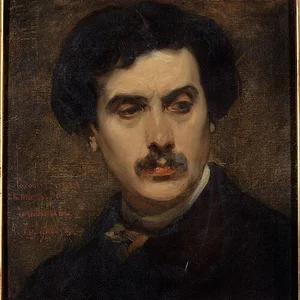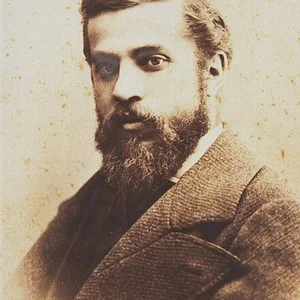

Alfred Boucher (1850-1934) was a French sculptor born in Nogent-sur-Seine, a student of Paul Dubois and Auguste Dumont. He is particularly known for encouraging young artists, including Camille Claudel, and for founding La Ruche, an artists' colony in Paris.
Alfred Boucher(1850 — 1934)
Alfred Boucher
France
7 min read
Frequently asked questions
Key Facts
- Born on September 24, 1850 in Nogent-sur-Seine, into a family of craftsmen
- Won the Salon prize in 1875 with his sculpture 'Tu porteras'
- Discovered and encouraged Camille Claudel, recommending her to Auguste Rodin around 1883
- Founded La Ruche in 1902, an artists' colony in Paris that would welcome Chagall, Léger, and Modigliani
- Died on March 13, 1934 in Nogent-sur-Seine, the town that dedicated a museum to him
Works & Achievements
A sculptural group that earned Boucher the Grand Prix de Rome in 1875. This academic work, with its expressive figures, demonstrates his early mastery of anatomy and narrative composition.
One of his most celebrated works, depicting runners crossing the finish line. This marble group, acclaimed at the 1887 Salon, reflects Boucher's taste for dynamic subjects rooted in human effort.
A Symbolist sculpture representing a female figure in motion that evokes the flight of a bird, characteristic of Boucher's style blending realistic rigor with Symbolist poetry.
A public commission attesting to the official recognition Boucher enjoyed under the Third Republic, which regularly entrusted him with commemorative monuments for French cities.
Boucher's most significant social and architectural achievement: the creation of this artists' colony in Paris stands as his most enduring legacy to art history, having welcomed the pioneers of the School of Paris.
Anecdotes
In 1882, Alfred Boucher noticed an eighteen-year-old girl named Camille Claudel who was learning sculpture in Paris. Convinced of her exceptional talent, he lent her his studio on the boulevard du Montparnasse before leaving for Rome, and warmly recommended her to Auguste Rodin. This generous gesture would change the destiny of the future great French sculptor.
After the 1900 Universal Exhibition, Boucher purchased the Rotonde des Vins — a circular pavilion built for the event — and had it dismantled and rebuilt at the passage de Dantzig in the 15th arrondissement of Paris. In doing so, he created La Ruche in 1902, an artists' colony where rents were deliberately kept low to allow artists of modest means to work in good conditions.
The son of a wheelwright from Nogent-sur-Seine, Alfred Boucher was born into a modest, working-class family. Thanks to the determination of his local teachers, who had spotted his talent, he moved to Paris and enrolled at the Beaux-Arts. In 1875, he won the prestigious Prix de Rome with his sculpted group 'Tu marceras', which propelled him into the ranks of the recognized sculptors of his era.
At La Ruche, Boucher welcomed foreign artists from across Europe, often penniless: Marc Chagall, Fernand Léger, Amedeo Modigliani, and Alexander Archipenko all found refuge and studios there. Boucher acted as a generous patron, sometimes reducing or waiving rents for the most destitute artists, contributing to the birth of what would come to be known as the École de Paris.
Primary Sources
Au but, marble group presented by Mr. Alfred Boucher, sculptor, student of Messrs. Paul Dubois and A. Dumont.
I am sending you Mademoiselle Claudel, whose talent has greatly impressed me. I recommend her most warmly and am convinced that she will give you every satisfaction.
Mr. Alfred Boucher, sculptor, declares that he is dedicating the buildings acquired and reconstructed at passage de Dantzig to the creation of studios intended for artists without means, rented at modest rates.
Alfred Boucher, born in Nogent-sur-Seine on 26 September 1850, student of Dubois and Dumont, Grand Prix de Rome 1875. Founder of La Ruche, an artists' community in Paris.
Key Places
Alfred Boucher's birthplace, where he was born in 1850 and died in 1934. The town is home to the Musée Camille Claudel, which pays tribute to the two sculptors connected by this Champagne town.
Boucher trained here under Paul Dubois and Auguste Dumont, two respected academic sculptors, acquiring the technical mastery that would earn him the Grand Prix de Rome.
The official residence of Prix de Rome laureates, Boucher stayed here from 1875 and refined his art through close study of masterworks from Antiquity and the Italian Renaissance.
An artists' colony founded by Boucher in 1902, built from remnants of the 1900 Universal Exhibition. It welcomed Chagall, Léger, Modigliani, and dozens of artists from the School of Paris.
A museum dedicated to Alfred Boucher's work, housing numerous sculptures and maquettes that trace the evolution of his style throughout his career.
Typical Objects

Essential tools for shaping clay and plaster, which Alfred Boucher used daily in his studio to create his maquettes before transposing them into marble or bronze.

An indispensable intermediate step in the sculptural creation process, the maquette allowed Boucher to prepare his large compositions before the definitive work in the noble material.

The stone sculptor's instruments, they symbolize the precision and physical strength demanded by the monumental sculpture that Boucher practiced throughout his career.

Boucher would draw his compositions before sculpting them; these sketchbooks bear witness to his rigorous method, inherited from the academic teaching of the École des Beaux-Arts.

As the benevolent manager of the artists' colony, Boucher kept the rent accounts — often very low or waived altogether — in order to support artists without financial means.

An award granted by the French State to the finest students of the Beaux-Arts, this medal — won in 1875 — opened the doors of the Villa Medici in Rome to Boucher and brought him official recognition.
School Curriculum
Vocabulary & Tags
Key Vocabulary
Daily Life
Morning
Alfred Boucher rose early to make the most of natural light, which was essential for sculpture work. He began his day in his Parisian studio, modeling clay or working marble directly, often assisted by students tasked with preparing materials and maintaining the space.
Afternoon
In the afternoons, Boucher received his students or went to La Ruche to handle the administrative affairs of the artists' community. He visited the residents' studios, offering advice and encouragement, and sometimes negotiated rent reductions for those in the greatest need.
Evening
Evenings were often devoted to the social life of the Parisian art world: exhibition openings, dinners at collectors' homes, gatherings at the École des Beaux-Arts. Boucher moved in circles where sculptors, painters, and intellectuals of the Third Republic rubbed shoulders.
Food
Like many French people of the Belle Époque, Boucher ate simply: bread, vegetables, meat, and cheese made up his everyday fare. His Champenois roots gave him a pronounced taste for regional produce, and the midday meal remained the main occasion for conviviality throughout the day.
Clothing
In his studio, Boucher wore the sculptor's grey or white smock, protecting his clothes from plaster and marble dust. For official occasions — the Salon, prize-giving ceremonies, receptions — he wore the dark bourgeois suit expected of recognized artists in the Third Republic.
Housing
In Paris, Boucher had a large studio with living quarters, essential for accommodating marble blocks and models. He always maintained ties with Nogent-sur-Seine, where he returned later in life, and managing La Ruche meant juggling between his workspace and the artists' colony at the passage de Dantzig.
Historical Timeline
Period Vocabulary
Liens externes & ressources
Références
Œuvres
Tu marceras
1875
Monument à Camille Desmoulins, Guise
1889
Fondation de La Ruche
1902