Imaginary interview with Hokusai
by Charactorium · Hokusai (1760 — 1849) · Visual Arts · 6 min read
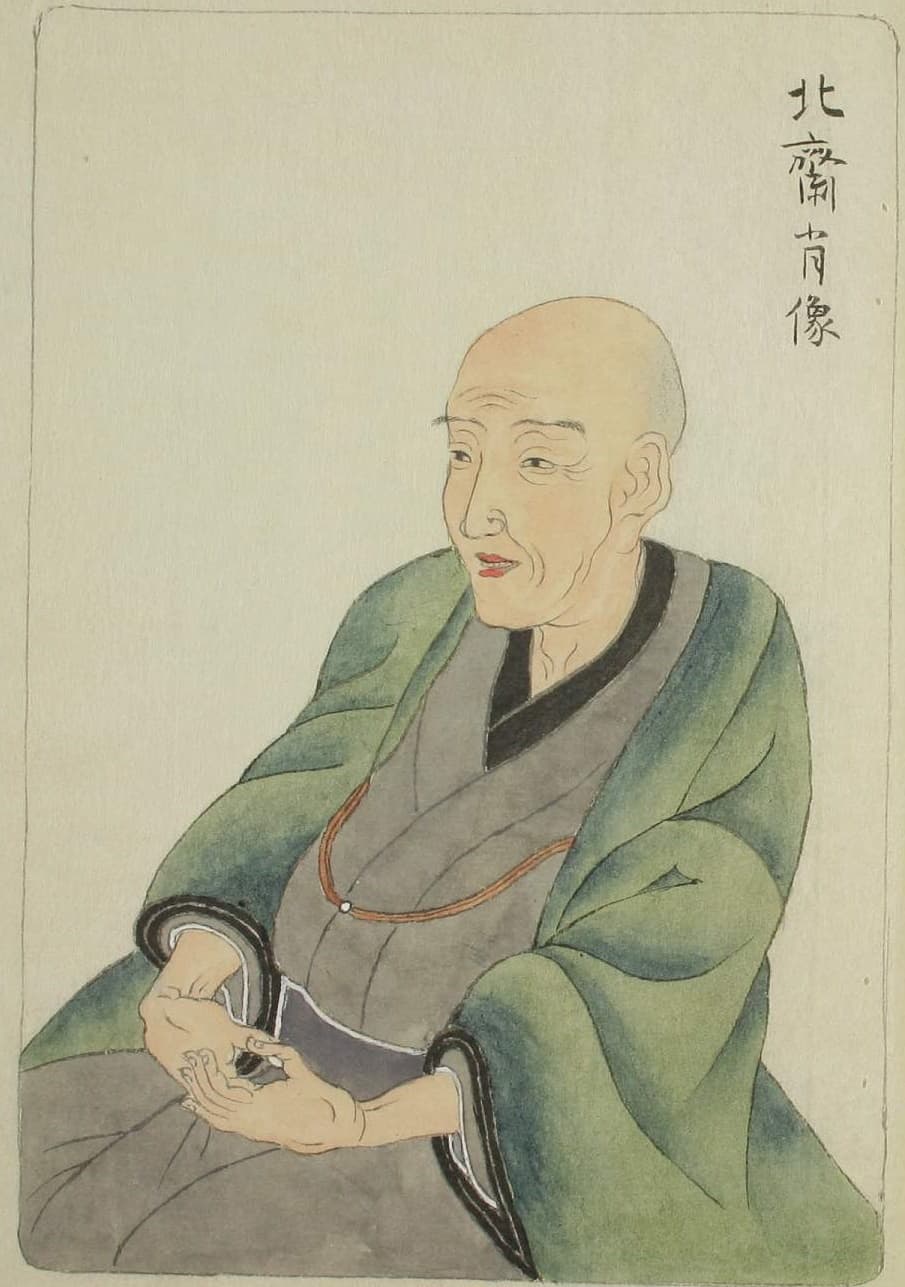
Autumn 1834. In a cluttered shop in the Honjo district of Edo, the old man sits on the floor, a brush between his fingers, sheets of washi piled up to his knees. He has just signed with a new name—yet another—and between strokes, agrees to talk about the wave, Mount Fuji, and the art he swears he has not yet learned.
—How was this wave of Kanagawa born, the one the whole world seems to recognize today?
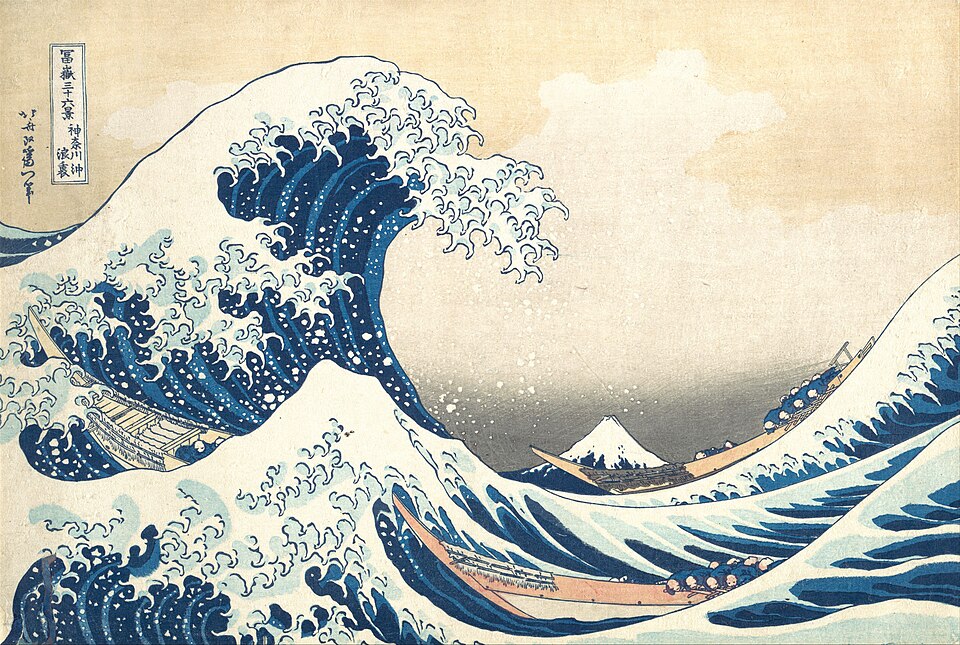
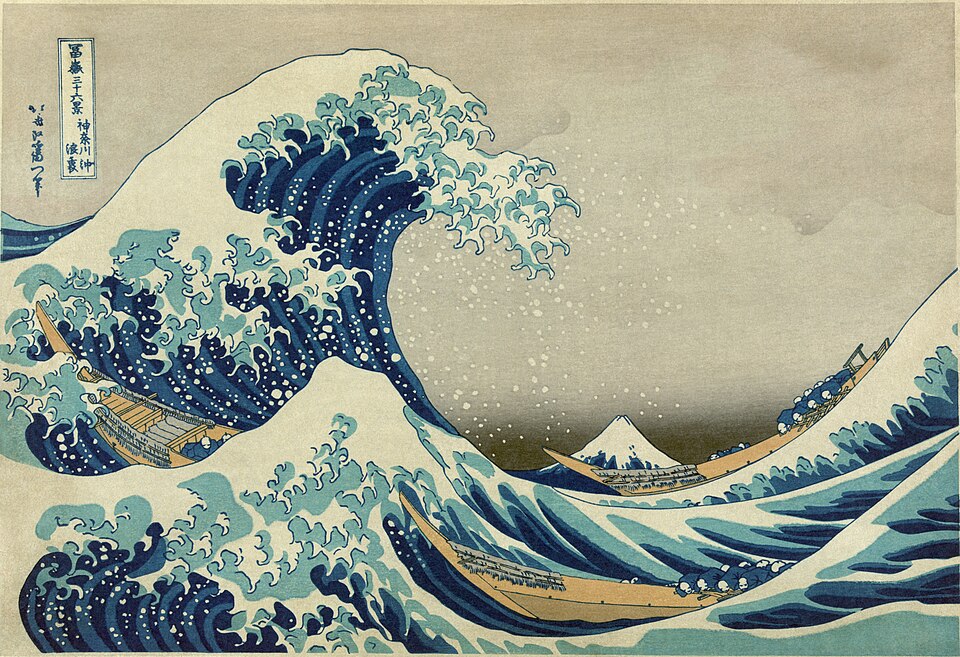
It was born from a blue that was not from here. This bero-ai from China and beyond the seas, this Prussian blue that arrived in our shops around the twentieth year of my century, had a depth our indigos never reached. I wanted to see how far it could bite into the paper. So I raised a wave above the fishing boats, those swift oshiokuri-bune that carry fish to Edo across Sagami Bay, and I placed Mount Fuji very small, in the distance, motionless under the foam. People think I painted the sea. I painted the instant when water turns into a claw. Without this new pigment, my wave would be but a ripple.
People think I painted the sea. I painted the instant when water turns into a claw.
—Why did you depict Fuji thirty-six times, and then even more?
Because a mountain cannot be grasped in a single glance. I began my Thirty-six Views of Mount Fuji and the public demanded so many that we had to carve ten more—forty-six in the end, each a trick to capture the same peak. Fuji behind a cooper hooping his barrel, Fuji seen from a bridge, Fuji reddened by dawn. What I sought was not the mountain but permanence: it remains while people bustle, fish, die, and begin again. The ancients called meisho those famous places that one paints and visits. Fuji, however, is not a place. It is a lesson in patience set upon the horizon.
—Yet you painted Fuji without, they say, ever having climbed it. Did that not bother you?
Climbing a mountain means having your nose in the rocks and your breath short; you see nothing. I contemplated it from afar, from the alleys of Honjo or the dusty roads, and it was this distance that made it sacred. In my One Hundred Views of Mount Fuji, those three books in black, gray, and white that I consider the peak of all I have done, I looked at it a thousand times without ever laying a hand on its snow. The word gokoku, the protection of the country, is attached to this peak as to a guardian. You do not take a guardian in your arms. You lift your eyes to him, and you work under his gaze.
You do not take a guardian in your arms. You lift your eyes to him.
—One often forgets that a print is not the work of a single man. What would you say about those who work with you?
My hand draws, but it is not enough. I trace the composition on thin paper, then a carver transfers each line onto the hangi, that cherry wood block which must be carved with a patience I do not have. Then the printer applies the colors block by block—as many blocks as shades—to produce a nishiki-e, a brocade picture. And behind it all, the publisher, a Nishimuraya, who advances the money and senses what will please. An artist alone is just a man who scribbles. The print, however, is a whole craft, a chain where my vanity must yield before the carver's blade.
—You once enjoyed the shogun's favor. Do you remember that demonstration before his court?
The year 1804. I was challenged to paint on a grand scale before the crowd. I had an immense sheet spread on the floor, dipped a broom into sumi ink as one plunges an oar into water, and in one stroke traced the body of a Buddhist monk, then added the facial details with a fine brush. People laughed, then fell silent. This is what is not understood enough: an artist must know how to amuse the people as well as flatter the powerful. Later, when the shogunate forbade painting actors and courtesans, many lamented. As for me, I already had my mountains and waves. They had pushed me toward landscape without knowing it.
An artist must know how to amuse the people as well as flatter the powerful.
—They say you changed houses dozens of times. Why this constantly shifting life?
Because it is simpler to flee disorder than to tidy it. My studios filled with papers up to the ceiling, with brushes, ink sticks, sketches I never threw away—and when I could no longer set down my straw cushion, I left. More than ninety dwellings in my life, in Edo, sometimes to escape a creditor, often out of sheer weariness of the mess. I wore my indigo cotton kimono stained with ink, rarely changed clothes, washed little. Let no one be mistaken: it was not negligence. It was stinginess. Every minute given to the household broom was a minute stolen from the fude, my brush.
It is simpler to flee disorder than to tidy it.
—What was a typical day like in those cluttered studios?
I rose before dawn. The first gesture was not to eat, but to rub the sumi ink stick on the wet stone—that slow motion gathered my spirit better than any prayer. Then I drew, sitting on the floor, surrounded by my washi sheets. In the afternoon, I corrected the blocks my carvers brought me, or I went out into the streets of Edo to watch a porter, a vendor, a dog scratching itself—all of that flowed into my sketchbooks. In the evening, by oil lamp, I continued. They say I talked to my drawings. That is possible. I asked them to yield their form, for they know it before I do.
—You speak of those sketchbooks. What did you aim to gather in your Manga?
Everything. Absolutely everything the eye encounters. My Hokusai Manga is not stories, but thousands of sketches—bodies wrestling, frogs, waves, grimaces, bridges, rain. The word manga for me means 'drawings following the idea,' lines that follow thought without a leash. I first conceived it as a manual for my students, whom I taught without a word, by drawing before them. Then the volumes multiplied, fifteen in all. A man who wants to paint must first learn to look at a thousand things. My sketchbooks are that gaze, laid flat on mulberry paper.
—You bore more than thirty names in your life. What were you seeking by changing your signature like that?
A name is a skin. When I had shed, when I felt I had crossed a threshold, I had to change it. I left the studio of Katsukawa Shunsho at the same time as the name he had given me. At seventy-five, I took that of Gakyo Rojin Manji—the old madman of painting. Mad, yes, for what other word for a man who draws from morning to night without ever believing he has arrived? Each name marked a new beginning, an admission that the previous one no longer sufficed. People think names are meant to be recognized. Mine served to keep me from becoming fixed.
A name is a skin. When I had shed, I had to change it.
—You are old, famous, admired. Why do you still say you have not learned to paint?
Because it is the truth, and it burns me more than it saddens me. I wrote to my publisher what I think without mincing words: since the age of six I have had the mania of drawing the form of things, but everything I produced before seventy is worthless. Worthless. It is toward one hundred that I will perhaps touch the quick of beings. People think this is an old man's coquetry. They are mistaken. Each year, my line understands a little better how a bird stays in the air, how water curls back. If I stopped content, I would already be dead. The day I think I know, throw away my brushes.
The day I think I know, throw away my brushes.
—Imagine you are granted a few more years. What would you do with them?
Ah, if heaven would grant me ten more years—no, just five—I would finally become a true painter. It is not death that frightens me, but leaving with my hand still clumsy. Recently, in Obuse, at the home of my host Takai Kozan, I painted a phoenix on the ceiling of a festival float, at over eighty years old, and my fingers held the brush more firmly than ever. You see: each work teaches me the next. Grant me this reprieve and I swear the next stroke will be better. It is the only prayer I know.
This imaginary interview was generated by artificial intelligence from sources documented in Hokusai's profile. It dramatises what the figure might have said based on what we know about them, but does not constitute attested historical testimony. For primary sources and factual documentation, refer to the full profile.