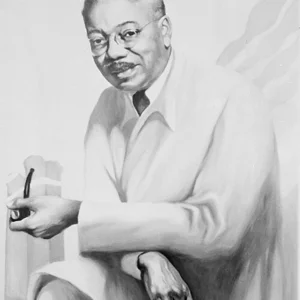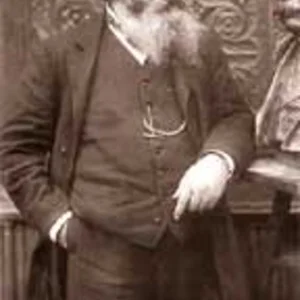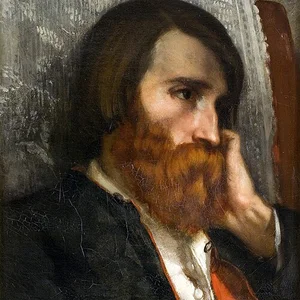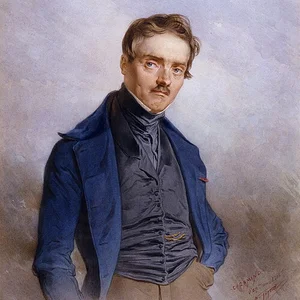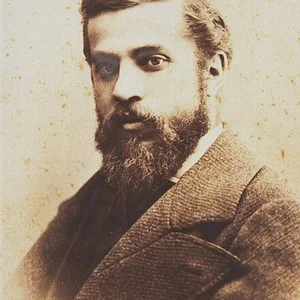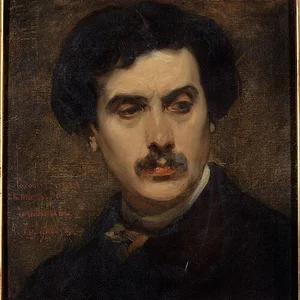

French sculptor and painter (1831-1900), winner of the Grand Prix de Rome in 1859. A leading figure of academic sculpture under the Second Empire and the Third Republic, he created iconic works blending realism with the classical ideal.
Alexandre Falguière(1831 — 1900)
Alexandre Falguière
France
8 min read
Frequently asked questions
Key Facts
- Born in Toulouse in 1831
- Won the Grand Prix de Rome in 1859 with “Tarcisius, Christian Martyr”
- Exhibited “The Winner of the Cockfight” at the 1864 Salon, a landmark work that established his reputation
- Appointed professor at the École des Beaux-Arts in Paris in 1882, where he trained numerous artists
- Died in Paris in 1900; a Paris Métro station (line 12) bears his name
Works & Achievements
Marble group depicting a triumphant young boy brandishing his rooster; submitted as a pensioner's work from Rome, it won the medal of honor at the 1864 Salon and was acquired by Napoleon III, bringing Falguière to wide public attention.
Marble statue of the young Roman martyr carrying the Holy Sacrament; at once realistic and deeply moving, the work confirms Falguière's mastery in rendering youthful flesh and inner emotion.
A lion standing watch over a soldier's tomb, commemorating French resistance during the Franco-Prussian War of 1870; one of the first major patriotic commissions of the Third Republic entrusted to Falguière.
Marble portrait of his friend and contemporary Rodin, testament to a strong artistic friendship; Rodin returned the favour by sculpting Falguière's likeness in turn, shortly before the latter's death.
An expansive sculptural ensemble erected at the Place du Carrousel in Paris in memory of the republican orator Léon Gambetta; a landmark state commission of the Third Republic, it established Falguière at the pinnacle of official monumental sculpture.
Marble statue depicting the goddess of the hunt in motion; characteristic of Falguière's elegant academicism, combining mythological reference with the natural dynamism of the female form.
A monument gifted by France to the United States and unveiled in front of the White House, celebrating the Marquis de Lafayette and Franco-American friendship; one of the few works by Falguière to cross the Atlantic.
Anecdotes
During his stay at the Villa Medici in Rome (1860–1865), Falguière sculpted a marble group depicting a victorious young boy brandishing his fighting cock. Sent to Paris as an “envoi de pensionnaire,” the work triumphed at the Salon of 1864, winning the medal of honor and was purchased by Napoleon III himself — a dazzling consecration for an artist still training abroad.
Falguière was also a painter who exhibited regularly at the Salon, which was rare among the great sculptors of his time. He displayed canvases on mythological subjects and nudes with as much ease as his marbles, baffling critics who could no longer decide whether to classify him as a sculptor or a painter.
A close friend of Auguste Rodin, Falguière made a celebrated bust of his colleague and benevolent rival; Rodin returned the compliment shortly before Falguière's death in 1900. These two giants of late-nineteenth-century French sculpture thus paid each other mutual tribute — a testament to a rare artistic friendship in a milieu often marked by jealousy.
The monument to Gambetta, inaugurated in 1884 on the Place du Carrousel in Paris, unleashed political passions. Some republicans felt the depiction of the statesman was too allegorical and bore little resemblance to the man; Falguière had to navigate the conflicting demands of his patrons and his own artistic vision — a perilous exercise well known to every official sculptor of the Third Republic.
Appointed professor at the École des Beaux-Arts de Paris in 1882, Falguière trained generations of sculptors in a studio renowned for its rigor and warmth. He instilled in his students a taste for rigorous draughtsmanship while encouraging them to observe nature directly, refusing to let them content themselves with copying the Antique without understanding the life of forms.
Primary Sources
No. 2814 — Falguière (Jean-Alexandre-Joseph), student of M. Jouffroy, born in Toulouse. — Winner of the cockfight, marble group.
M. Falguière's group is distinguished by the truthfulness of its movement, the fineness of its modeling, and the naturalness of its expression; it honors the teaching of the French School in Rome.
M. Falguière reveals in this group a sense of realism and a natural grace that recall the masters of the Italian Renaissance while remaining deeply French in feeling.
Falguière combines in one person the sculptor of genius and the delicate painter, the patient teacher and the artist ever attentive to living beauty rather than to cold imitation of the Antique.
The fellows of the 1860 intake report that Falguière worked every morning from dawn, first sketching from life in the gardens before joining his sculpture studio.
Key Places
Falguière's birthplace, where he was born on September 7, 1831, and completed his first artistic studies at the local École des Beaux-Arts before moving to Paris.
The institution where Falguière trained under the sculptor Jouffroy, won the Prix de Rome in 1859, and later taught as a professor of sculpture from 1882 until his death.
The home of the Académie de France in Rome, where Falguière resided from 1860 to 1865 thanks to the Prix de Rome; it was here that he conceived the "Winner of the Cockfight" that made him famous.
The annual exhibition venue where Falguière presented his major works and received his official honors, from his triumph in 1864 through his final submissions before 1900.
The site where Falguière's monument to Gambetta was erected and inaugurated in 1884, an emblematic republican commission; the monument was demolished in 1954, though some elements have been preserved.
Typical Objects

Falguière's everyday tools for carving marble, available in dozens of different sizes partly inherited from his master Jouffroy. The mallet struck the chisel to knock precise chips from the stone.

His preferred raw material imported from Italy, whose fine grain he had learned to appreciate during his Roman stay; the largest blocks weighed several tons and required a crane to be hoisted into the studio.

An indispensable preparatory step before any major work: Falguière would first model the composition in clay to study volumes and poses before transposing it into marble or plaster intended for casting.

He drew constantly, from life or from memory, accumulating anatomical studies and compositional sketches; this sketchbook nourished both his sculptures and his paintings exhibited at the Salon.

The working garment of every sculptor, cut from a fabric resistant to marble dust and plaster splashes; it was often so dusty that one could guess, from its color, which material the artist was working with.

The obligatory intermediary between clay modeling and bronze casting: the founder received a plaster model made in the sculptor's studio, then proceeded with casting using the lost-wax technique.

The highest distinction, received in 1864; in the 19th century, these medals were not merely honorary — they concretely opened the doors to major state commissions and guaranteed an artist's reputation.
School Curriculum
Vocabulary & Tags
Key Vocabulary
Daily Life
Morning
Falguière would arrive at his vast Montparnasse studio at dawn to make the most of the natural light essential for modelling. He often began with drawing sessions or touch-ups on a clay maquette before attacking the marble alongside his craftsmen.
Afternoon
Afternoons were devoted to posing sessions with live models, to directing his assistants as they roughed out blocks under his supervision, and to receiving visits from patrons or students who came to see the progress of works in progress.
Evening
In the evenings, Falguière frequented the artistic circles and brasseries of the Latin Quarter and the Beaux-Arts district, maintaining an active social life with painters, sculptors, and critics. These gatherings wove the networks that won him his major official commissions.
Food
Having remained attached to the cuisine of the South-West despite decades in Paris, he favoured hearty dishes that kept him going through the long, physically demanding studio days. Meals shared with fellow artists in the brasseries were also an opportunity for passionate debates on art and politics.
Clothing
In the studio he wore a white or grey linen smock, inevitably smeared with plaster and marble dust. For vernissages, sessions at the Institut, and official ceremonies, he wore a dark bourgeois suit adorned with his decorations, including the Légion d'honneur.
Housing
He lived and worked in a large studio-apartment in the Montparnasse district, a space typical of academic sculptors who needed substantial volume to work on monumental pieces. The studio was cluttered with plaster casts, sketches, and stone blocks at various stages of carving.
Historical Timeline
Period Vocabulary
Liens externes & ressources
Références
Œuvres
Vainqueur au combat de coqs
1864
Tarcisius, martyr chrétien
1868
Monument funéraire au Père-Lachaise (Le Lion)
1875
Buste d'Auguste Rodin
1882
Diane chasseresse
1887
Statue équestre de Lafayette, Washington D.C.
1891