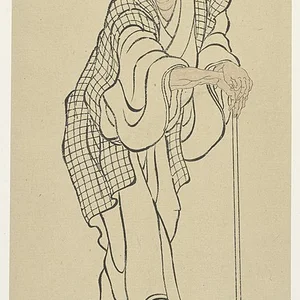

Japanese painter, draftsman, and printmaker of the Edo period (1760–1849), master of ukiyo-e woodblock printing, celebrated for his series *Thirty-six Views of Mount Fuji*. His work had a major influence on European Impressionist and Post-Impressionist artists.
Frequently asked questions
Key Facts
- Katsushika Hokusai naît à Edo (Tokyo) en 1760 et se forme très jeune à la gravure sur bois dans l'atelier d'un maître de l'ukiyo-e
- Il change plus de trente fois de nom au cours de sa vie, témoignant de ses évolutions artistiques et spirituelles constantes
- Entre 1830 et 1832, il publie sa série des Trente-six vues du mont Fuji, dont La Grande Vague de Kanagawa, qui deviendra l'une des images les plus reproduites au monde
- Il couvre plus de 360 volumes illustrés dans ses Manga (1814-1878), encyclopédie visuelle du Japon qui influencera profondément les artistes européens du XIXe siècle
- Il continue de peindre jusqu'à sa mort en 1849 à l'âge de 88 ans, déclarant vouloir vivre cent ans pour atteindre la perfection artistique
Works & Achievements
The world's most famous woodblock print, from the series Thirty-six Views of Mount Fuji. It depicts a gigantic wave threatening fishing boats with Fuji in the background, symbolizing the power of nature against human fragility.
A series of 46 prints (initially 36, with 10 added due to success) exploring Fuji from various locations and situations. It marks the pinnacle of landscape in Japanese printmaking and introduced Prussian blue on a massive scale.
Fifteen volumes of encyclopedic sketches covering the human body, animals, plants, and natural phenomena. This drawing manual would influence European artists, particularly the Impressionists.
A trilogy of illustrated books in black, grey, and white, considered by Hokusai himself to be the pinnacle of his art. The diversity of viewpoints and mastery of line are exceptional throughout.
A provocative and dreamlike print from the collection Kinoe no Komatsu, depicting a female diver surrounded by octopuses. It is considered one of the first erotic representations of this kind in Japanese art.
From the series A Tour of Waterfalls in the Provinces, this print shows tiny pilgrims before a monumental waterfall. It illustrates Hokusai's mastery in depicting the movement of water.
A monumental painting executed on the ceiling of a festival float in Obuse, one of Hokusai's last major works at age 84. It bears witness to a creative energy that remained intact into extreme old age.
Anecdotes
Hokusai changed his name more than thirty times throughout his life, a common practice among Japanese artists to mark a new creative stage. His final pseudonym, 'Gakyo Rojin Manji' (the old man mad about painting), which he adopted at 75, perfectly captures his obsessive and passionate temperament.
At 88, just weeks before his death, Hokusai is said to have declared: 'If heaven would grant me ten more years — no, five years — I could become a true painter.' He worked until the very end of his life, refusing to stop despite his advanced age and frailty.
Hokusai moved more than 90 times throughout his life in Edo (Tokyo), often out of superstition or to escape creditors. It is said he never cleaned his studios and simply preferred to move whenever they became too cluttered with papers and brushes.
In 1804, during a public demonstration commissioned by the shogun, Hokusai painted an enormous portrait of a Buddhist monk on a sheet of paper laid flat on the ground, using a broom dipped in ink. He then added a few fine-brush details to astonish the crowd.
Primary Sources
A collection of nearly 4,000 drawings published between 1814 and 1878, featuring studies of human bodies, animals, landscapes, and scenes of daily Japanese life, originally conceived as a teaching manual for his students.
A three-volume work in which Hokusai depicts Fuji in all its forms, seasons, and perspectives, illustrating his quest for absolute mastery of line and composition.
Hokusai describes his artistic approach: 'From the age of six, I had a mania for drawing the form of objects. By fifty, I had published an infinity of drawings, but everything I produced before the age of seventy is not worth counting.'
Hokusai presents his series as an exploration of Fuji's permanence in contrast to the fleeting nature of human activity, weaving together grand landscapes and scenes of everyday work.
Key Places
Hokusai's birthplace and home, a working-class neighborhood populated by craftsmen, merchants, and actors. It was in this bustling city that he developed his work over more than seven decades.
Hokusai's obsessive subject, a sacred symbol of Japan that he depicted in hundreds of different forms across his most famous series. He may never have climbed it, but contemplated it from afar throughout his life.
The presumed setting of the scene depicted in The Great Wave off Kanagawa, with Mount Fuji visible in the background. The boats are fast fishing vessels (oshiokuri-bune) transporting fish to Edo.
The town where Hokusai stayed on several occasions between 1842 and 1844, hosted by his patron Takai Kozan. There he painted festival float ceilings and monumental canvases now preserved in the Hokusai Museum in Obuse.
Museum opened in 2016 in the Sumida ward, not far from the places where Hokusai lived in Edo. It holds more than 1,500 original works and traces the full span of his career.
Typical Objects

Essential support for ukiyo-e printmaking, carved by specialist craftsmen. Hokusai would draw the composition on thin paper, then carvers would transfer it onto the wood block before printing.

Hokusai's primary tool, which he wielded with exceptional virtuosity to trace his dynamic lines. He owned brushes of every size, from the finest for detail work to the broadest for flat areas of color.

Black China ink prepared by rubbing a solid ink stick on a damp stone, used for preparatory drawings and monochrome prints. Its density and fluidity vary depending on dilution.

A sheet of washi paper printed by layering multiple wood blocks inked in different colors, a technique mastered in the 18th century and brought to its peak by Hokusai.

An everyday object of the Edo period, frequently depicted in genre prints. Hokusai himself is sometimes described as a tobacco smoker, a habit widespread among the artisan classes of Edo.

Traditional Japanese handmade paper crafted from mulberry fibers, both strong and absorbent. Hokusai used it for his preparatory drawings as well as his sketchbooks (manga).

A lacquered wood or ceramic container holding the mineral and plant-based pigments used for painting and printing: Prussian blue (introduced to Japan around 1820), vermilion red, ochre yellow, green.
School Curriculum
Vocabulary & Tags
Key Vocabulary
Daily Life
Morning
Hokusai rose early, often at dawn, and immediately began drawing before even having his meal. He prepared his sumi ink by slowly grinding the ink stick on a wet stone, a meditative gesture that helped him focus. He worked seated on the floor on a straw cushion, surrounded by sheets of washi paper, brushes of all sizes, and works in progress.
Afternoon
The afternoon was devoted to more elaborate work: compositions for woodblock prints, corrections to the carved blocks made by his craftsmen, or responses to commissions from publishers such as Tsutaya Juzaburo. He sometimes received students whom he taught by drawing directly in front of them, without verbal explanation. He would also wander the streets of Edo to observe passersby, vendors, and artisans — all sources of motifs for his sketchbooks.
Evening
In the evening, Hokusai ate frugally and often continued drawing by the light of an oil lamp, surrounded by his thousands of accumulated sheets. He was known for never tidying his studio, letting papers pile up to the ceiling. According to those close to him, he would sometimes murmur to his drawings as if speaking to them, asking them to reveal their form.
Food
Hokusai lived simply and ate in the manner of Edo's common classes: white rice, miso soup, pickled vegetables, tofu, and dried fish. He drank green tea throughout the day, brewed in a small cast-iron teapot he always kept within reach. Little interested in gastronomy, he viewed meals as a simple necessity to keep working.
Clothing
Hokusai wore the indigo blue cotton kimono typical of Edo craftsmen, often stained with ink and pigments. In winter, he added a padded haori (short jacket) on top. He was known for neglecting his appearance, rarely changing his clothes and sometimes refusing to wash, preferring to devote all his time and energy to drawing.
Housing
Hokusai moved more than 90 times in his life, always occupying small, modest lodgings in the working-class neighborhoods of Edo. His studios were invariably overrun with papers, brushes, and printing materials, with barely enough room to sleep on a futon rolled up in a corner. Unlike prosperous artists, he never owned a large house or a permanent studio.
Historical Timeline
Period Vocabulary
Visual Style
Style ukiyo-e caractérisé par des contours noirs affirmés, des aplats colorés francs, le bleu de Prusse dominant, et une composition dynamique où la nature écrase les silhouettes humaines.
Sound Ambience
Ambiance sonore d'un atelier d'estampe à Edo : outils de gravure, froissement du papier washi, rumeur de la ville marchande et cloches de temple au loin.
Liens externes & ressources
Références
Œuvres
La Grande Vague de Kanagawa (神奈川沖浪裏)
vers 1831
Trente-six vues du mont Fuji (富嶽三十六景)
1830-1832
Hokusai Manga (北斎漫画)
1814-1878
Cent vues du mont Fuji (富嶽百景)
1834-1835
Le Rêve de la femme du pêcheur (蛸と海女)
1814
Cascade d'Amida (阿弥陀ヶ滝)
vers 1833