Imaginary interview with Hypatia of Alexandria
by Charactorium · Hypatia of Alexandria (vers 355/370 — 415) · Sciences · Philosophy · 6 min read
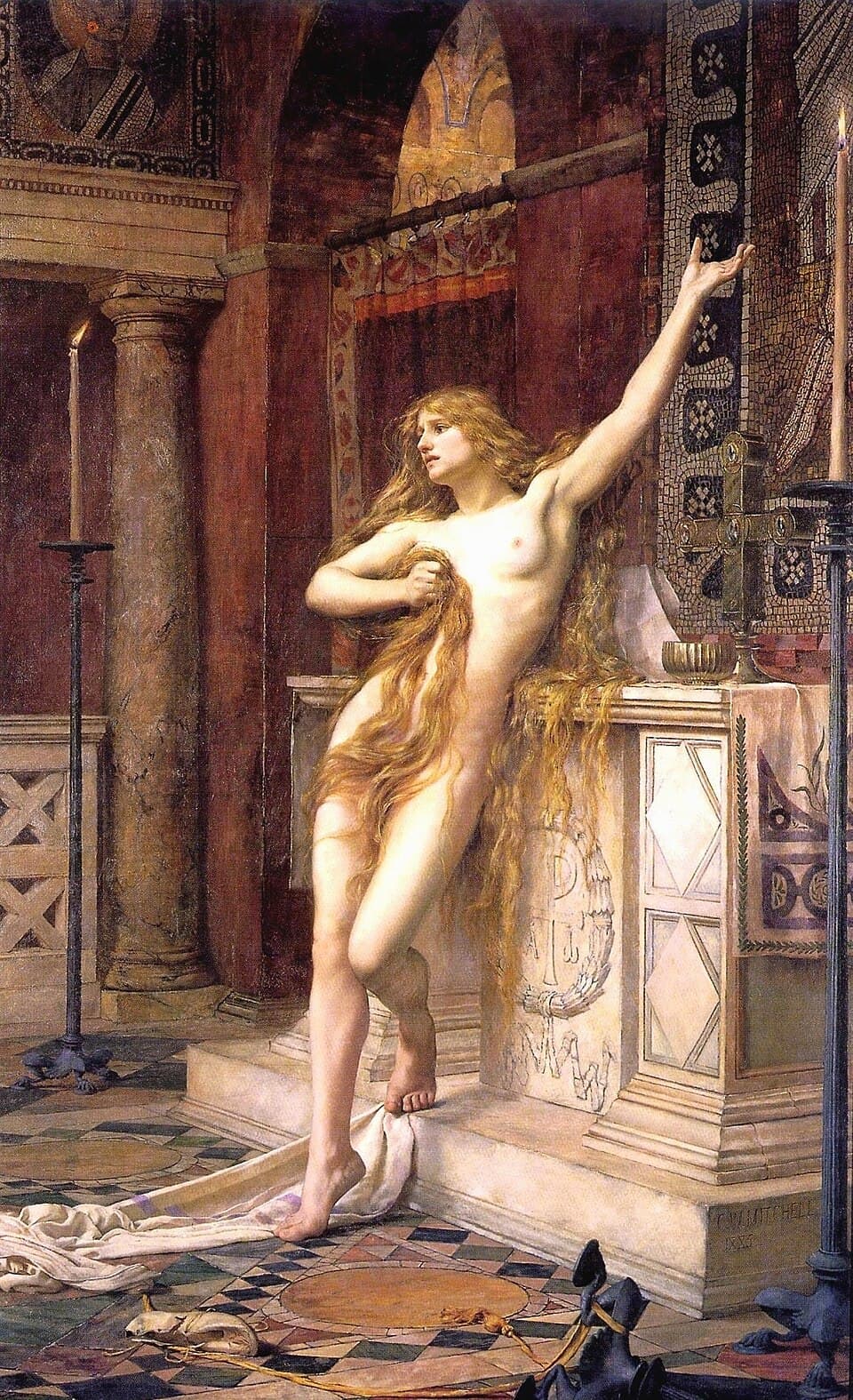
Alexandria, an afternoon in the early 5th century. In the courtyard of a large peristyle house, between an armillary sphere and unrolled papyrus scrolls, a woman clad in the rough philosopher's cloak receives us. Hypatia, daughter of Theon, has just finished her lesson; she agrees to speak of her books, her instruments, and a city that is seething.
—You are said to have spent years revising the treatises of the Ancients. What exactly did you bring to a text like Diophantus's Arithmetica?
My father Theon taught me that an ancient text is not a monument to be worshipped, but a road to be maintained. The Arithmetica of Diophantus was admirable and obscure, full of shortcuts the author thought obvious but which led my students astray. So I annotated it, unfolding the silent steps, adding problems where the proof jumped too quickly. I did the same for the Conics of Apollonius — those curves born from a cone sliced by a plane: ellipse, parabola, hyperbola. Sometimes I am asked if I was creating. I would answer that to transmit is already to create: a theorem no one can read anymore is a dead theorem. On my papyrus, I wrote not for glory, but so that a young man from Cyrene, ten years later, would understand at once what had cost me nights.
To transmit is already to create: a theorem no one can read anymore is a dead theorem.
—Do you remember being aware that you were the first woman to comment on these great texts?
Awareness of being "the first" is a vanity that philosophy taught me to flee. But I was not ignorant of what was whispered in the streets: that a woman held the calamus over Ptolemy's Almagest alongside her father was astonishing. For that great astronomical treatise, I worked on certain parts of Book III, where one measures the Sun's motion. I felt neither rare nor a prodigy; I felt in my place, in the Mouseion where Theon taught, surrounded by spheres and scrolls. If people were astonished, it is because astonishment reveals habit, not nature. An intellect has no sex, any more than a number has a homeland. I let the gossips marvel and returned to my calculation tables.
—Among your correspondents, Synesius asked you for instruments. What exactly did he request?
Synesius wrote to me from Cyrene with an affection that still moves me. In one of his letters, he addressed me thus — "to my mistress in philosophy, my mother, my sister, my teacher, and everything that bears an honorable name" — then begged me: "send me an astrolabe of the best workmanship." The astrolabe, you see, is not a scholar's toy: it is the sky made portable, a bronze disk on which one reads the height of the stars and the hour of the night. I had one prepared for him, carefully engraved, because a poorly calibrated instrument lies more surely than an ignorant person. Measuring the sky demands the same probity as reading Plato: one cheats neither with the stars nor with the truth.
—Beyond the astrolabe, how did you come to be interested in other measuring instruments?
Philosophy ascends toward the Ideas, but the hand must know how to descend to matter. I described to Synesius the construction of a hydrometer, that graduated tube which one plunges into a liquid to weigh its density at a glance. This may seem humble next to the Conics, but I never despised the humble: whoever can measure water and wine already understands that the world obeys number. In my house in Alexandria, between the papyrus scrolls and the armillary sphere, these objects lived side by side. My students read a silent lesson there: the geometer who disdains his tools is like the pilot who scorns the oar. Theory and craftsmanship are the two legs of the same walk.
—Your classes are said to have gathered pagans and Christians. How did you keep this house open to all?
I taught Plato and Plotinus to anyone who wished to listen, without asking anyone before which altar they knelt. Neoplatonism seeks the One, that principle above all — and one does not rise toward the One by sorting souls according to their rites. In my audience, a future Christian bishop sat next to the son of a priest of the old gods; together they untangled a demonstration and forgot, for the time of a theorem, what separated them in the street. That was, in my eyes, the true office of the master: to offer a ground where reason alone commands. I wore the tribon, the philosopher's cloak, precisely because it belongs to no sect. Geometry, like wisdom, belongs to no Church.
Geometry, like wisdom, belongs to no Church.
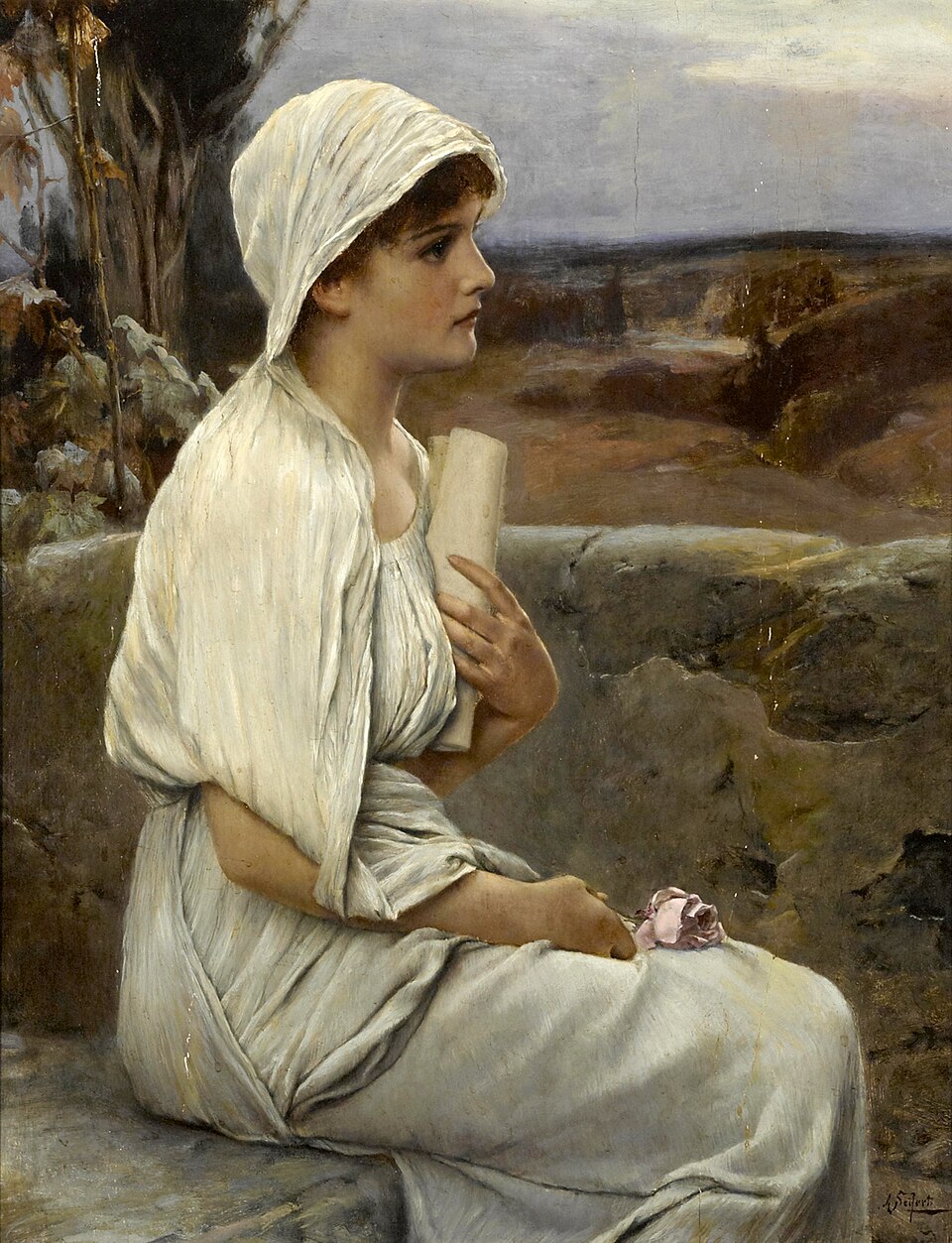
—How did you feel seeing your students go forth across the Mediterranean?
A quiet pride, and a little melancholy. My students came from everywhere — from Cyrene, from Constantinople — and left to carry elsewhere what we had pondered together. Synesius was one of them: having become a bishop, he never stopped calling me his mistress in philosophy, and his correspondence remains, I believe, the most faithful witness of my school. Teaching is a strange seed: one does not know where the wind will carry it. Some of my disciples govern Churches, others provinces. I did not give them a doctrine to recite, but a way of seeking — and that way travels better than any scroll. A school has no walls; it has roads.
—Why did you insist on wearing that coarse woolen cloak, the tribon, in the streets of such a wealthy city?
The tribon is nothing but a cloak of rough wool, without dye or embroidery — and that is precisely why I loved it. In an Alexandria where people were judged by the purple of their tunic, this garment said without a word: here is someone who has broken with luxury. I wore it as the men of my calling did, for the philosopher dresses neither as woman nor as man, but as a seeker of truth. My table followed the same rule: bread, olives, fruit, wine heavily diluted with water. A body too pampered weighs down the soul that would ascend to the stars. Walking through the city clad in this wool was already teaching, even before opening my mouth.
—It is said that one of your admirers received a memorable lesson from you. What happened?
Damascius likes to tell this story, and I let it circulate, for it says something true. A young man had fallen in love with me — not with my intellect, but with my face. Rather than long speeches on temperance, I showed him a cloth soiled by the body, and made him understand that it was this, this poor matter, that he desired, and not the Beautiful itself. The Beautiful, you see, is not touched with hands: one ascends to it through the soul, as Plato teaches. I did not despise that boy; I wanted to turn his eyes from the reflection toward the source. Philosophy is not made to adorn the passions, but to guide them — firmly, sometimes harshly — toward what truly deserves to be loved.
—You are close to Prefect Orestes, while Bishop Cyril is rising in power. How do you experience this rivalry?
Since Cyril became bishop in 412, the city has been tearing itself apart. He and Prefect Orestes, my friend, contend for authority over Alexandria like two contrary winds on the same ship. I go to see Orestes, sometimes by chariot through the city, and we talk of governing with measure. That is enough to fuel rumors: they say I prevent him from reconciling with the Church, that my philosophy bewitches him. Yet I meddle in no temple intrigue. But in a city where schism rumbles, a free woman who advises power becomes a convenient target. The parabalani, those henchmen said to be charged with caring for the sick, are beginning to enforce a law other than that of reason.
—As a child, you saw the Serapeum fall. What does the current climate of your city inspire in you?
I was a child when, in 391, a mob brought down the Serapeum, that temple which bore a part of the world's memory. Irreplaceable things were destroyed there in the name of a faith that thought itself in a hurry. Since then, I have learned to recognize that wind: it blows when men prefer certainty to inquiry. The schism that stirs Alexandria is another gust of it. I continue to teach Plato in broad daylight, to measure the sky with the astrolabe, to discuss with whoever knocks at my door — that is my only response. If one day I am reproached for having sought the truth without lowering my head, I will live with it. A lamp does not apologize for lighting those whom the darkness suits.
A lamp does not apologize for lighting those whom the darkness suits.
Read further
This imaginary interview was generated by artificial intelligence from sources documented in Hypatia of Alexandria's profile. It dramatises what the figure might have said based on what we know about them, but does not constitute attested historical testimony. For primary sources and factual documentation, refer to the full profile.