

Greek mathematician, astronomer, and philosopher of the 4th–5th centuries, she taught in Alexandria and advanced the sciences of antiquity. An iconic figure of female scholarship, she was murdered in 415 during religious unrest.
Hypatia of Alexandria(vers 355/370 — 415)
Hypatia of Alexandria
Empire romain, Égypte antique
6 min read
Frequently asked questions
Key Facts
- Taught mathematics and astronomy at the Neoplatonic school of Alexandria in the 4th century
- Commentator on the works of Euclid and Ptolemy, contributing to the transmission of mathematical knowledge
- Inventor or improver of the astrolabe, an astronomical measuring instrument
- Murdered by a mob in 415 during conflicts between Christians and pagans in Alexandria
- Symbol of ancient science and the intellectual equality of women
Works & Achievements
Revision and annotation of Diophantus of Alexandria's treatise on algebra. This work contributed to the transmission of this foundational text of ancient mathematics.
Pedagogical edition of the treatise on conic sections, making these advanced geometries accessible to students at her school.
Work carried out in collaboration with her father Theon on Ptolemy's great astronomical treatise. Hypatia is identified as the author of certain parts of Book III of the commentary.
Technical text transmitted through correspondence with Synesius, describing the construction of astronomical instruments, attesting to her practical knowledge of astronomy.
Public lectures on Plato and Plotinus, open to all regardless of their religion. Her teaching shaped a generation of Mediterranean intellectuals, several of whom went on to become Christian bishops.
Anecdotes
Hypatia taught philosophy and mathematics to students who came from across the Mediterranean world, including high-ranking Christians. Her student Synesius of Cyrene, who became a bishop, wrote her admiring letters that have survived to this day, bearing witness to a deep respect and an intellectual friendship that crossed religious boundaries.
According to the account of Damascius, when an admirer had fallen in love with her, Hypatia allegedly presented him with a soiled cloth, saying: 'This is what you love, young man, and not the Beautiful.' This anecdote, whether true or legendary, illustrates how her contemporaries perceived her mastery of the passions and her total devotion to philosophy.
Hypatia was the first woman known with certainty to have commented on the great mathematical texts of Antiquity. She worked on the Conics of Apollonius and on Ptolemy's Almagest, making these works more accessible to her students through revised and annotated editions.
In 415 of the Common Era, Hypatia was murdered by a mob of fanatical Christians in the streets of Alexandria. Dragged from her chariot, she was hauled to a church, mutilated, and burned. This tragic event deeply affected her contemporaries and symbolizes for historians the rise of religious intolerance in late Antiquity.
Primary Sources
To my mistress in philosophy, my mother, my sister, my teacher and everything that bears an honorable name... send me an astrolabe of the finest craftsmanship.
Hypatia, daughter of Theon the mathematician of Alexandria, herself a philosopher and very well known, surpassed her father in learning. She took the lead of the school of Plato and Plotinus, and expounded to all who wished to hear her the principles of philosophy.
There was a woman at Alexandria named Hypatia, daughter of the philosopher Theon, who had made such attainments in literature and science as to far surpass all the philosophers of her own time.
The whole city loved and venerated her in an extraordinary way, but the leaders of the Church harbored a deep envy of her, for she often conversed with Orestes, and this caused a scandal in the ecclesiastical community.
Key Places
Hypatia's birthplace and the city where she lived and taught. A major intellectual center of the ancient world, it housed the famous library and renowned schools of philosophy.
Intellectual institution where Alexandrian scholars taught. Theon, Hypatia's father, was affiliated with it, and it was in this environment that she received her education.
The hometown of Synesius, one of Hypatia's most important disciples. Their correspondence between Alexandria and Cyrene is a major testimony to her teaching.
Capital of the Eastern Roman Empire. Synesius traveled there to defend his province and maintained a correspondence with Hypatia, who remained in Alexandria.
Typical Objects
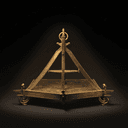
Astronomical instrument used to measure the altitude of celestial bodies. Hypatia built them for her students, as evidenced by a letter from Synesius asking her to construct one.

Instrument for measuring the density of liquids. Hypatia described its construction in a letter to Synesius, demonstrating her interest in practical scientific instruments.

Writing medium used in Alexandria. Hypatia recorded her mathematical and astronomical commentaries on papyrus, the standard material of Alexandrian scholars.

A coarse woolen cloak, the distinctive mark of ancient philosophers. Hypatia wore it publicly, thereby asserting her identity as a philosopher in the streets of Alexandria.

A model representing the movements of celestial bodies, used in astronomical teaching. Hypatia used it to explain the theories of Ptolemy to her students.

A reusable writing surface for calculations. Hypatia's students used it to note down mathematical demonstrations during lessons.
School Curriculum
Vocabulary & Tags
Key Vocabulary
Tags
Mouvement
Daily Life
Morning
Hypatia rose early, before dawn, to observe the stars and record their positions. She devoted the first hours of the day to reading and annotating mathematical texts on papyrus scrolls in her personal library.
Afternoon
In the afternoon, she held her lectures in a public space or in her home, welcoming students of all backgrounds and beliefs. She would sometimes travel by chariot through the city to meet dignitaries such as the prefect Orestes, her close friend.
Evening
In the evenings, Hypatia attended philosophical banquets where Plato, Plotinus, and astronomy were discussed. She also corresponded by letter with her students scattered across the Empire, such as Synesius in Cyrene.
Food
As a Neoplatonist philosopher, Hypatia likely practiced a dietary restraint close to vegetarianism, a value held within that philosophical tradition. Her diet was that of Alexandria's upper classes: wheat bread, olives, salted fish, vegetables, Mediterranean fruits, and wine diluted with water.
Clothing
Hypatia wore the tribon, the coarse woolen cloak of philosophers, a symbol of her intellectual vocation and her disdain for luxury. This garment, identical to that worn by male philosophers, granted her an immediately recognizable intellectual authority in the streets of Alexandria.
Housing
Hypatia likely lived in a large Alexandrian peristyle house, with an inner courtyard, a library, and a teaching room. Her family home, inherited from her father Theon, was a place of learning where astronomical instruments, papyrus scrolls, and calculation tablets coexisted.
Historical Timeline
Period Vocabulary
Visual Style
Esthétique de l'Alexandrie de l'Antiquité tardive : architecture hellénistique monumentale, instruments scientifiques en bronze, lumière méditerranéenne chaude et portraits réalistes de style romano-égyptien.
Sound Ambience
Ambiance sonore d'Alexandrie au tournant du Ve siècle : port actif, ville cosmopolite mêlant grec, copte et latin, école philosophique animée de discussions savantes.
Liens externes & ressources
Références
Œuvres
Commentaire sur l'Arithmétique de Diophante
v. 400
Commentaire sur les Coniques d'Apollonios
v. 400
Commentaire sur l'Almageste de Ptolémée (avec Théon)
v. 390-400
Description de la construction d'un astrolabe
v. 400-410
Enseignement oral de la philosophie néoplatonicienne
v. 395-415
See also
Related Characters
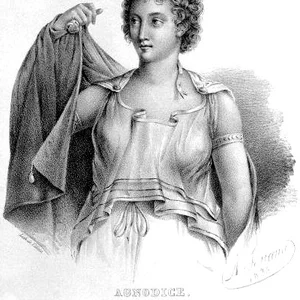
Agnodice
400 av. J.-C. — 360 av. J.-C.
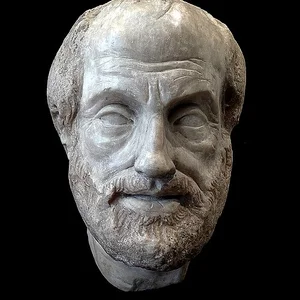
Aristotle
460 av. J.-C. — 401 av. J.-C.

Philostratus of Athens
300 — ?
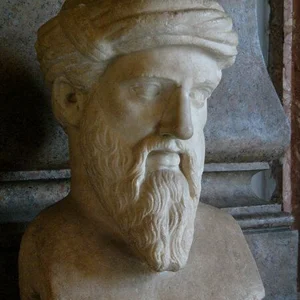
Pythagoras
582 av. J.-C. — 490 av. J.-C.
Alexander II of Macedon
Anne Thérèse de Marguenat de Courcelles, marquise de Lambert