Imaginary dialogue between Synésios de Cyrène and Hypatia of Alexandria
by Charactorium · Hypatia of Alexandria (vers 355/370 — 415) · Sciences · Philosophy · 5 min read
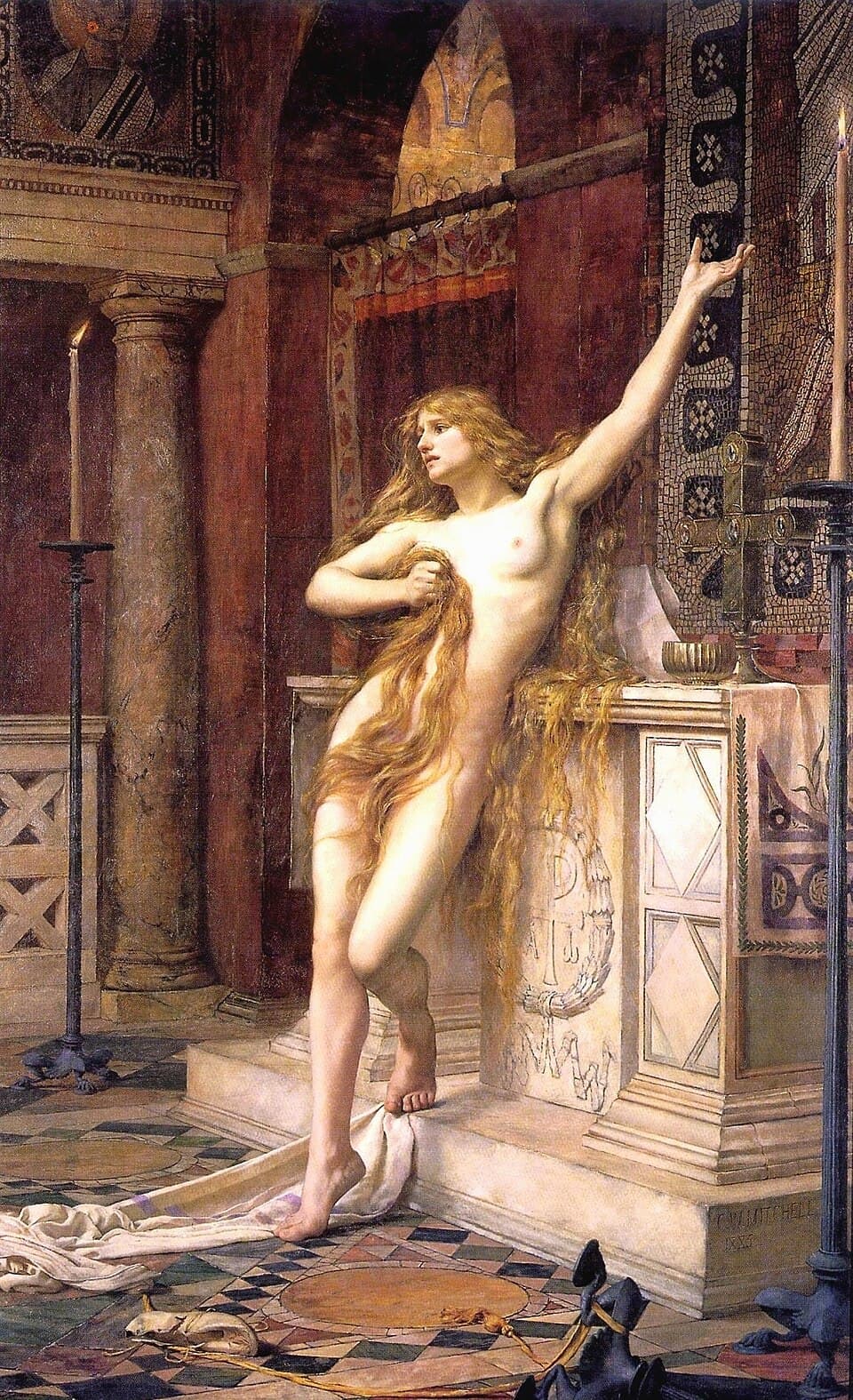
It is in the peristyle courtyard of her house in Alexandria, among papyrus rolls and brass instruments, that Hypatia receives her former pupil in the autumn of 412. Synesius of Cyrene, now bishop of Ptolemais, has made the journey one last time to see her whom he calls his mistress in philosophy. On a table, the astrolabe she once forged for him catches the slanting evening light. Twenty years after the lessons of his youth, the disciple has come less to question than to understand the woman who shaped his mind.
—Mistress, when I studied with you, you were constantly revising the Arithmetica of Diophantus. Why comment on the ancients rather than write your own treatises?
My dear Synesius, you are mistaken about what you call 'mine' and 'the ancients'. When I revise the Arithmetica of Diophantus or the Conics of Apollonius, I am not copying: I make clear what had become obscure, I correct the errors of copyists, I add the proofs the author left unspoken. A mathematical text without a teacher to explain it is a lamp without oil. Do you remember those mornings when you struggled with a wax tablet, and a single line added in the margin made everything clear? That is my work. Writing a new treatise flatters vanity; transmitting intact the treasure of the geometers saves science itself from oblivion.
—And Ptolemy's Almagest, which you commented on with your father Theon? They say Book III bears your own hand.
My father Theon gave me everything: numbers, stars, a taste for astronomical tables. We worked side by side on the commentary of the Almagest, and yes, the third book — the one dealing with the Sun's motion and the length of the year — bears my revision. I take no special glory from it: a daughter who extends her father's work only returns what she received. But I will confess to you, who know my house, that those hours bent over Ptolemy's epicycles, checking every computed position, were the happiest of my life. The truth of a number never lies, and asks neither favor nor flattery.
—Do you remember the letter in which I requested an astrolabe of the finest workmanship? How do you fashion instruments of such precision?
How could I forget? Your letter asked me for an astrolabe of the finest workmanship, and I believe I satisfied you. You see, the instrument is but a projection: one flattens the celestial sphere onto a bronze disk, engraves the network of fixed stars on the openwork rete, and slides under it the tympans engraved for each latitude. He who knows how to read an astrolabe holds the sky in his palm and knows the hour from a star's height. I have them forged under my eyes, for a single degree badly engraved falsifies every reading. You see, Synesius: philosophy ascends toward the intelligible, but it always descends again into bronze and the craftsman's hand. The star and the tool are one.
He who knows how to read an astrolabe holds the sky in his palm.
—In your lessons, you handled the hydrometer and that brass armillary sphere. What use is it for a philosopher to measure the density of water?
What a strange division you make, you who were my pupil! The hydrometer that weighs the density of a liquid and the armillary sphere that figures the circles of the world obey the same law: everything in creation is measured, numbered, ordered. When I dip the graduated tube into water and read how far it sinks, I touch with my finger the hidden harmony of bodies. A philosopher who disdained the hand and experience would be but a babbler. Plato himself required one to enter geometry before entering wisdom. My students first learn to measure the visible; only then does their mind rise, without vertigo, toward the invisible.
—Your classes welcomed pagans and Christians like me, now a bishop. How do you teach Plato to souls that everything separates?
You are the living proof of my answer, Synesius: pagan I received you, bishop you left, and between us nothing has changed. In my hall, I ask no one before what altar he bows. I expound Plato and Plotinus, I show that the soul desires the One, that unique principle from which everything flows — and that desire, the Christian and the pagan alike carry within them. Neoplatonism is not a rival religion: it is the discipline that teaches one to think. My former students are now scattered from Cyrene to Constantinople, some priests, others prefects. If they still understand each other across their cults, it is because they learned here to seek the truth together. That is the only homeland I have given them.
In my hall, I ask no one before what altar he bows.
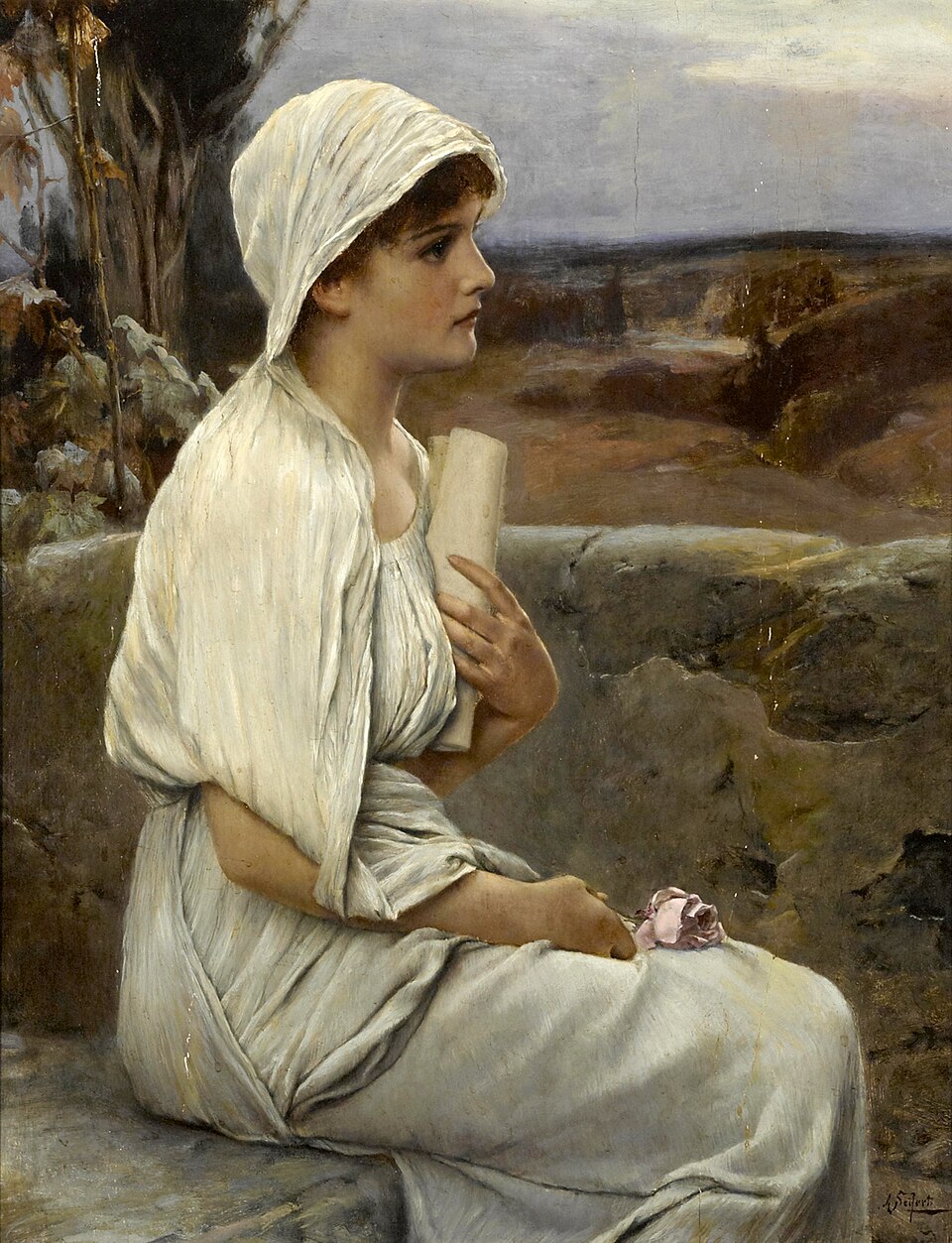
—Throughout the Empire you are named as the one who surpassed her father and took the head of Plato's school. Does this fame weigh on you?
Fame is a cloak that others throw over your shoulders; you do not choose it. That they say of me that I surpassed my father would especially flatter Theon, who taught me everything. What touches me is not that my name is spoken from Cyrene to Constantinople, but that my students, wherever they go, continue to question. A school does not live by the glory of the one who led it, but by the minds it set free. You yourself, now shepherd of a people, yet you still write to me like a curious schoolboy. That is worth a thousand praises. Fame passes; a disciple who thinks for himself remains.
—They still tell the story of the young man infatuated with you, to whom you showed a cloth. Why do you always wear the tribon of the philosophers?
Ah, that story still runs through the streets! Yes, a young man had become inflamed for my person, thinking he loved wisdom when he only coveted a body. I put a soiled cloth before his eyes and said: That is what you love, young man, and not the Beautiful. Sometimes a harsh remedy is needed to cure a soul sick with its senses. If I wear the tribon, that coarse woolen cloak worn by male philosophers, it is no coquetry of austerity: it is that he who has mastered his desires no longer needs ornament. The Beautiful is not palpable, Synesius; it is contemplated by the intellect. My garment says it before my mouth.
The Beautiful is not palpable; it is contemplated by the intellect.
—You who taught me temperance, how do you live each day? They say you disdain the meats and wines of banquets.
People always exaggerate the austerity of philosophers, but it is true that I eat little and simply: wheat bread, olives, some fruit, wine heavily diluted with water. The body is a mount; one feeds it so that it may carry the soul, not so that it drags it through the mud. I rise before dawn to note the position of the stars, and a belly weighed down with flesh and wine could not follow the stars. It is not contempt for the world, Synesius, but economy: every pleasure one subtracts from the body, one gives back to the mind. You saw it at my house: our banquets nourished above all the conversation — we shared Plato more willingly than the dishes.
—Mistress, ever since Cyril occupied the episcopal seat, you are constantly seen at the side of Prefect Orestes. Does this friendship not expose you?
You touch on a point that darkens this year. Since Cyril received the episcopal seat, a shadow has fallen over the city; he cannot bear that an imperial prefect retains his own authority. Orestes is my friend, yes, and he was before governing Egypt: we speak of philosophy as much as of the city. Must I deny him because a bishop is troubled by our accord? I conspire with no one; I advise a just magistrate, and that should scandalize only those who prefer obedience to reason. They murmur, they envy me, they insinuate that I turn the prefect from the Church. But I do not walk masked, Synesius: I go through the streets in broad daylight, in my chariot, and my door remains open to anyone who wishes to learn.
—The city is no longer what it was when I studied. The bishop's parabalani prowl, and people fear for Orestes's friends. Are you not afraid?
Fear is a bad counselor, and I do not let it govern my days. Yes, those men the bishop employs — officially to care for the sick — are increasingly becoming a militia, and rumor swells against anyone who does not bend. But what would you have me do? Close my school, burn my commentaries, deny Orestes and Plato to buy my tranquility? A life saved at the cost of reason is not worth living. You leave tomorrow for your diocese, Synesius, and you carry my serenity along with my greetings. I have taught all my life that one must fear error more than men. I am not going, at my age, to belie my own lessons.
A life saved at the cost of reason is not worth living.
Read further

This imaginary interview was generated by artificial intelligence from sources documented in Hypatia of Alexandria's profile. It dramatises what the figure might have said based on what we know about them, but does not constitute attested historical testimony. For primary sources and factual documentation, refer to the full profile.