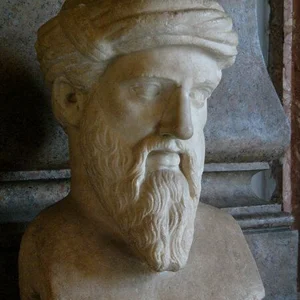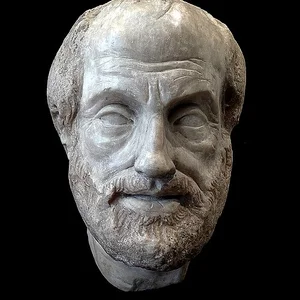

Greek philosopher born in Stagira (384–322 BC), Aristotle founded his own school, the Lyceum, in Athens. He developed comprehensive systems of logic, metaphysics, ethics, and politics that profoundly influenced Western thought.
Aristotle(460 av. J.-C. — 401 av. J.-C.)
Aristotélès
Athènes
7 min read
Frequently asked questions
Famous Quotes
« Man is a political animal»
« Happiness is the activity of the soul in accordance with virtue»
« To know is to know through causes»
Key Facts
- 384 BC: Born in Stagira, Macedonia
- 367 BC: Joins Plato's Academy in Athens
- 335 BC: Founds his own school, the Lyceum, in Athens
- 322 BC: Leaves Athens and takes refuge in Chalcis, where he dies
- Major contributions: Creation of formal logic (syllogism), classification of the sciences, theory of ethics (virtue and the golden mean)
Works & Achievements
A collection of logical treatises including the Categories, On Interpretation, and the Analytics. Aristotle establishes formal logic and the syllogism, tools of reasoning used for two millennia.
A foundational work in which Aristotle studies being as being and the first causes of reality. This text shaped the entire tradition of Western philosophical thought.
A moral treatise dedicated to his son Nicomachus, in which Aristotle defines happiness as the activity of the soul in accordance with virtue. It is one of the founding texts of Western ethics.
An analysis of the different forms of government and of life in community. Aristotle examines the constitutions of numerous Greek city-states.
A treatise on literary art, celebrated for its theory of tragedy and the concept of catharsis (the purification of emotions through dramatic spectacle).
A vast zoological inquiry based on direct observation of hundreds of species. Aristotle classifies animals and describes their behaviors with pioneering rigor.
A treatise on nature, motion, and change. Aristotle develops his theory of the four causes and his conception of the natural world.
A study of the nature of the soul and its faculties (nutrition, sensation, thought). This treatise is considered one of the earliest texts in psychology.
Anecdotes
Aristotle was the tutor of the young Alexander of Macedon, the future Alexander the Great, for approximately three years beginning in 343 BC. King Philip II entrusted him with his son's education at the sanctuary of the Nymphs, in Mieza. This teacher-student relationship is one of the most celebrated in history.
Aristotle had a habit of teaching while walking along the shaded paths of the Lyceum, his school in Athens. His students thus came to be known as the "Peripatetics", from the Greek peripatein meaning "to walk". This pedagogical method has remained associated with his name.
Upon the death of Alexander the Great in 323 BC, anti-Macedonian sentiment spread through Athens. Aristotle, regarded as close to the Macedonians, was accused of impiety. He chose to flee to Chalcis, declaring that he did not wish Athens to "sin twice against philosophy", alluding to the condemnation of Socrates.
Aristotle was a passionate observer of nature. He dissected marine animals on the island of Lesbos and produced anatomical descriptions of remarkable precision for his time. Some of his observations on cephalopods were not confirmed by modern science until centuries later.
After the death of his first wife Pythias, niece of his patron Hermias, Aristotle lived with Herpyllis, originally from Stagira. In his will, he expressly requested that Pythias's bones be placed beside his own, testifying to a deep attachment.
Primary Sources
Happiness is an activity of the soul in accordance with virtue, and if there are several virtues, in accordance with the best and most complete among them.
Man is by nature a political animal. He who lives outside the city, naturally and not by chance, is either a degraded being or a superhuman one.
All men by nature desire to know. The pleasure we take in the perceptions of our senses is proof of this.
Tragedy is the imitation of a noble action, carried through to its end and having a certain magnitude, by means of language embellished with various kinds of ornament. It operates through pity and fear to bring about the purgation of these emotions.
We must, without reluctance, approach the study of every animal, for in each there is something natural and beautiful.
Key Places
School founded by Aristotle in 335 BC, located near the temple of Apollo Lykeios. It was there that he taught his courses while walking along the peripatos (covered walkway).
Aristotle's birthplace, in the north of present-day Greece. His father Nicomachus practiced there as a physician at the court of the king of Macedon.
The place where Aristotle taught the young Alexander, in the sanctuary of the Nymphs. Caves and gardens served as the setting for his teachings.
Aristotle stayed there between 345 and 343 BC, conducting remarkable zoological and biological research in the lagoon of Pyrrha.
The city where Aristotle took refuge in 323 BC after the death of Alexander, and where he died the following year.
The school where Aristotle studied for twenty years under the direction of Plato, from 367 to 347 BC.
Typical Objects

Everyday writing instruments at the Lyceum. Aristotle used them to record his observations and prepare his lectures.

Supports for Aristotle's writings and the Lyceum's library, one of the first great collections of texts in the Greek world.

Small blades and needles used by Aristotle for his anatomical studies on marine and terrestrial animals.

A common instrument in Greek philosophical schools, used to measure time and observe celestial movements.

Essential lighting for long evenings of reading and writing. Aristotle was renowned for his diligent work.

A musical instrument forming part of Greek education. Aristotle devoted reflections to music in his Politics.
📷 CC BY-SA 4.0 · Wikimedia Commons ↗
Shells, dried plants, and animal remains collected during his stays on Lesbos for his zoological work.
School Curriculum
Vocabulary & Tags
Key Vocabulary
Daily Life
Morning
Aristotle rose early, at dawn, like most Greeks of his era. After a brief wash and a light meal of bread dipped in wine or olive oil, he made his way to the Lyceum. He devoted his mornings to the most demanding lectures, reserved for his advanced students, which he delivered while walking along the covered walkways.
Afternoon
In the afternoon, Aristotle gave more accessible lectures, open to a broader audience, on subjects such as rhetoric or politics. He also dedicated time to research, cataloguing his naturalistic observations and working on his treatises. The library of the Lyceum, which he had built up himself, was a central working tool.
Evening
In the evenings, Aristotle sometimes attended symposia (philosophical banquets) at the homes of friends or patrons. He was known for his moderation in drinking and his elegant dress. He also spent long evenings reading and writing by the light of oil lamps.
Food
Aristotle's diet was typical of a wealthy Athenian citizen of the 4th century BC: barley or wheat bread, olives, figs, goat cheese, grilled fish, vegetables, and wine diluted with water. Meat was reserved for feast days and religious sacrifices.
Clothing
Aristotle wore a himation, a large piece of fabric draped over the left shoulder, in fine wool or linen depending on the season. He was known for taking care of his appearance, wearing rings and keeping his hair cut short, which was considered a sign of refinement.
Housing
Aristotle likely lived in a well-appointed Athenian house, with rooms arranged around an open-air inner courtyard. As a metic (a foreign resident of Athens), he was not permitted to own landed property and therefore had to rent his accommodation.
Historical Timeline
Period Vocabulary
Visual Style
Un style visuel inspiré de l'esthétique classique grecque, baigné dans la lumière dorée méditerranéenne, avec des colonnades de marbre, des platanes ombragés et les teintes chaudes de terre et d'ocre caractéristiques d'Athènes.
Sound Ambience
L'ambiance sonore du Lycée d'Aristote mêle les pas sur les allées de gravier, les discussions philosophiques murmurées en marchant, les chants d'oiseaux méditerranéens et le bruissement des platanes dans la brise athénienne.
Liens externes & ressources
Références
Œuvres
Organon (ensemble logique)
vers 350-340 av. J.-C.
Métaphysique
vers 340 av. J.-C.
Éthique à Nicomaque
vers 340 av. J.-C.
Politique
vers 330 av. J.-C.
Poétique
vers 335 av. J.-C.
Histoire des animaux
vers 343 av. J.-C.
Physique
vers 340 av. J.-C.