Imaginary interview with Jane Goodall
by Charactorium · Jane Goodall (1934 — 2025) · Sciences · 5 min read
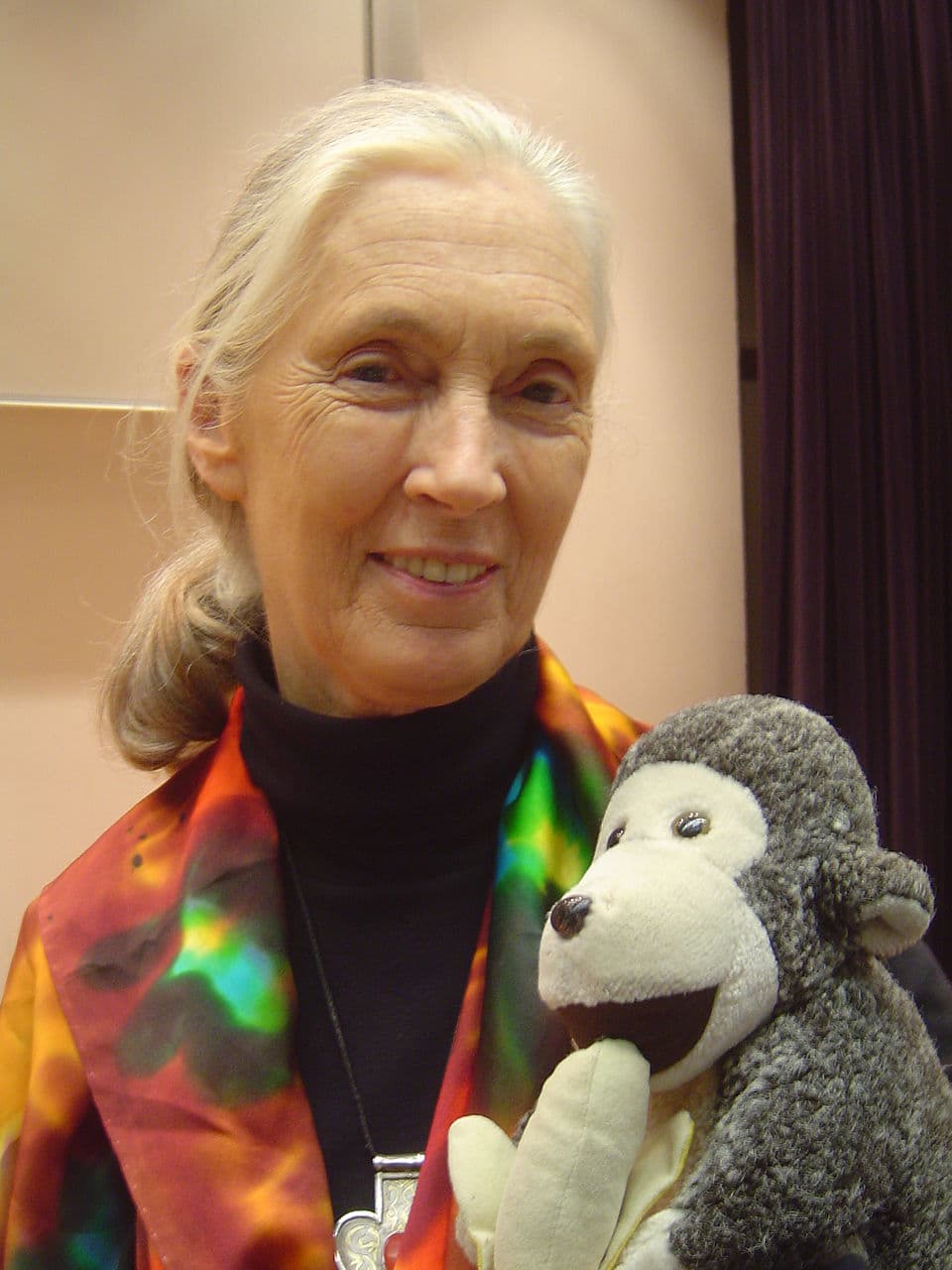
We met her in a simple room, binoculars resting on a stack of dog-eared notebooks, a map of Gombe forest pinned to the wall. In her nineties, her voice remains low, patient, as if attuned to the rhythm of an observation that never ends. She spoke to us about chimpanzees as a distant family whose silences she has never stopped translating.
—How were your very first weeks in the forest, before the chimpanzees accepted you?
I lived under a canvas tent with my mother Vanne, without running water, without electricity, on the steep slopes that plunge toward Lake Tanganyika. Every morning I woke before dawn, because chimpanzees leave their nests at first light, and I climbed up to sit, motionless, my binoculars in hand. For months they fled from me: a pale white silhouette that had no business there. I learned to disappear into the landscape, to wear khaki tones, not to stare, to let time do its slow work. Habituating these animals cost me more than a year of patience — but it is the only currency the forest accepts.
Patience is the only currency the forest accepts.
—People often talk about the 'banana camp' at Gombe. What did it mean to you?
At first, to draw those shy shadows a little closer, I placed bunches of bananas near the camp. It was decisive: suddenly David Greybeard and a few others came within sight, and I could read on their faces what no textbook had described. But I quickly understood the price of this ease: bananas changed behaviors, stirred tensions, distorted what I was trying to observe without disturbance. I eventually gave them up. You always think you need to help nature reveal itself a little; in truth, you must mainly learn not to interrupt it. My field notebooks from those years bear the trace of that constant doubt between seeing and disturbing.
—Do you remember the day you saw a chimpanzee making a tool?
October 1960. I can still see it: David Greybeard, crouched near a termite mound, picking a blade of grass, stripping off the leaves, and inserting it into the mound to withdraw clinging termites. In the Shadow of Man recounts this scene — 'I had witnessed a chimpanzee not only using but actually making a tool.' An animal was not just using an object, it was shaping it for a purpose. Yet we had been taught that toolmaking was the defining trait of humans, the very boundary of our species. Sitting there, my notebook on my knees, I was not aware of tearing down a wall. I was simply noting what I saw, honestly, as always.
I didn't know I was tearing down a wall; I was simply noting what I saw.
—How did Louis Leakey react to that observation?
When my report reached him, Louis Leakey replied with a telegram I have never forgotten: 'Now we must redefine tool, redefine man, or accept chimpanzees as humans.' Redefine tool, redefine man, or welcome chimpanzees among humans. He had that genius for instantly gauging the significance of a tiny fact — a blade of grass in a termite mound on the shores of Lake Tanganyika. For the science of the time, it was an earthquake. For me, it was above all confirmation that these beings deserved to be seen differently than as mechanisms. Science had drawn a clear line between them and us; that morning, the line began to tremble.
Science had drawn a clear line between them and us; that morning, it began to tremble.
—You had no university degree when it all began. How did that happen?
In 1957, I was working as a secretary at the National Museum of Kenya in Nairobi when I met Leakey. I had no bachelor's degree, no training in zoology — nothing but a childhood passion for animals, born in the gardens of Bournemouth where my mother had encouraged my curiosity. Leakey saw it as an asset: he wanted a fresh perspective, uncluttered by university theories, someone who would observe without knowing in advance what to find. It is often forgotten, but ignorance of dogmas is sometimes the best method. He was looking for eyes, not a curriculum vitae.
Ignorance of dogmas is sometimes the best method.
—How do you get a PhD at Cambridge without ever having passed a bachelor's degree?
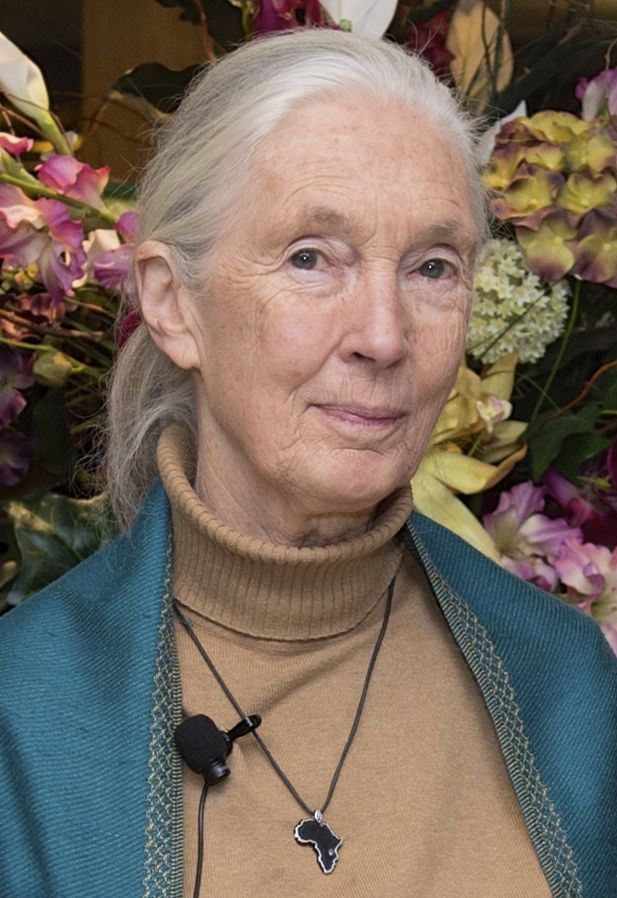
In 1965, I received my doctorate in ethology at Cambridge, based solely on my field notes from Gombe — one of the few people admitted without a prior degree. The experience was singular: some professors criticized me for giving first names to my chimpanzees, attributing personality to them, speaking of mind and emotion. They demanded I reduce everything to numbers, to digits. I held firm. My notebooks did not lie: each animal had a face, a story, a character. Cambridge gave me the legitimacy the academic world demanded, but the real lesson I had learned in the forest, long before entering a lecture hall.
—Why were you so determined to name the chimpanzees rather than number them?
Because they were not interchangeable. Flo, David Greybeard, Goliath: each had his or her temperament, tricks, tendernesses, rages. I was accused of anthropomorphism, that cardinal sin of the science of the time which forbade attributing any emotion to animals. But my field notebooks, filled hour after hour, showed political alliances, grief, play — a whole inner life. I refused to reduce these individuals to serial numbers to reassure an orthodoxy. Time has proven me right: what was dismissed as the naivety of an untrained young woman is now a foundation of ethology. Naming was not fantasizing; it was refusing to lie about what I saw.
Naming was not fantasizing; it was refusing to lie about what I saw.
—The idea of animal culture, passed down through generations, took a long time to be accepted. What were you discovering through your binoculars?
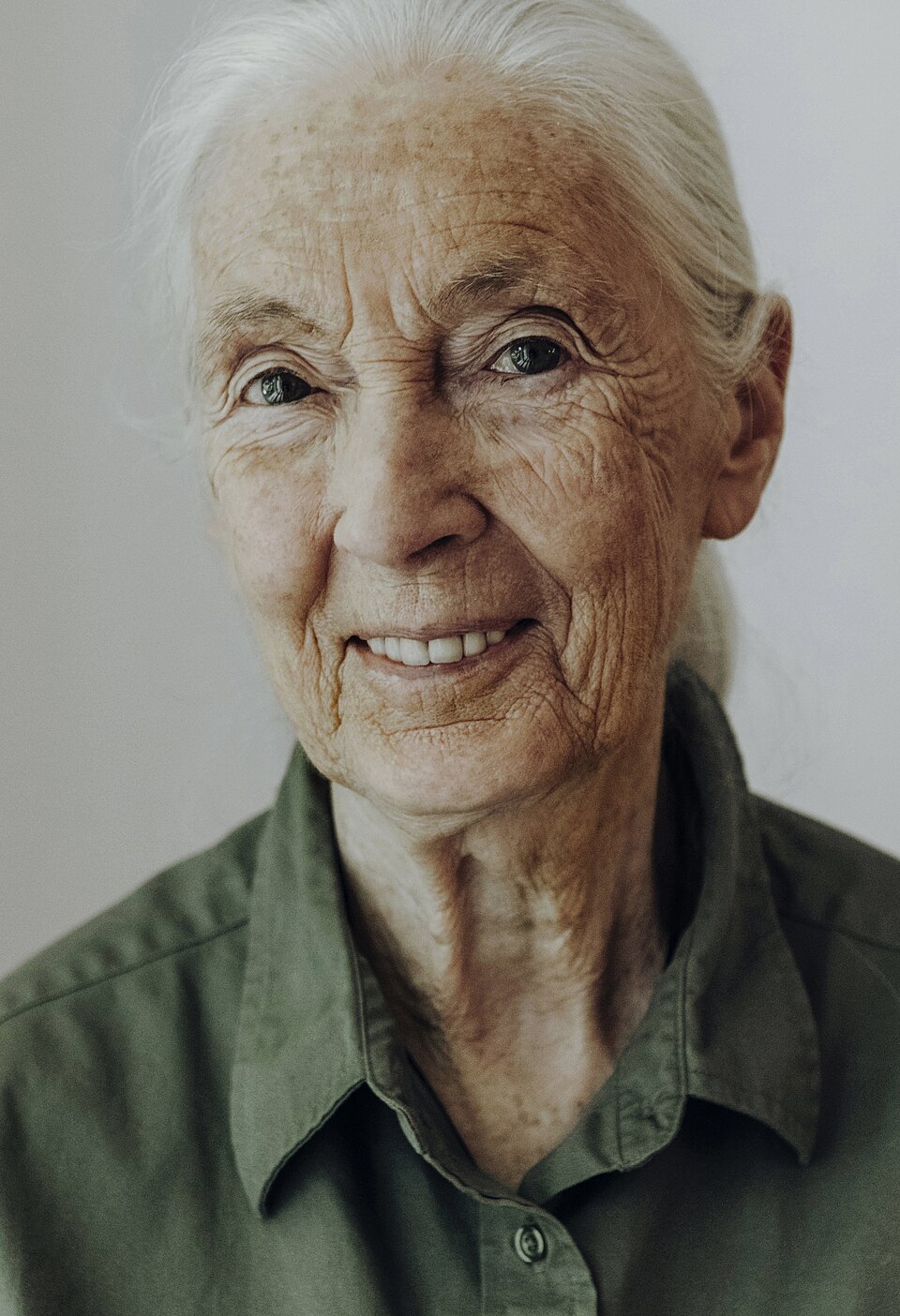
That techniques were not inscribed in genes, but learned, imitated, handed down. A youngster watched its mother fish for termites and repeated the gesture, clumsily at first, then with confidence. I was patiently observing cultural transmission: different groups used different tools in different ways. Later, in The Chimpanzees of Gombe, I wrote that tool use among these animals was not a unitary phenomenon, but suggested the transmission of learned behaviors across generations. Each community, in short, had its customs. We had to admit that culture, too, was not our exclusive property.
—In 1986, in Chicago, something shifted. What happened?
I came to that international conference as a researcher, to talk about behavior, data, publications. And they showed me satellite maps: the forests of Africa, those I thought eternal, reduced to shreds, surrounded by deforestation and poaching. I entered that room a scientist and I left it an activist. I could no longer sit under a tree at Gombe taking notes on pant-hoots while the habitat of these animals disappeared. I almost stopped fieldwork to travel the world, three hundred days a year, pleading the cause of conservation. It was both a mourning and a rebirth.
I entered that room a scientist and I left it an activist.
—You founded Roots & Shoots in 1991. Where do you find this hope, while describing so much destruction?
Roots & Shoots was born in my living room in Dar es Salaam, with a dozen Tanzanian high school students and a very simple idea: that every young person act concretely, for their community, for animals, for the earth. Today there are millions of them, in more than sixty countries. My hope rests on a conviction I once wrote: every individual matters, every individual has a role to play, every individual makes a difference. You cannot get through a single day without having an impact on the world — but we have the choice of the impact we leave. That is what I tell children: their hands, together, are vaster than all the felled forests.
Every individual makes a difference — and we have the choice of the impact we leave.
This imaginary interview was generated by artificial intelligence from sources documented in Jane Goodall's profile. It dramatises what the figure might have said based on what we know about them, but does not constitute attested historical testimony. For primary sources and factual documentation, refer to the full profile.