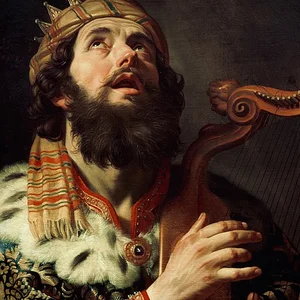

David is a major figure in the Hebrew Bible, the second king of Israel and Judah (c. 1038–968 BCE). Famous for his victory over the giant Goliath and for his psalms, he unified the Israelite kingdoms and established Jerusalem as the religious capital.
Frequently asked questions
Famous Quotes
« The Lord is my shepherd; I shall not want (Psalm 23, verse 1)»
« Who is this uncircumcised Philistine that he should defy the armies of the living God? (1 Samuel 17, verse 26)»
Key Facts
- c. 1040 BCE: David is born in Bethlehem, son of Jesse
- c. 1025 BCE: David defeats the Philistine giant Goliath with a sling and a stone
- c. 1010 BCE: David becomes king of Israel after the death of Saul
- c. 1000 BCE: David conquers Jerusalem and makes it the capital of the unified kingdom
- The Book of Psalms: traditionally attributed to David, an important work of religious poetry
Works & Achievements
The legendary confrontation in which David, a young shepherd, defeats the Philistine giant Goliath armed with nothing but a sling and a stone. This event becomes foundational to his political authority and marks a turning point in the struggle against the Philistines.
David achieves the political unification of the twelve tribes of Israel and the kingdom of Judah, creating a unified and strengthened state. This unification lays the foundations for a kingdom that would dominate the region for several generations.
David captures Jerusalem and makes it the political and religious capital of his kingdom, installing the Ark of the Covenant there. This decision transforms Jerusalem into the spiritual center of Judaism.
The composition of a major collection of liturgical poems and prayers attributed to David, incorporated into the biblical Book of Psalms. These texts become foundational to both Jewish and Christian religious practice.
David establishes a centralized administration with an organized royal court, a standing army, and a system of governance that serves as a model for the kingdoms of the Levant. This structure endures beyond his reign.
David leads a series of military conquests that extend Israelite territory to the Euphrates, subduing the Philistines, Moabites, and Arameans. These victories establish Israel as a major regional power.
David establishes a royal dynasty whose prestige endures for several centuries and becomes a messianic reference in Jewish tradition. The concept of the Messiah is associated with a future descendant of David.
Anecdotes
David, a humble shepherd from Bethlehem, was summoned to the court of King Saul to play the harp and soothe his fits of melancholy. His music became so celebrated that David quickly won the affection of the people and became the closest friend of the king's son, Jonathan. It was at court that David discovered his military talents and began his rise to power.
According to biblical accounts, David defeated the giant Goliath, champion of the Philistines, armed with nothing but a sling and stones. This spectacular event marked a turning point: David became a national hero and earned the name 'giant-slayer'. This victory symbolizes the triumph of courage and faith over brute strength.
David established Jerusalem as the capital of his unified kingdom around 1000 BCE, transforming this small fortress into a major political and religious center. He built the Royal Palace there and had the Ark of the Covenant transferred to the city, consolidating both religious and political power in one place.
David is said to have composed or inspired the Psalms, a collection of 150 liturgical poems that became the heart of Jewish and Christian prayer. These texts, attributed to David the 'poet-king', express faith, repentance, and praise, and are still used in religious services to this day.
Despite his military successes, David committed adultery with Bathsheba, the wife of one of his generals, which brought him into conflict with the prophet Nathan. This episode, recounted in biblical texts, shows that even the greatest kings are not exempt from human weakness and divine punishment.
Primary Sources
David said to the Philistine: "You come against me with sword and spear and javelin, but I come against you in the name of the LORD Almighty, the God of the armies of Israel, whom you have defied."
David captured the fortress of Zion — the City of David. And David became more and more powerful, because the LORD God Almighty was with him.
The LORD is my light and my salvation — whom shall I fear? The LORD is the stronghold of my life — of whom shall I be afraid?
[mention of the] house of David, confirming the historical existence of David and his royal dynasty
Key Places
David's birthplace according to biblical tradition. This is where he was born and grew up as a shepherd before becoming king of Israel.
The capital established by David after his conquest. He built the royal palace there, and the city became the political and religious center of the unified kingdom.
The site of the famous battle where David, a young shepherd, faced and defeated the giant Goliath — a founding event of his legend.
The city where David reigned as king of Judah for seven years before conquering Jerusalem and unifying the Israelite kingdoms.
The site of the Temple of Jerusalem, associated with David who prepared its construction and installed the Ark of the Covenant there — a symbol of royal and religious power.
Typical Objects

A simple weapon made of a leather or fabric strap used to hurl stones. According to the biblical account, David used it to slay the giant Goliath, making it the emblematic weapon of the young shepherd who became king.

A plucked string instrument characteristic of the ancient Near East. David is celebrated for his musical talents and is said to have composed the Psalms, making the lyre the instrument associated with his musical and spiritual practice.

A long, curved stick used by shepherds to guide and protect their flocks. David spent his youth as a shepherd in Judea before becoming king, making the staff a symbol of his humble origins.

A symbol of royal power in the ancient Near East, ornate and worn by kings. David wore it as the second king of Israel and Judah, representing his authority and his unification of the Israelite kingdoms.

The primary combat weapon of Iron Age warriors in the Near East. David distinguished himself as a victorious warrior and military leader, wielding the sword in numerous campaigns to defend and expand his kingdom.

Writing materials used across the ancient Mediterranean and Near East to record sacred texts. The Psalms attributed to David are said to have been inscribed or written on such surfaces, becoming foundational texts of the Hebrew tradition.

Protective equipment carried by warriors and kings during the early Iron Age. David, as both warrior and king, would have used it in battle and military campaigns to defend Israel against its enemies.

A sacred chest containing the Tablets of the Law, the central symbol of Hebrew worship. David transferred the Ark to Jerusalem, transforming the city into the religious and spiritual capital of Israel and establishing its enduring sacred significance.
School Curriculum
Vocabulary & Tags
Key Vocabulary
Tags
Mythologie
Daily Life
Morning
David begins his day before dawn, first in prayer and then in consultation with his advisers and generals. As king, he receives reports from his military commanders and discusses affairs of the kingdom, particularly the defense against external threats from neighboring peoples.
Afternoon
The afternoon is devoted to administering the kingdom: judicial hearings, settling disputes between tribes, and managing tributes. David also takes part in military training and hunting, activities essential for maintaining the physical strength and authority expected of a warrior-king of this era.
Evening
In the evening, David withdraws to his royal chambers for meals with his court and his many wives. He dedicates time to music and composing psalms — activities for which he is renowned — while musicians play instruments such as the harp and the lyre.
Food
The royal diet includes meats (lamb, goat, poultry) from the royal flocks, barley or wheat bread, dried fruits, honey, and imported wine. Royal meals are elaborate and feature rare delicacies, reflecting the king's privileged status and wealth.
Clothing
David wears fine linen tunics, a symbol of his royal standing, often adorned with costly purple dye. He is crowned with a diadem, wears finely crafted leather sandals, and wraps himself in richly decorated mantles for official ceremonies.
Housing
David resides in the royal palace of Jerusalem, a fortress built on the heights of Zion, with reception halls, private apartments, and chambers for his large household. The palace is the administrative and religious heart of the kingdom, located near the Tabernacle housing the Ark of the Covenant.
Historical Timeline
Period Vocabulary
Visual Style
Un style visuel mêlant l'art levantine antique aux influences byzantines, centré sur les teintes chaudes de la terre et l'or bruni, avec un éclairage dramatique qui sublime le guerrier-poète à la fois martial et spirituel.
Sound Ambience
Une ambiance sonore majestueuse mêlant les chants sacrés de psaumes hébraïques, les notes chaudes d'une lyre ancienne, les échos d'un palais fortifié en pierre, et les bruits d'une ville antique animée, créant une atmosphère de pouvoir spirituel et guerrier dans le Jérusalem antique.
Liens externes & ressources
Références
Œuvres
Victoire contre Goliath
vers 1020 av. J.-C.
Unification des royaumes d'Israël et de Juda
vers 1010-1000 av. J.-C.
Établissement de Jérusalem comme capitale
vers 1000 av. J.-C.
Les Psaumes de David
vers 1000-960 av. J.-C.
Consolidation du pouvoir royal centralisé
vers 1010-968 av. J.-C.
Campagnes militaires d'expansion territoriale
vers 1005-990 av. J.-C.
Institution de la dynastie davidique
vers 1000 av. J.-C.