Imaginary interview with Jean Jaurès
by Charactorium · Jean Jaurès (1859 — 1914) · Politics · 5 min read
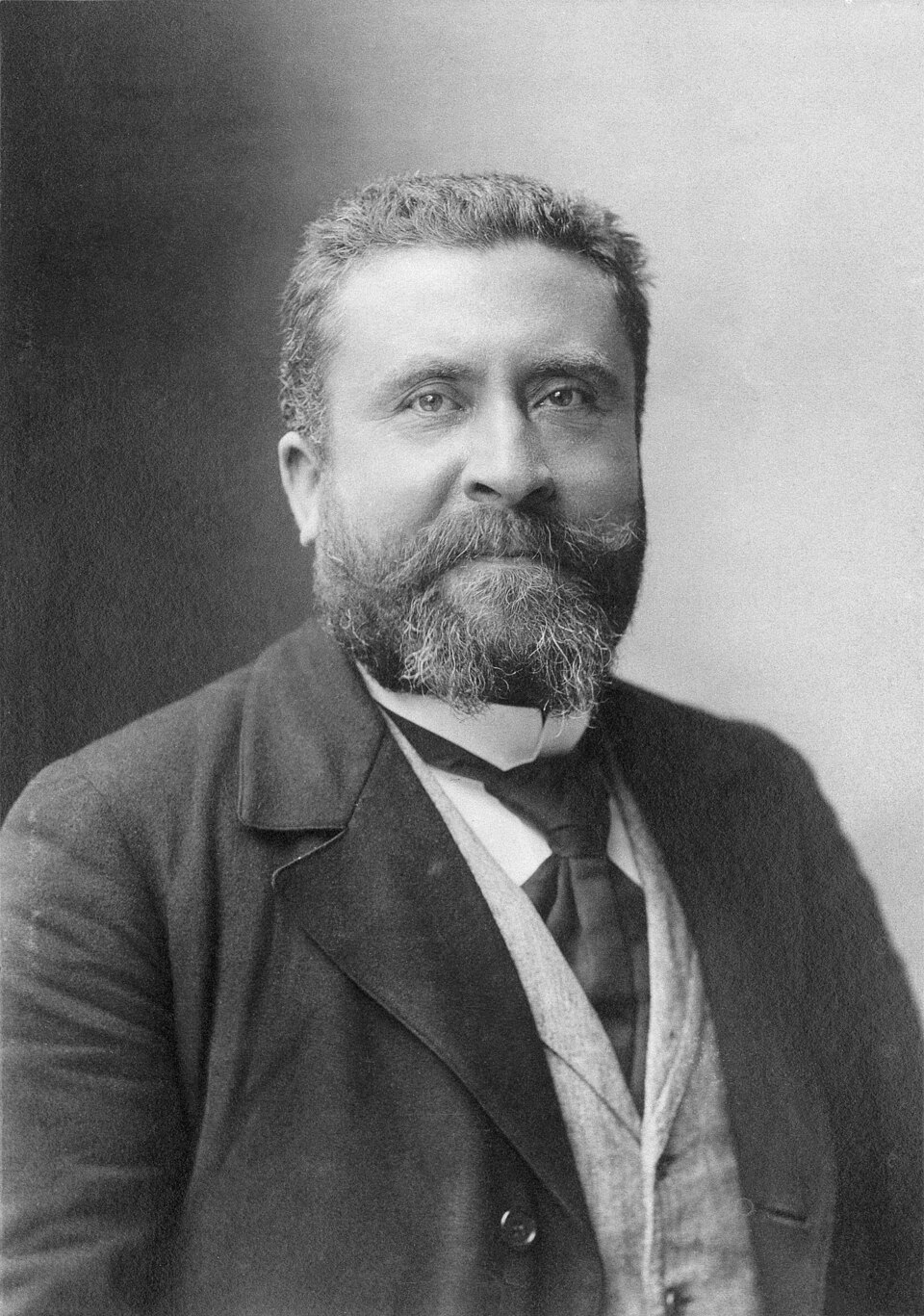
We meet Jean Jaurès in the late spring of 1914, in the editorial offices of L'Humanité on the rue du Croissant in Paris. Afternoon light filters through windows half-obscured by paper; he writes standing at his desk, pen in hand, a sheaf of parliamentary dispatches at his elbow. He greets us with a vigorous handshake, sweeps a chair clear of back issues, and begins to talk — and when he talks, the walls seem to lean in.
—You hold an agrégation in philosophy, yet here you are in a newspaper office rather than a lecture hall. How does philosophy survive the journey into politics?
Philosophy did not survive it — it drove it. When I was teaching at Albi in 1881, preparing lectures on Plato or Kant, I kept circling the same question every honest mind eventually reaches: what is real? The answer, when you look squarely at the world, is that a miner breathing coal dust six days a week is more real than any ideal republic written on parchment. My doctoral thesis argued that matter and idea are not opponents but two faces of a single truth. My politics have been nothing but that argument continued by other means — considerably louder means, I confess.
Matter and idea are not opponents — my politics have been that argument continued by louder means.
—The mining district of Carmaux became your electoral base in the 1890s. What did those workers teach you that no university chair could have?
They taught me that solidarity is not a sentiment — it is a discipline, earned through shared risk. When the miners of Carmaux struck in 1893, they were not reading pamphlets about collectivisme; they were refusing to be buried alive a little at a time by men who would never once descend underground. I walked that district, listened at kitchen tables, and understood something I had only theorized before: that justice must be indivisible. You cannot defend the republic's principles from a podium while tolerating that the republic's workers are treated as instruments of production. The moment you accept the second, you have surrendered the first.
—When did you first decide that the Dreyfus Affair demanded your public voice — not merely your private conviction?
Less a decision than an accumulation. Through 1897 and into early 1898, I watched Captain Dreyfus condemned on documents I grew increasingly certain were forged, with the army closing its ranks behind the lie. Many colleagues hesitated — the enemies were powerful, the electoral costs were real. But I kept returning to a single fact: a man was rotting on Devil's Island for something he did not do. I wrote first in La Dépêche de Toulouse, then produced the Les Preuves articles for La Petite République, not out of bravado but out of the conviction I later tried to pass on to students in Albi: courage means seeking the truth and saying it, not surrendering to a triumphant lie simply because it is louder.
—In Les Preuves you dismantled the military's case document by document. Was that a journalist's method or a philosopher's?
Both — and the distinction matters less than people assume. Les Preuves was an exercise in evidence, yes, but evidence marshalled toward a moral demand. The whole truth must be spoken; full light must be shed; and if the government, if the military commanders have failed their duty, they must be judged. Those were not rhetorical flourishes — they were logical conclusions. The method I learned in philosophy seminars — proceed from premise to consequence, accept no ambiguity when clarity is achievable — was precisely what the Dreyfus affair of 1898 required. The prosecution had built its case on shadow. I insisted on daylight. A republic that cannot survive that insistence has already ceased to deserve the name.
A republic that cannot survive the insistence on daylight has already ceased to deserve the name.
—Creating the SFIO in 1905 meant uniting factions that had spent years denouncing one another. How do you persuade rivals to become comrades?
You force them to look honestly at what they share — and at what they stand to lose by remaining divided. The French socialist movement through the 1890s was a quarrel among brilliant men with incompatible temperaments and nearly identical goals. That is the worst kind of quarrel, because each side can accuse the other of betraying principles while actually defending its own vanity. At the Congrès du Globe we agreed on a single discipline: the workers of France needed one party, not five rival sects. I was never the most doctrinaire man in that room — and I believe that was useful. Doctrine divides. A common purpose, clearly stated and patiently repeated, can hold.
—People say your voice could carry to thousands without any amplifying device. What actually happens to you when you speak before a great assembly?
I confess I am no reliable witness to my own oratory. I am told I once tore my jacket clean through under the arms during a heated speech at the Palais Bourbon — which I find entirely plausible; I have no memory of it, which perhaps proves the point. What I can say is that addressing a mass meeting is nothing like delivering a lecture. In a hall you give your argument to minds; at a meeting of thousands you give your conviction to bodies, and the response comes back as something physical — a pressure, a current that moves back through you. The philosophical training, all those years in Albi and afterwards, tells me where I am going. But the voice, the gesture, the momentum — those belong to the crowd as much as to the speaker.
—In L'Armée nouvelle you propose replacing the standing army with a citizens' militia. How do you respond to those who call that dangerously naïve?
I respond by asking what the professional army has actually produced. Not security, but a caste insulated from democratic oversight — capable, as the Dreyfus case demonstrated, of forging documents and destroying an innocent man to protect its own authority. My proposal is not pacifist surrender; I wrote in 1911 that war lies deep in all things as death lies deep in life, and I have no illusions about human nature. But a militia of citizens defends a territory; a standing army too often serves the ambitions of whoever can capture its command. That is not naïveté. It is a lesson history offers at great and recurring cost to those who refuse to read it.
—Your opposition to the three-year conscription law in 1913 cost you many supporters. Do you fear that your antimilitarism is misread as indifference toward France?
Constantly — and it is the most dishonest charge my opponents make. To love France is not to love a flag or a general staff; it is to love the men who will be asked to die under that flag when war comes. The three-year law was not a shield — it was a provocation. Every additional year of service imposed in Paris was answered by a corresponding escalation in Berlin. I said plainly at the Chamber during the Agadir crisis: this road ends in catastrophe. Opposing the law was not weakness toward Germany. It was the only form of patriotism I know how to practice with a clear conscience — the kind whose first obligation is to keep living men alive.
The only patriotism I know how to practice is the kind whose first obligation is to keep living men alive.
—On the evening of July 31, 1914, you were at the Café du Croissant working on an article. What were you trying to say in that piece?
The same thing I have said in different arrangements for twenty years: that war between European peoples is not inevitable, that the workers of France and Germany owe each other more solidarity than they owe their respective governments, and that the IIe Internationale still had both the means and the moral obligation to act. The situation after Sarajevo was grave, but not yet irreversible — telegrams were still moving, chancelleries had not fully committed. I believed that a coordinated refusal across borders could give the governments pause. The article was the argument distilled to its simplest form: stop. Just: stop. I had not yet finished the sentence when the window opened.
—You have given your life to the conviction that peace among peoples is achievable through collective solidarity. How do you hold that conviction when violence seems always to be waiting just outside the window?
By looking honestly at the alternative. I do not deceive myself — I know that war is latent beneath all things as death is latent beneath life. But despair is also a form of capitulation, and a more comfortable one than action. Every evening when I walk back from the Chamber past the workers finishing their shifts, past the cafés filling up along the Grands Boulevards, I think: these people are not abstractions. They are the reason. They have no interest in dying for a treaty clause or a colonial boundary. The SFIO, the Internationale, twenty years of patient argument built across borders — that is not nothing. That is, in fact, everything worth defending.

This imaginary interview was generated by artificial intelligence from sources documented in Jean Jaurès's profile. It dramatises what the figure might have said based on what we know about them, but does not constitute attested historical testimony. For primary sources and factual documentation, refer to the full profile.