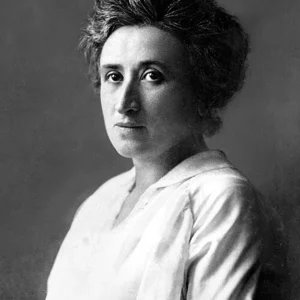

Rosa Luxemburg was a Polish-born revolutionary activist and Marxist theorist who became a naturalized German citizen. Co-founder of the Communist Party of Germany (KPD), she championed a socialist revolution rooted in the mass consciousness of the working class. Arrested during the Spartacist uprising of January 1919, she was murdered by paramilitary soldiers.
Rosa Luxemburg(1871 — 1919)
Rosa Luxemburg
Allemagne, Empire russe
8 min read
Frequently asked questions
Famous Quotes
« Freedom is always the freedom of the one who thinks differently.»
« Those who do not move do not notice their chains.»
Key Facts
- 1871: Born in Zamość, in the Russian Empire (present-day Poland)
- 1898: Obtained German citizenship through marriage; joined the SPD (Social Democratic Party)
- 1905: Participated in the Russian Revolution and developed the theory of the mass strike
- 1915: Imprisoned for pacifism; wrote the 'Junius Pamphlet' against the war while in detention
- January 1919: Co-led the Spartacist uprising in Berlin; murdered on January 15, 1919
Works & Achievements
A major work of Marxist economic theory in which Luxemburg analyzes the mechanisms of capitalist accumulation and its internal contradictions. This work became a foundational reference for heterodox Marxist thought.
A political pamphlet analyzing the role of the mass strike as an instrument of social revolution, inspired by the Russian Revolution of 1905. It profoundly influenced European revolutionary strategy.
A critical pamphlet against Bernstein's revisionism, arguing for the necessity of proletarian revolution over gradual reform. A founding text in the ideological debates of the socialist left.
A course in political economy written in prison, offering an accessible introduction to Marxist theory. Published posthumously, it remains an important educational text.
The creation, together with Karl Liebknecht, of an underground revolutionary organization in Germany opposed to World War I. This league became the nucleus of the Communist Party of Germany.
A political and ideological struggle against Germany's entry into the war and a critique of nationalism. Her writings and activism established her as one of the leading figures of revolutionary pacifism.
A body of letters and journalistic articles developing her political thought, situational analyses, and critique of capitalism. These writings form an essential documentary record of Western Marxism.
Anecdotes
Rosa Luxemburg was born in 1871 in Zamość, in the Polish part of the Russian Empire. Afflicted with a bone disease in childhood, she would remain slightly disabled but developed an iron will and exceptional intelligence, learning Polish, Russian, German, French, and Latin.
To escape tsarist persecution and pursue her studies, Rosa Luxemburg entered into a marriage of convenience with Gustav Lübeck in 1898, which allowed her to obtain German citizenship. This arrangement opened the doors of the University of Zurich, where she would go on to earn a doctorate in political economy.
At the Second International congress in Stuttgart in 1907, Rosa Luxemburg joined Lenin in defending a landmark amendment calling on socialists to transform any imperialist war into revolution. Her eloquence captivated delegates who had come from across Europe.
Imprisoned in Breslau during the First World War, Rosa Luxemburg continued to write in secret. Her 'Letters from Prison', addressed to friends and filled with poetic observations about nature and the birds she watched from her cell, reveal a profound literary sensibility.
On January 15, 1919, Rosa Luxemburg was arrested by the Freikorps (far-right paramilitary units) in Berlin, beaten with rifle butts, then shot in the head. Her body was thrown into the Landwehr Canal. Recovered five months later, she was buried at Friedrichsfelde Cemetery, which would become a place of pilgrimage for socialists around the world.
Primary Sources
The accumulation of capital is the purpose and driving force of capitalist production. But this accumulation presupposes a new realization of surplus value. Surplus value must be transformed into new capital.
Social reform and social revolution are not absolutely opposed to one another. They are absolutely opposed terms, between which no reconciliation is possible. The question is whether we are moving gradually toward socialism in stages, or whether it is through radical upheaval that we get there.
Freedom exists only for those who believe in it. It is not given — it must be won. That is why true freedom always begins where doubt begins, where one dares to ask questions.
Capital presents itself as an antagonistic force that dominates the economic life of capitalist society. What appears to be the free activity of the individual is in reality nothing more than the expression of economic forces that dominate him.
Humanity stands at a crossroads: on one side the road leading to barbarism, on the other the road leading to socialism. The working class must choose. There is no third way.
Key Places
Rosa Luxemburg's birthplace in Poland (then under Russian rule). She was born there in 1871 into an intellectual Jewish family whose values deeply shaped her political thinking.
The Swiss city where Rosa Luxemburg studied mathematics and political economy at the university. A hub of political exile, it was here that she developed her Marxist theory between 1889 and 1893.
The major center of Rosa Luxemburg's political activity, where she settled and became a leading figure in the German Social Democratic Party (SPD). She co-founded the Spartacist League there and played a key role in the Revolution of 1918.
The Polish capital where Rosa Luxemburg threw herself into revolutionary movements against Tsarist rule. She returned there repeatedly despite the risk of arrest, and was eventually imprisoned.
The Prussian city where Rosa Luxemburg continued her studies and became more deeply involved in socialist circles. There she met activists who shaped her commitment to revolutionary politics.
The site where Rosa Luxemburg's body was found on January 31, 1919, after she was murdered during the suppression of the Spartacist uprising. It has since become a symbol of the struggle for justice.
Typical Objects

Rosa Luxemburg was a prolific journalist and pamphleteer. Her articles in socialist publications and her political brochures were her intellectual weapons in the fight against capitalism and for international revolution.

A symbol of Luxemburg's political commitment, she spent several years in prison for her revolutionary and anti-militarist activities, particularly during the First World War.

The emblem of the international socialist movement to which Rosa Luxemburg dedicated her life. This symbol represents her commitment to equality and proletarian revolution.

The everyday tools of a prolific intellectual who was constantly writing letters, articles, and theoretical treatises. Her extensive body of writing makes her one of the most important voices in political thought.

Rosa Luxemburg was a leading Marxist theorist. She studied and commented on the works of Marx and Engels, spreading their ideas through her own writings.

A symbol of the political agitation of the late 19th and early 20th centuries. Luxemburg was actively involved in workers' protest movements and demonstrations against the war.

An everyday object for an intellectual working late into the night. Luxemburg wrote her texts by the light of these primitive sources before electricity became widespread.
School Curriculum
Vocabulary & Tags
Key Vocabulary
Tags
Daily Life
Morning
Rosa Luxemburg began her day early, typically devoted to reading newspapers and political correspondence. She had a modest breakfast, typical of the European intellectual class, before immersing herself in her writing and economic analysis.
Afternoon
Afternoons were generally spent meeting with socialist comrades, writing articles for political publications, or attending to her responsibilities within German and Polish socialist organizations. She led an intensely activist life, engaging in theoretical debates and political strategy.
Evening
Rosa Luxemburg's evenings were often given over to party meetings, public assemblies, or intellectual discussions in small groups. She moved in socialist and revolutionary circles, where she championed her theories on imperialism and proletarian revolution.
Food
Rosa Luxemburg followed a simple, modest diet characteristic of left-wing intellectuals of her era. She ate mainly bread, vegetables, cheese, and fruit, with meat only occasionally. Coffee and tea accompanied her long working sessions.
Clothing
She wore austere, practical clothing typical of the bourgeois intellectual woman of the late nineteenth century: dark long dresses, plain blouses, an understated hat. Her appearance reflected a deliberate rejection of frivolity, in keeping with her egalitarian convictions.
Housing
Rosa Luxemburg lived in modest urban intellectual lodgings, first in Germany and later in Poland, often in neighborhoods where socialist circles concentrated. Her interiors were spare, filled with books, newspapers, and political documents rather than elaborate furniture.
Historical Timeline
Period Vocabulary
Visual Style
Un style graphique à la croisée du réalisme socialiste et de l'Art Nouveau, inspiré des affiches politiques allemandes du début du XXe siècle. L'utilisation de contrastes forts entre lumière et ombre crée une atmosphère d'intensité intellectuelle et de mobilisation révolutionnaire, amplifiée par des lignes angulaires expressionnistes.
Sound Ambience
Une ambiance sonore pleine de tension révolutionnaire et d'agitation politique, mêlant les bruits de la vie urbaine européenne du début du XXe siècle aux échos des luttes sociales et de l'activisme intellectuel de Rosa Luxemburg.
Liens externes & ressources
Références
Œuvres
The Accumulation of Capital (L'Accumulation du capital)
1913
The Mass Strike, the Political Party and the Trade Unions (La Grève de masse, le parti et les syndicats)
1906
Réforme ou révolution
1899
Introduction to Political Economy (Introduction à l'économie politique)
1925 (posthume)
Fondation de la Ligue Spartakiste
1916
L'opposition à la Première Guerre mondiale et la campagne antiguerre
1914-1919
Correspondance politique et philosophique
1893-1919