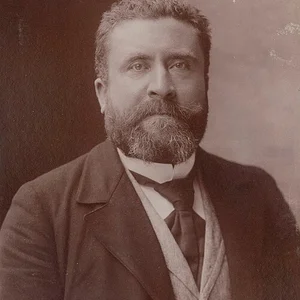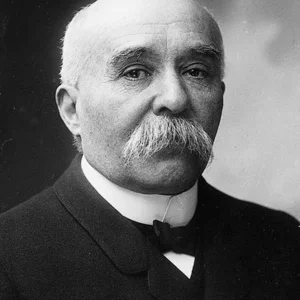

French statesman (1841–1929), Georges Clemenceau is best known for his decisive role during the First World War as Prime Minister (1917–1920). Nicknamed 'The Father of Victory', he led France to victory and negotiated the Treaty of Versailles.
Georges Clemenceau(1841 — 1929)
Georges Clemenceau
France
7 min read
Frequently asked questions
Famous Quotes
« War is too serious a matter to be left to the generals.»
« When I was young, I was told that I would become wiser as I grew older. So far I have not noticed it.»
« Law is the foundation of freedom.»
Key Facts
- 1841: Born in Mouilleron-en-Pareds (Vendée)
- 1906–1909: First ministry, social reforms and separation of Church and State
- 1917–1920: Second ministry during the Great War, mobilizes the nation for victory
- 1918: Signing of the Armistice on November 11
- 1919: Negotiation and signing of the Treaty of Versailles with Germany
Works & Achievements
Clemenceau led this republican, pro-Dreyfus daily newspaper. It was under his direction that Zola's 'J'accuse' was published, a founding act of intellectual engagement.
Clemenceau was one of the principal architects of this treaty ending the First World War. He negotiated with Wilson and Lloyd George the conditions imposed on Germany.
Although passed before his ministry, Clemenceau ensured its firm application as Minister of the Interior and then President of the Council, guaranteeing republican secularism.
Memoirs in which Clemenceau revisits the Versailles negotiations and defends his actions. An essential work for understanding his vision of peace.
A philosophical work in which Clemenceau, retired from politics, shares his reflections on science, religion, and the meaning of life.
An essay dedicated to his close friend Claude Monet, testifying to Clemenceau's passion for art and his role in preserving the Water Lilies for the nation.
Anecdotes
During a pistol duel against Paul Déroulède in 1892, both opponents fired and missed each other. Clemenceau reportedly commented with irony: "We aimed like politicians." The incident perfectly illustrates his combative character and biting humor.
Clemenceau was nicknamed "the Tiger" due to his fierce temperament and his ability to bring down governments. As a journalist and senator, he contributed to the fall of no fewer than sixteen cabinets, which also earned him the nickname "the cabinet-toppler."
A close friend of Claude Monet, Clemenceau encouraged him to paint the famous Water Lilies series and played a decisive role in convincing the French state to accept the donation of these canvases, now installed at the Orangerie des Tuileries. He visited Monet at Giverny dozens of times over the decades.
At the signing of the Treaty of Versailles on June 28, 1919, in the Hall of Mirrors, Clemenceau deliberately chose this location to symbolically erase the humiliation of the proclamation of the German Empire at the same spot in 1871. The choice was a calculated act of historical revenge.
On February 19, 1919, the anarchist Émile Cottin fired seven bullets at Clemenceau as he was getting into his car. One bullet lodged near his lung, but the 77-year-old man returned to work a few days later, declaring that the shooter deserved a few weeks of shooting lessons.
Primary Sources
My foreign policy and my domestic policy are one and the same. Domestic policy? I wage war. Foreign policy? I wage war. I always wage war.
Clemenceau, editor of the newspaper L'Aurore, chose the title "J'accuse…!" for Zola's open letter to President Félix Faure, denouncing the injustice done to Captain Dreyfus.
Clemenceau writes in his memoirs: "It is easier to make war than to make peace." He revisits the difficult negotiations of the Treaty of Versailles and his disagreements with Wilson and Lloyd George.
Announcing the armistice, Clemenceau declares: "France, yesterday the soldier of God, today the soldier of humanity, will always be the soldier of the ideal." The entire Chamber rises to give him a standing ovation.
Key Places
Clemenceau's birthplace, where he was buried according to his wishes, standing upright facing east, beside his father. His childhood home is now a museum.
The centers of Clemenceau's parliamentary life for more than forty years, first as a deputy then as a senator. It was from these chambers that he waged his political battles.
Clemenceau lived for many years in his apartment on Rue Franklin, now converted into the Musée Clemenceau. He worked there and died there in 1929.
The site of the signing of the Treaty of Versailles on June 28, 1919, chosen by Clemenceau for its symbolic resonance vis-à-vis Germany.
Clemenceau regularly visited the front during the war, touring the trenches to bolster the morale of the soldiers, which strengthened his image as an indomitable war leader.
Typical Objects

Clemenceau wore grey gloves at all times, which became his trademark. He suffered from eczema on his hands and rarely removed them, even indoors.

A characteristic accessory of the Parisian bourgeois of the Belle Époque, the bowler hat accompanied Clemenceau on his daily outings.

Clemenceau ran this pro-Dreyfus daily from 1897. It was in its columns that Zola's famous "J'accuse" was published.

Clemenceau regularly used a cane, especially in his later years. It also symbolised the austere elegance of the man.

A tireless journalist and polemicist, Clemenceau wrote thousands of articles throughout his life. The pen was his weapon as much as the podium.

An ever-present symbol in Clemenceau's offices, a reminder of his deep-seated attachment to the republican values inherited from the Revolution.
School Curriculum
Vocabulary & Tags
Key Vocabulary
Tags
Concept
Daily Life
Morning
Clemenceau rose very early, often at dawn, in his apartment on rue Franklin. He began his day with a careful reading of several newspapers, annotating articles and preparing his rebuttals. A black coffee and a frugal breakfast accompanied this morning press review.
Afternoon
The afternoon was devoted to political affairs: sessions at the Senate or the Chamber, ministerial meetings, or writing articles for the press. During the war, he frequently visited the front, walking the trenches to galvanize the troops.
Evening
In the evenings, Clemenceau sometimes received close friends or collaborators for simple dinners. An avid reader, he also spent his evenings writing and engaging in philosophical reflection. He went to bed relatively early to be fully operational by dawn.
Food
Clemenceau ate simply and without excess. He appreciated the Vendée cuisine of his childhood and drank little alcohol. His diet was that of a man mindful of his health, having trained as a physician.
Clothing
He invariably wore a dark suit, a bowler hat, and his famous grey gloves which concealed his eczema. His appearance was austere but well-kept, a reflection of his sober and determined personality.
Housing
His apartment on rue Franklin in Paris, in the 16th arrondissement, was modest for a man of his standing. Simply furnished and cluttered with books and newspapers, it reflected Clemenceau's spartan character. He also maintained ties to the Vendée throughout his life.
Historical Timeline
Period Vocabulary
Visual Style
Style réaliste et contrasté évoquant la presse illustrée et la photographie de la IIIe République, entre dorures des palais parlementaires et boue des tranchées, dans des tons sourds rehaussés de bleu républicain.
Sound Ambience
Ambiance sonore mêlant l'effervescence politique parisienne de la Belle Époque — débats parlementaires houleux et presses d'imprimerie — aux sons graves et poignants du front pendant la Grande Guerre.
Liens externes & ressources
Références
Œuvres
L'Aurore (direction du journal)
1897-1899
Traité de Versailles
28 juin 1919
Loi de séparation des Églises et de l'État
1905-1906
Grandeurs et misères d'une victoire
1930 (posthume)
Au soir de la pensée
1927
Claude Monet : les Nymphéas
1928