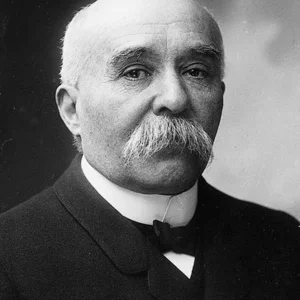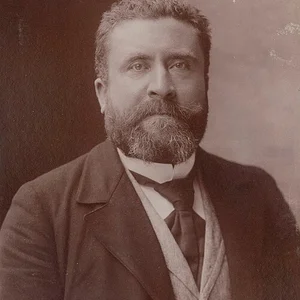

Jean Jaurès (1859-1914) was a major French politician and founder of the unified Socialist Party. A passionate advocate for social justice, pacifism, and democracy, he opposed the war before being assassinated in 1914.
Jean Jaurès(1859 — 1914)
Jean Jaurès
France
7 min read
Frequently asked questions
Famous Quotes
« An honest employer does not exploit his workers»
« Peace is the condition of all social justice»
Key Facts
- 1881: Elected deputy of Tarn, beginning his political career
- 1895: Founds the newspaper L'Action socialiste and becomes a leader of the socialist movement
- 1901: Creates the French Socialist Party (PSF), seeking to unify the left-wing movement
- 1905: Achieves the merger of various socialist factions, creating the SFIO (French Section of the Workers' International)
- July 31, 1914: Assassinated by a nationalist, Raoul Villain, on the eve of World War I
Works & Achievements
A monumental multi-volume work that reinterprets the French Revolution through the lens of socialism. Jaurès demonstrates how social struggles run throughout the entire revolutionary period.
A series of articles published in La Petite République, in which Jaurès methodically proves the innocence of Captain Dreyfus and exposes the military conspiracy. A courageous and decisive act in the Dreyfus Affair.
An essay in which Jaurès proposes replacing the professional army with a defensive citizens' militia. He develops his vision of a national defence compatible with pacifist and republican ideals.
Jaurès creates this socialist daily, which quickly becomes an influential press organ. He shapes it into a space for intellectual debate and political mobilisation in the service of the workers' cause.
A major political achievement by Jaurès, who succeeds in unifying the divided French socialist factions into a single party, the French Section of the Workers' International.
Jaurès's doctoral thesis in philosophy, reflecting his rigorous intellectual formation. He develops a materialist and idealist conception of reality that would serve as the foundation of his later political thought.
Anecdotes
In 1898, Jaurès publicly took a stand in favor of Dreyfus in the columns of La Dépêche de Toulouse, at a time when many were still hesitant. His intellectual courage earned him threats, but he did not relent, convinced that justice is indivisible.
An outstanding orator, Jaurès could address crowds of several thousand people without a microphone, his powerful voice carrying all the way to the back rows. A contemporary recounts that he gestured with such force that he sometimes tore his jacket under the arms.
A brilliant graduate of the École Normale Supérieure, Jaurès passed the agrégation in philosophy with highest honors in 1881. He taught in Albi before entering politics, and retained throughout his life an intellectual rigor that impressed even his opponents.
On July 31, 1914, a few hours before his assassination, Jaurès dined at the Café du Croissant in Paris with colleagues from L'Humanité. He was still working on an article calling for peace in Europe. A young nationalist, Raoul Villain, shot him twice through the open window.
Jaurès was one of the key architects of the unification of the French socialist movement. In 1905, he brought together the various socialist factions to found the SFIO (Section Française de l'Internationale Ouvrière), thus laying the foundations for a unified and lasting socialist party.
Primary Sources
War lies at the heart of all things, as death lies at the heart of life. But just as life can be long and beautiful despite the death that ends it, so too can societies live long in peace despite the possibility of war.
The whole truth must be told. Light must be shed. And if the government, if the military commanders have failed, they must be judged.
Courage means seeking the truth and speaking it; it means not submitting to the law of triumphant lies that pass, and not echoing with our soul, our mouth, and our hands the imbecile applause and fanatical jeers.
This newspaper will be that of all republicans, all socialists, all those who want social justice and peace among peoples. We have no other ambition than to be useful.
The French Revolution is the highest form ever reached by the political life of peoples. It affirmed at once the rights of the individual and the sovereignty of the nation.
Key Places
Birthplace of Jean Jaurès, where he was born on September 3, 1859. A Jean Jaurès museum is now dedicated there to his life and work.
It is at the Palais Bourbon that Jaurès delivered his great parliamentary speeches, defending workers, opposing war, and fighting social injustices.
Restaurant located on rue Montmartre in Paris, where Jaurès was assassinated on July 31, 1914 by Raoul Villain while he was dining with collaborators from L'Humanité.
Mining town for which Jaurès was elected deputy in 1893. He actively supported the miners' and glassworkers' strikes, forging his identity as a defender of the working class.
Jaurès collaborated extensively with this major regional republican daily newspaper, through which he spread his Dreyfusard and socialist ideas throughout the south-west of France.
Liens externes & ressources
Références
Œuvres
Histoire socialiste de la Révolution française
1901-1908
L'Armée nouvelle
1911
Fondation du journal L'Humanité
1904
Unification socialiste – création de la SFIO
1905
De la réalité du monde sensible (thèse de philosophie)
1891