Imaginary dialogue between Jean Pasquerel and Joan of Arc
by Charactorium · Joan of Arc (1412 — 1431) · Military · 6 min read
It is in a lodging on the banks of the Loire, on a winter evening at the end of the year 1429, that Brother Jean Pasquerel finds Joan by the fireside. The white armor hangs on a hook, the rolled standard sleeps against the wall, and the smell of candle wax mingles with that of burning wood. Confessor to the Maid since the early days, he said Mass before her battles, heard her morning prayers, and saw her weep over the dead. The summer campaigns are over, the assault on Paris has failed, and this evening he comes as a friend to seek the woman behind the cuirass.
—You who opened your soul to me in confession, tell me: these Voices, how long have they dwelt in you, and what do they ask of you?
Brother Jean, you are one of those to whom I can say this without fear of mockery. I was thirteen years old, at Domrémy, in my father's garden, when a voice came to me at midday, from the direction of the church. I was very frightened the first time. Then I recognized Saint Michael, and after him Saint Catherine and Saint Margaret, who spoke to me gently and told me to be a good child and go often to church. Only later did they command me to set out for France and to rescue the kingdom. I hear them clearly, especially when the bells ring. They are not dreams: I see them with my eyes, I kiss their feet, and their counsel has never deceived me.
—Before I knew you, you went twice to Vaucouleurs to ask Baudricourt for an escort. Where did such boldness come from?
I had no choice, Brother Jean: my Voices urged me to go to the dauphin, and I could not disobey God to please men. The first time, Sir Robert de Baudricourt mocked me and sent me back to my father, thinking I was mad or possessed. But I returned, for what I had been commanded weighed more heavily than his mockery. By dint of standing before him without trembling, he finally gave me men and a sword. I tell you: it was not my boldness that conquered him, but that he saw I was not lying. The great always yield when they sense that one fears only one thing, and that thing is not them.
I could not disobey God to please men.
—When you arrived at Chinon, the dauphin had hidden among his people to test you. How did you recognize him without ever having seen him?
You know well, Brother Jean, that I cannot tell everything that happened in that great hall. Charles had blended into the crowd of his courtiers, dressed without splendor, and one of them wore richer clothes than he to deceive me. Yet I went straight to him and called him my gentle dauphin. My Voices had shown him to me. Then I told him in secret something that only he knew, and his face changed: he believed me. Do not ask me that sign, I promised it. Know only that after that, I was no longer looked upon as a lost shepherdess, but as the awaited envoy.
—Each morning I said Mass for you, and I saw you receive Communion and then weep. Why these tears, Joan?
Because I see what the captains do not want to see, Brother Jean: behind every victory, there are bodies of men, French as well as English, who will not rise again. I weep for them, for they are souls, and I would like them to die confessed. You know that I had you get up before dawn for Mass, and that I begged you not to let any soldier go into battle without pardon. The war I wage, I would wage without hatred. That is why before each assault, I first summon the enemies to return in peace. If they shed their blood, may they know that I prayed them not to.
—At Orléans, at Les Tourelles, I saw you fall, an arrow above your breast, then go back. Where did you find that strength?
I had announced that wound before it happened, Brother Jean — my Voices had told me. The arrow entered between my shoulder and neck, and seeing it protruding from my flesh, I wept like a child, for I am a woman and the pain was great. They wanted to charm the wound with words, but I refused: I let them put oil and lard on it, and I confessed to you. Then, seeing our men about to retreat, I took up my standard again and carried it to the foot of the bulwark. When our people saw my banner floating, they found a second wind, and the English yielded. It was not I who conquered that day: it was the courage restored to my men.
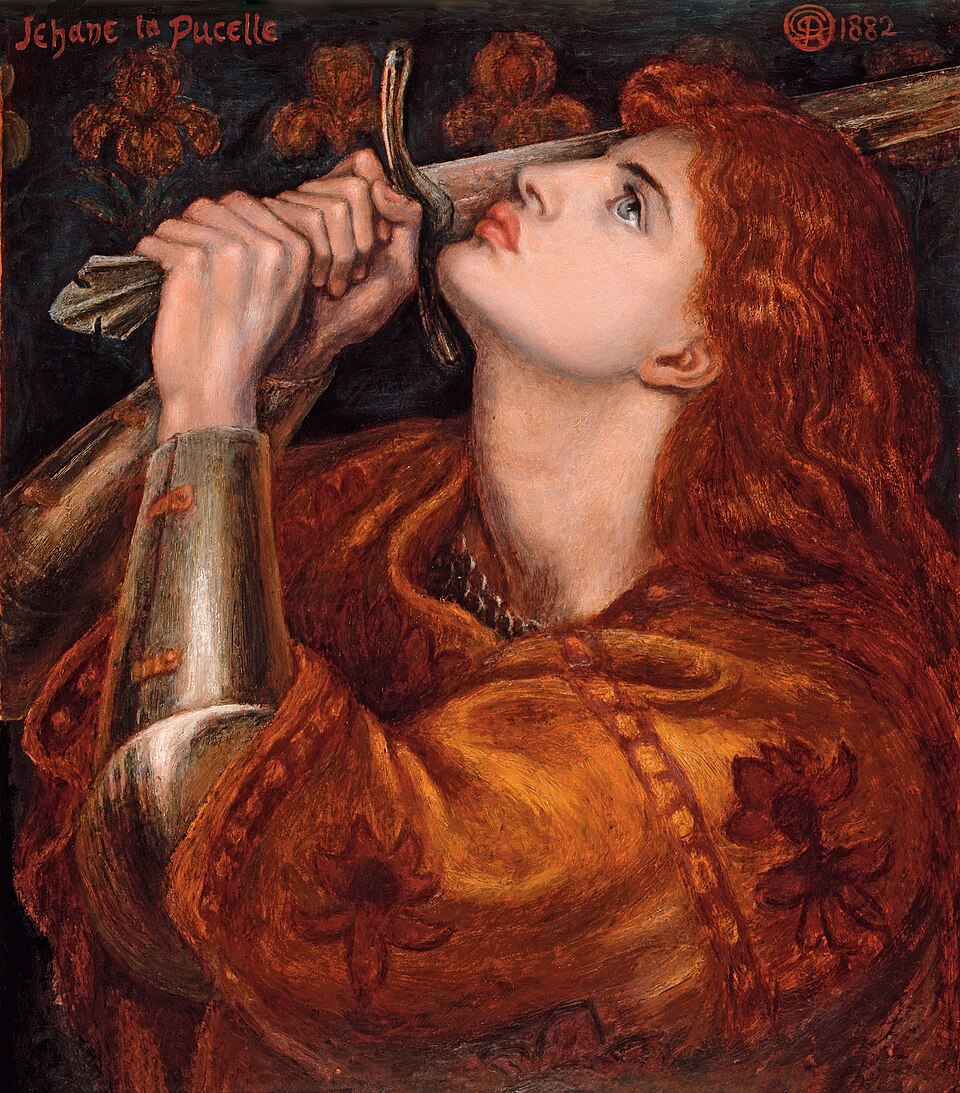
—In nine days, what the captains could not do in seven months. You are called the Maid of Orléans: do you like that name?
The name Maid, I bear willingly, for it says what I am and what I have promised to remain. But Orléans is not my work, Brother Jean, it is God's and that of the brave people who followed me. Think: the city had been suffocating since autumn, the townspeople were eating their reserves, and no one dared attempt anything. I entered through the Burgundy Gate, had supplies brought in, and told the captains that we must strike, not wait. They found me too bold. But in nine days, the English bastilles fell one after another. If they want to give me a nickname, let them remember above all that the Maid did only what the Voices had commanded her.
—You always carried your white standard embroidered with Christ. Why did you say you held it dearer than your sword?
Because the sword kills, Brother Jean, and the standard gathers. I loved it forty times more than my sword, for on it was painted Our Lord holding the world, and two angels at his side. When I went to the assault, I carried it myself for fear of killing anyone; I never killed a man. My men, seeing it raised high, knew where the danger was and where they needed to go. It was a sign for them, and a prayer for me. The sword I had found at Sainte-Catherine-de-Fierbois was beautiful, but I cared little for it. The standard bore my entire mission, and that is why I held it closest to God.
I carried it myself for fear of killing anyone; I never killed a man.
—From Fierbois to Reims, you led the dauphin to be crowned in enemy territory. At the anointing, what did you feel?
It was the greatest day, Brother Jean — the one for which God had sent me. We had crossed lands held by the enemy, Troyes, Châlons, almost without fighting, for the cities opened their gates to us. At Reims, on July 17, when the archbishop anointed Charles with the holy oil, I held my standard close to the altar. They asked me why my banner was there; I replied that it had been through the hardship, and it was only right that it should be in the honor. At that moment, my king was no longer the contested dauphin: he was the anointed king, anointed like his fathers before him. I wept again, but with joy this time. My first mission was accomplished; I already felt that the rest would be harder for me.
—Before the campaign, clerics examined you for weeks at Poitiers. Do you fear that one day the Church will call you a heretic?
The doctors of Poitiers questioned me for three weeks, Brother Jean, and you know they found nothing in me but what is good and Christian. I am only a poor girl who knows neither A nor B, but when pressed on faith, I defer to Our Lord, who speaks better than I. If churchmen wish to condemn me one day, let them beware: I appeal to the judgment of God and of the Holy Father in Rome, not to their word alone. My Voices have warned me that I will be taken before Saint John's Day, and that it must be so. I know neither the day nor the hour, but I will not deny what I have seen and heard, even if they lead me to the fire.
I will not deny what I have seen and heard, even if they lead me to the fire.
—You speak of fire without trembling. I who have watched over your sleep know you are fragile — where does this peace come from?
Brother Jean, I tremble like any other before death; I am not made of iron. But I have one thing that my judges will not have: the certainty of having obeyed. As long as I do what my Voices command me, I fear nothing but to displease them. You have heard me confess, you know I hide nothing from God; so what does it matter to me what men decide for my body? They can chain it, even burn it — my soul they will not have. Only remember, when all this is over, to tell the truth about me: that I never blasphemed, never denied my faith, and that I loved this kingdom more than my own life. The rest, I leave to God.


This imaginary interview was generated by artificial intelligence from sources documented in Joan of Arc's profile. It dramatises what the figure might have said based on what we know about them, but does not constitute attested historical testimony. For primary sources and factual documentation, refer to the full profile.