Imaginary interview with Joséphine Baker
by Charactorium · Joséphine Baker (1906 — 1975) · Performing Arts · Society · 6 min read
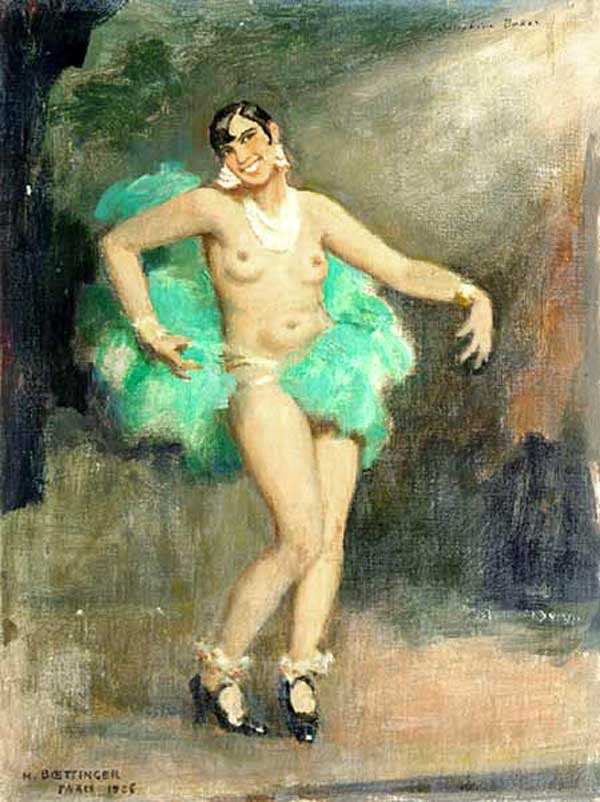
We meet Joséphine Baker in the small apartment on the Rock of Monaco offered to her by Princess Grace — autumn 1974, a few weeks after her triumphant return to the Bobino stage in Paris, where the audience refused to stop applauding for twenty minutes. At sixty-eight, she carries herself with the same precise authority that once made the whole of Paris stop and stare. On the table beside her, a cup of black coffee and, catching the afternoon light, the ribbon of her Légion d'honneur.
—What do you remember of Saint-Louis, and what did those early years ultimately give you?
Saint-Louis was both my beginning and my wound. I was eleven years old when the riots came in 1917 — not a distant rumor but fire in the streets, men and women fleeing with whatever they could carry. We hid. We prayed. I learned very early that in Missouri, the color of your skin could put a price on your life at any moment. But I also learned something the riot-makers never intended to teach: that the only way out was through movement, through art, through refusing to stay where they wanted to keep me. Every step I took toward the road, toward music, finally toward the boat to France — all of it began in that burning street. Saint-Louis gave me my reason to run, and, eventually, my reason to face it down.
—In 1937 you took French citizenship. What did that decision truly mean to you?
When I signed those papers in 1937, I was not simply changing a document. I was cutting a cord that had been strangling me since birth. In America, no matter how many front pages my face appeared on, I would be seated at the back of a restaurant, turned away from a hotel, watched by eyes that reduced me to a color. France was not perfect — I had no illusions about its own contradictions — but Paris had offered something my birth country refused: the right to be judged by my work, my voice, my presence on a stage. I remember thinking, once the ink was dry, that I could finally breathe without checking first whether breathing was permitted in this particular room. When I later stood at the Washington podium in my French army uniform, that uniform was the truest answer I could give to everything I had fled.
I could finally breathe without checking whether breathing was permitted in this particular room.
—You arrived in Paris in 1925 with almost nothing, and La Revue Nègre changed everything overnight. What was it like to walk onto that stage at the Théâtre des Champs-Élysées?
I had arrived with almost nothing — a trunk of costumes and the absolute determination to make it work. That night at the Théâtre des Champs-Élysées, Paris came to meet me — not gently. The audience went silent first, then erupted. La Revue Nègre was not simply a show; it was jazz moving through bodies in ways that European concert halls had kept behind locked doors, rhythms they had read about in magazines but never felt in their bones. I sensed the electricity before the curtain even rose — a dangerous charge in the air, as if the city itself knew something was about to break open. I had been told I was too dark, too angular, not the right kind of beautiful. That night I discovered that the right kind of beautiful was the kind that makes a room forget how to breathe.
The right kind of beautiful was the kind that makes a room forget how to breathe.
—The banana-belt costume became one of the most recognizable images of the twentieth century. How did you think about the image you were projecting?
The bananas — everyone wants to talk about the bananas. I understand why: sixteen of them, dangling from my hips at the Folies Bergère in 1926, and within weeks my face was on every news-stand in Europe. But here is what people rarely ask: I chose that costume. I understood exactly what I was doing. Paris had a fantasy about Africa, about something primal and untamed. I took that fantasy and wore it like armor, danced it into something so extreme it became a provocation — my provocation, not theirs. When you control the absurdity, you control the room. Paul Colin painted me on those posters with clean geometric lines, Art Déco strokes, a silhouette that said: this woman is a force. The bananas were a door. I walked through it to absolute freedom.
—When France fell in 1940, you could have used your American passport and your fame to sit the war out safely. Why did you choose to fight?
Several people close to me said exactly that: you are a star, you are protected, stay out of it. But I had become French by choice, which is a far more deliberate thing than French by accident of birth. And Captain Abtey came to see me and explained what was needed. I did not hesitate for a single afternoon. These were the people who had let me breathe, who had given me a stage, a country, a life that resembled freedom. The least I could do was risk that life to protect theirs. There is a kind of debt that can only be paid with action — not with concerts, not with newspaper interviews. When Paris fell silent under the Occupation, the only meaningful answer was to become one of the voices it could not silence.
—Your missions for the Deuxième Bureau required you to smuggle intelligence across borders. How did you carry secrets without being caught?
I traveled through Morocco, Spain, Portugal — countries where the Axis had eyes and ears in every hotel lobby — and I traveled as a star, which is the most useful disguise imaginable. Nobody searches a famous singer's luggage with real thoroughness; they ask for autographs. The information was written in invisible ink on my sheet music, sometimes on my body. I memorized troop movements, airfield positions, conversations overheard at the right parties. What I remember most vividly is not the danger but a strange calm during those crossings. On stage I had always known how to hold a face perfectly still while everything inside is moving at full speed. Espionage, it turned out, required exactly the same discipline. Marrakech, Lisbon, Madrid — they were all, in a way, performances.
—You adopted twelve children of different nationalities and faiths and brought them to the Château des Milandes. Was the Tribu Arc-en-ciel an act of love, a political statement, or something you could not separate?
Both — and anyone who tells you that love and politics can be separated has never tried to raise a family. When I began bringing children home to Les Milandes — a Korean boy, a Colombian girl, a Japanese child, a Finnish boy, a Moroccan, a child from the Périgord next door — I wanted the world to see what it could look like if you simply decided that blood and soil had no claim on how you love. Twelve children, twelve nationalities, several religions, one table. Was it naive? Perhaps. But I had seen what happens when nations decide that difference is intolerable. I had hidden as a child in Saint-Louis while men burned houses because the skin of the people inside was the wrong color. The Tribu Arc-en-ciel was my answer to every man who ever held a torch.
—In 1951, you refused to perform before segregated audiences in America. What happened when you held that line?
My condition was simple and absolute: if colored patrons could not sit where white patrons sat, I would not step onto the stage. No exceptions, no negotiations, no polite compromises. Some venues turned me away. Others gave in. A few that had never before admitted a Black audience to the main floor did so for the first time that season — not out of generosity, but because the box office demanded it. I had written to the NAACP stating this position clearly, and I meant every word of it. I had no illusions that one singer could dismantle a legal system built over generations. But I understood that every time a house opened its floor to a mixed audience, something shifted — even slightly — in what people understood to be inevitable. 1951 was not the end of anything. It was evidence that the walls had a seam.
—At the March on Washington on August 28th, 1963, you were the only woman to speak from the podium. What did you say to that crowd of a quarter of a million people?
I stood there in my French army uniform and I spoke about what I knew from experience, not from theory: that there existed a country where I could walk into any restaurant, take any seat, be judged by my art and not by my complexion. France had given me that. America had not — not yet, not fully, not for everyone standing on that lawn. I told that crowd what it felt like to return to Europe and breathe freely again, to feel like a complete human being rather than a category. I did not say it to wound anyone. I said it because the truth spoken out loud, in front of witnesses, is the only currency that buys anything lasting. Martin Luther King spoke of a dream that day. I spoke of something I had already lived.
Martin Luther King spoke of a dream. I spoke of something I had already lived.
—A few weeks ago at the Bobino, Paris gave you a twenty-minute standing ovation. What does a night like that tell you about a life like yours?
Twenty minutes. I am told it lasted twenty minutes, though I could not count them — I was standing there at the Bobino with the stage lights in my face and a sound that felt less like applause than like the sea. I am sixty-eight years old. I was expelled from Les Milandes five years ago with almost nothing. Princess Grace opened her door to me when many others had quietly closed theirs. And then Paris came back — all of Paris — as if to say: we remember who you are. What does a night like that tell you? It tells you that nothing was wasted. Not the château, not the campaigns, not the years of fighting, not the twelve children I tried to raise as proof of something the world was not yet ready to believe. You do not receive an ovation like that for a career. You receive it for a life. And I intend to keep living mine.

This imaginary interview was generated by artificial intelligence from sources documented in Joséphine Baker's profile. It dramatises what the figure might have said based on what we know about them, but does not constitute attested historical testimony. For primary sources and factual documentation, refer to the full profile.