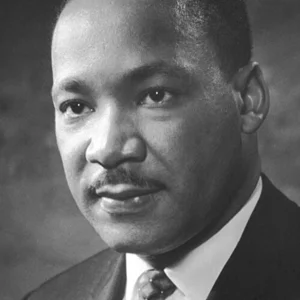

African-American Baptist pastor (1929–1968) and major leader of the civil rights movement in the United States. He championed nonviolence and racial equality, becoming one of the most influential figures of the 20th century before his assassination.
Martin Luther King(1929 — 1968)
Martin Luther King
États-Unis
8 min read
Frequently asked questions
Famous Quotes
« I have a dream that one day this nation will rise up and live out the true meaning of its creed.»
« Darkness cannot drive out darkness; only light can do that. Hate cannot drive out hate; only love can do that.»
« Injustice anywhere is a threat to justice everywhere.»
Key Facts
- 1955–1956: Montgomery Bus Boycott in Alabama against racial segregation
- 1963: Delivered the 'I Have a Dream' speech at the March on Washington for Jobs and Freedom
- 1964: Awarded the Nobel Peace Prize at the age of 35
- 1965: Led the Selma to Montgomery marches in support of Black voting rights
- 1968 (April 4): Assassinated in Memphis, Tennessee
Works & Achievements
King's first book, recounting the Montgomery Bus Boycott and laying out the philosophical and Christian foundations of his doctrine of nonviolence.
A foundational text written in the margins of newspapers from his cell, responding to white clergymen who urged him to wait; in it he justifies civil disobedience and the urgency of equality.
Considered one of the greatest speeches in American history, it expresses the vision of a reconciled, equal, and fraternal America, and remains the universal symbol of the civil rights movement.
A book analyzing the causes and stakes of the major demonstrations of 1963, advocating for immediate and radical action against segregation.
King affirms his faith in humanity's capacity to overcome violence and hatred through nonviolence, in the context of the Cold War and decolonization.
The last book published during his lifetime, in which King broadens his struggle to encompass economic inequality and criticizes the Vietnam War, charting a path toward broader social justice.
His final speech, delivered the night before his assassination in Memphis, in which King, as if prophetically, alludes to his own death while expressing his certainty that his people will reach the promised land of freedom.
Anecdotes
During the Montgomery Bus Boycott of 1955, Martin Luther King was not expected to lead the movement: it was Rosa Parks herself and the NAACP activists who chose this unknown 26-year-old pastor to head the Montgomery Improvement Association. His eloquence at the first public meeting electrified the crowd and propelled him to the heart of the struggle.
On August 28, 1963, during the March on Washington, King had prepared a very different speech. It was singer Mahalia Jackson who called out to him from the stage: 'Tell them the dream, Martin!' He then set aside his notes and improvised the most famous part of his speech, 'I Have a Dream', which became one of the most significant texts of the 20th century.
In 1964, King received the Nobel Peace Prize at just 35 years old, becoming at the time the youngest laureate in history. He donated the entire $54,000 prize to the civil rights movement, refusing to keep a single cent for himself.
The FBI under director J. Edgar Hoover viewed King as a threat to national security and kept him under constant surveillance. Hoover even sent him an anonymous letter accompanied by compromising recordings, urging him to commit suicide before the presentation of his Nobel Prize. King ignored the letter and continued his fight.
King was stabbed as early as 1958, during a book signing in New York, by a mentally disturbed woman. The blade had lodged so close to his aorta that doctors stated that had he merely sneezed, he would have died. Ten years later, in 1968, he was shot and killed in Memphis, Tennessee.
Primary Sources
We know through painful experience that freedom is never voluntarily given by the oppressor; it must be demanded by the oppressed.
I have a dream that my four little children will one day live in a nation where they will not be judged by the color of their skin but by the content of their character.
I've been to the mountaintop... And I've seen the Promised Land. I may not get there with you. But I want you to know tonight, that we, as a people, will get to the Promised Land.
Nonviolence is not a method for cowards. It does resist. [...] The soul of nonviolence is love.
I refuse to accept the idea that mankind is so tragically bound to the starless midnight of racism and war that the bright daybreak of peace and brotherhood can never become a reality.
Key Places
The first parish where King served as pastor and the starting point of his activist commitment during the 1955–1956 bus boycott.
Site of the 'I Have a Dream' speech delivered on August 28, 1963, before 250,000 people during the March on Washington for Jobs and Freedom.
Scene of 'Bloody Sunday' on March 7, 1965, where peaceful marchers were violently attacked by police, sparking worldwide outrage and accelerating the passage of the Voting Rights Act.
The site where Martin Luther King was shot and killed on April 4, 1968. Now transformed into the National Civil Rights Museum.
King's birthplace, where he was born in 1929 and grew up in the Auburn Avenue neighborhood; his birth home and Ebenezer Baptist Church, where his father served as pastor, are preserved there.
The venue where King received the Nobel Peace Prize on December 10, 1964, cementing international recognition of his nonviolent struggle.
Typical Objects

King drew deeply from the writings of Mahatma Gandhi on nonviolent resistance. His Bible and Gandhi's works were constant companions and formed the foundation of his philosophy of peaceful civil disobedience.

An exceptional orator, King used the microphone as his primary tool for mobilization. His speeches delivered in Baptist churches, stadiums, and public esplanades were the driving force of his struggle.

As a pastor, King consistently wore the white clerical collar, a symbol of his moral and religious authority, paired with a plain dark suit that reinforced his image as a dignified and respected leader.

J. Edgar Hoover's FBI wiretapped King for years. The telephone paradoxically became one of the symbols of the repression he endured, even as he continued to organize the movement.

The marches organized by King were accompanied by signs bearing slogans demanding equality. These signs, carried peacefully, were the visual response to the violence of segregationists.

The medal received in Oslo in 1964 symbolized the international recognition of King's nonviolent struggle. He donated the entirety of the financial award to the civil rights movement.
School Curriculum
Vocabulary & Tags
Key Vocabulary
Tags
Daily Life
Morning
King woke early to pray and read the Scriptures, a practice inherited from his Baptist upbringing. He would then go through the national press to follow reactions to the movement's latest developments before making numerous phone calls to coordinate activist actions with his SCLC colleagues.
Afternoon
His afternoons were devoted to strategy meetings, negotiations with local authorities, or meetings with political officials in Washington. He also prepared his sermons and speeches, working on his texts drawing on the Gospels, Thoreau, and Gandhi.
Evening
In the evenings, King often officiated as a pastor in a church, turning the service into a militant gathering. He would then spend long hours discussing strategy with close collaborators such as Ralph Abernathy, late into the night, before retiring to a motel room — his itinerant life leaving him little time with his family in Atlanta.
Food
King loved traditional African American Southern cuisine: fried chicken, slow-cooked greens, cornbread, and sweet potato pie. Shared meals after services in the kitchens of Baptist churches were also moments of activist cohesion and community solidarity.
Clothing
King invariably wore a plain dark suit (black or navy blue) with a tie, an outfit that lent him the authority of both pastor and political leader. The white clerical collar appeared during religious ceremonies. This understated elegance was a deliberate activist choice: projecting African American dignity in the face of racist stereotypes.
Housing
The King family lived in a modest house in Atlanta, Georgia. During his relentless travels across the South and the country, King stayed in motels often reserved for Black guests, as hotels were segregated. The family home in Atlanta was even the target of a bombing in 1956, a symbol of the constant threats he faced.
Historical Timeline
Period Vocabulary
Visual Style
Esthétique documentaire en noir et blanc des années 1950-60, mêlant portraits intenses de militants dignes, grandes foules en marche et architecture monumentale de l'Amérique sudiste et fédérale.
Sound Ambience
Un mélange de gospels baptistes, de chants de liberté portés par des foules en marche et de la voix puissante d'un prédicateur s'adressant à des milliers de personnes dans l'Amérique ségrégationniste des années 1950-1960.
Liens externes & ressources
Références
Œuvres
Stride Toward Freedom : The Montgomery Story
1958
Lettre de la prison de Birmingham
1963
Discours 'I Have a Dream'
28 août 1963
Why We Can't Wait
1964
Discours de réception du Prix Nobel de la paix
10 décembre 1964
Where Do We Go from Here: Chaos or Community?
1967
Discours 'I've Been to the Mountaintop'
3 avril 1968