Imaginary interview with Katharine Burr Blodgett
by Charactorium · Katharine Burr Blodgett (1898 — 1979) · Sciences · Technology · 6 min read
Schenectady, a winter morning in the late 1950s. In the General Electric research laboratory, a woman in a dark lab coat tilts a perfectly transparent sheet of glass toward the light, then picks up a second one that reflects a thousand glints. Katharine Burr Blodgett sets down her notebook and agrees to speak, with that calm precision of people who have spent their lives measuring the infinitely thin.
—How does a fifteen-year-old girl end up walking through the doors of a major industrial laboratory?
I was fifteen, and one of my father's former colleagues gave me a tour of the General Electric laboratories, right here in Schenectady. That's where I was introduced to Irving Langmuir. He didn't treat me like a passing curiosity: he showed me his instruments, listened to my questions, and then advised me to go further in my studies before coming back. A dry piece of advice, almost a challenge. I followed it to the letter — a bachelor's degree from Bryn Mawr in 1917, a master's from Chicago the following year. And in 1918, they called me back: I became the first woman scientist hired by the company. My father, a patent attorney for the same company, had died before I was born; so I entered, without having planned it, the world that had been his.
He didn't treat me like a passing curiosity: he listened to me, then threw down a challenge.
—What did that PhD from Cambridge in 1926 mean for a woman of your generation?
The Cavendish Laboratory at Cambridge was then directed by Ernest Rutherford — the very heart of world physics. There I studied the behavior of electrons in ionized mercury vapor, an arid subject requiring endless nights of patience. When I received my PhD in 1926, I was told I was the first woman to earn that title in physics at that university. I didn't see it as a trophy; simply a door that others would now find slightly ajar. Honors came later, like the Garvan Medal in 1951 for women in chemistry. But I believe the true privilege was having, very young, mentors who judged an experiment on its rigor, not on the hand that conducted it.
Not a trophy: a door that others would now find slightly ajar.
—Do you remember the principle that allowed you to stack molecules one by one?
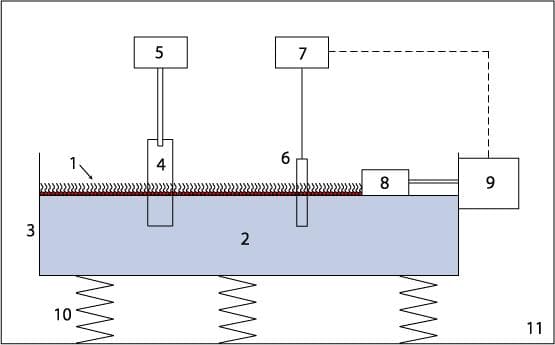
It all begins on water. In what is now called the Langmuir-Blodgett trough, you spread a film of molecules one layer thick on the surface, held by surface tension — that fine invisible skin of the liquid. Then you simply dip and slowly withdraw a plate: with each pass, a layer deposits itself, regular, on command. I described this process in 1935 in the Journal of the American Chemical Society. My material of choice was barium stearate, a fatty substance that agreed to order itself, molecule against molecule. What fascinated me was the control: building a thickness not by accident, but count by count, like stacking sheets of paper — except each sheet is a single molecule.
Building a thickness count by count, each sheet measuring a single molecule.
—How do you measure a thickness a thousand times finer than a hair, without complicated equipment?
By color. That's the principle of my color gauge. As I deposited my layers of barium stearate one by one, I noticed that the film took on changing hues depending on its thickness — a bit like the iridescence of an oil slick. Each color corresponds to a precise number of layers. So you just compare the resulting shade to a reference scale to read the thickness directly, to within a few molecules, without a microscope or costly instrument. I liked this economy of means: a ruler graduated at the molecular scale, almost fitting in your hand. Nature offered me the dial; I only had to learn to read it.
Nature offered me the dial; I only had to learn to read it.
—How did you achieve that famous "invisible glass"?
In 1938, I applied those same thin layers to glass, and I discovered that a carefully chosen thickness made almost all reflections disappear. The secret lies in light interference: the light reflected from the film's surface cancels out the light reflected from the glass, so the eye no longer perceives any glare. To demonstrate this, we photographed two frames side by side — one covered with annoying reflections, the other so clear you'd swear there was nothing there. The press called it invisible glass; the term stuck. I explained the reasoning in 1939 in the Physical Review, under the title Use of Interference to Extinguish Reflection of Light from Glass. It wasn't a magic trick, but an exact consequence of wave physics.
One covered with annoying reflections, the other so clear you'd swear there was nothing there.
—What does such an invention change for those looking through a lens or a scope?
Every optical instrument loses a bit of light at each glass surface it passes through, and picks up a stray reflection. Multiply that by the many lenses of a photographic objective or a microscope, and the image dims. By eliminating these reflections, my treatment makes images sharper, brighter, more faithful. It equipped cameras, eyeglasses, projectors. But the use that struck me most was the submarine periscope: a submerged sailor could finally observe the surface without being blinded by reflections on his own glass. A process born on a water trough, in a Schenectady laboratory, ended up making clearer the view of a man under the sea.
A process born on a water trough made clearer the view of a man under the sea.
—When the United States enters the war, how do your surface studies transform?
War shifts a laboratory's priorities. After the country entered the war in 1941, I was asked to turn my experience with surfaces toward pressing needs. In 1942, I worked on developing smoke screens — fine clouds capable of hiding troops or ships from enemy view, a matter of droplets and dispersion, very close to my films. I also looked into de-icing aircraft wings, because ice forming at altitude can doom a plane. The same concern for what happens at the boundary between two materials — air and metal, light and glass — guided me. Science does not cease to be science because it is put to the service of an emergency.
Science does not cease to be science because it is put to the service of an emergency.
—What is it like knowing your work is used for military purposes?
One does not always choose the use of one's discoveries, but one can choose to contribute with awareness. My smoke screens protected lives rather than taking them; my antireflective glass helped a man see better from his periscope, not to strike better. Over my career, I filed eight U.S. patents between 1917 and 1963, and several of these works found immediate application in wartime. I preferred concrete problems, those with a measurable answer: does this wing ice less? Does this cloud last long enough? The rigor of the laboratory is the same, whether you serve peace or face the storm. What changes is the weight of what you hold in your hands.
—What do you do once the lab coat is put away, in the evening?
I leave thin layers for broader things. In the evening, in Schenectady, I like to garden — there's an amusing continuity between tending plants and monitoring films, the same attention to small differences. I also take out my amateur telescope: after spending my days bent over the infinitely thin, I like to raise my eyes to the infinitely distant. There's bridge with my friends, and theater — I perform with the local troupe, which surprises those who imagine me buried in my notebooks of measurements. In summer, I retreat to a cottage on Lake George. You cannot measure well if you have not, somewhere, learned to look for the sheer pleasure of looking.
After days bent over the infinitely thin, I like to raise my eyes to the infinitely distant.
—You never knew your father. What place did that absence hold in your life?
My father, a patent attorney for General Electric, was killed by a burglar a few weeks before my birth in 1898. So I never knew him, and yet I grew up in the extension of his world — that of inventions, patents, laboratories. There is an irony there that I do not try to untangle: I ended up filing my own patents in the very company that employed him. I've often been asked if this was fate; I don't believe it. Let's say rather that a family transmits a climate, a way of looking at the world, even before it transmits memories. I received that climate without receiving the man, and I built the rest myself, layer by layer.
A family transmits a climate, a way of looking, even before memories.
This imaginary interview was generated by artificial intelligence from sources documented in Katharine Burr Blodgett's profile. It dramatises what the figure might have said based on what we know about them, but does not constitute attested historical testimony. For primary sources and factual documentation, refer to the full profile.