Imaginary interview with Kono Yasui
by Charactorium · Kono Yasui (1880 — 1971) · Sciences · 5 min read
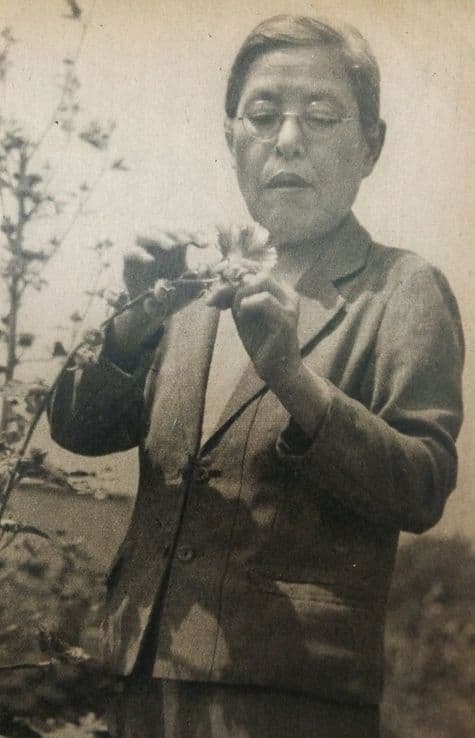
Ochanomizu, an autumn morning in the late 1960s. In a modest office where the smell of paper and dyes has never entirely disappeared, a woman of nearly ninety arranges glass slides with the precision of a gesture repeated ten thousand times. Kono Yasui agrees to look back on a life spent watching, through the microscope, the invisible world of plants.
—How did you become, in 1911, the first Japanese woman published in a foreign scientific journal?
It was a small floating fern, Salvinia natans, that opened the world to me. I wanted to understand its entire life cycle, from spore to adult plant, that slow passage from one generation to the next that so few had followed step by step. I sent my study to London, to the Annals of Botany, hardly daring to believe: a Japanese woman, a female, in a laboratory where we were barely tolerated. When the journal accepted it, in 1911, I understood that patient observation was worth all the passes. That same year, in Tokyo, Raichō Hiratsuka was founding her journal Seitō; I wrote no manifesto, I described a fern. But to describe honestly what one sees was already, in my own way, to claim a place.
Patient observation was worth all the passes.
—It is said that your departure abroad required a curious arrangement. What happened?
The Ministry of Education hesitated to fund a woman for a research stay. So they did what is often done with what is troublesome: they disguised it. My field of study was officially registered as 'science and home economics', as if I were going to learn housekeeping rather than count chromosomes. And I was expected to commit not to marry, to devote myself entirely to science. I accepted without drama: what I wanted was the microscope of Chicago, those years 1910 when I deepened plant cytology under foreign masters. They had given me an absurd label; I turned it into a train ticket.
They had given me an absurd label; I turned it into a train ticket.
—Your 1927 doctorate was on coal. How does a botanist come to study coal?
Because coal is nothing more than plants that have forgotten they were alive. Under the guidance of botanist Kenjiro Fujii, at Tokyo Imperial University, I cut translucent slices of fossil samples with a microtome, so thin that light passed through them, and I searched in the coal for the cellular trace of plants extinct for millions of years. One can still sometimes see the ghost of a tissue, the geometry of a cell frozen in black rock. This work earned me, in 1927, the honor of being the first Japanese woman to receive the title of rigaku hakushi, Doctor of Science. Much was said about this 'first'. I thought mainly of those patient plants that had taken eons to become coal, and which I was tracing backwards.
Coal is nothing more than plants that have forgotten they were alive.
—What did your working days actually look like?
They began early, in the silence of the laboratory. Mornings were devoted to preparation: cutting thin sections of plant or coal, staining them so that the chromosomes, otherwise nearly invisible, would show themselves, then mounting them under the optical microscope. In the afternoon, I counted. Counting chromosomes is a humble and stubborn task, requiring the same attention as a copyist who must not skip a line. And I taught the young women at the Tokyo Women's Higher Normal School, where I stayed from 1907 to 1949. In the evening, I drew by hand what I had seen, because photomicrography was not yet common. A sketchbook was then better than a machine.
Counting chromosomes requires the attention of a copyist who must not skip a line.
—Why did you hold onto that sketchbook so tightly, when photography already existed?
Because drawing is understanding twice. When I reproduced by hand the division of a cell, mitosis, those chromosomes that double and separate like dancers lining up in two rows, my hand was forced to follow what my eye thought it had seen — and sometimes it unmasked an error in my gaze. Karyology, the meticulous study of the number and shape of chromosomes, forgives no approximation. A snapshot freezes a moment; a drawing, on the other hand, forces you to choose what matters. For over forty years in Tokyo, that notebook was my true laboratory, the one where observation became knowledge.
Drawing is understanding twice.
—You refused, it is said, to be introduced as 'a learned woman'. Why?
Because the phrase confines rather than honors. At the time, people spoke of the atarashii onna, the 'new woman', educated and independent, often looked upon askance. I did not want that kind of curiosity. When I was introduced first as a woman, then as a researcher, readers were invited to marvel that I existed, not to examine what I had found. Yet a cytological preparation has no gender: it is either well done or poorly done. I only asked to be judged like any other scientist, on the clarity of my slides and the accuracy of my counts. To deny me that was to deny me science twice.
A cytological preparation has no gender: it is either well done or poorly done.
—And yet, at the end of your career, you founded a scholarship specifically for women. Is that not contradictory?
People have pointed that out, and I understand the objection. But refusing the label for oneself does not oblige one to close the door behind one. Toward the end of the 1950s, with chemist Chika Kuroda, the second Japanese woman to earn a doctorate in science, we pooled our savings to create a scholarship, a shōgakukai, for young women who wanted to do research. I did not want them to be treated as curiosities; I wanted them to have the material means to be ordinary researchers. The difference is subtle but complete: I was not asking for special consideration; I was asking for microscopes, salaries, time. Kuroda and I knew too well what it costs to have none of that.
I was not asking for special consideration; I was asking for microscopes, salaries, time.
—What does it feel like to observe, under a microscope, tissue millions of years old?
A kind of quiet vertigo. Before a fragment of fossil coal, you hold in your hand a piece of a sunken forest, and under the lens suddenly appears the wall of a cell that breathed in an age without name. Botany had taught me to read the present of plants; coal taught me to read their most distant past. It takes patience, many dyes, and an almost unreasonable trust that a structure as fragile as a cell can leave an imprint after so many geological eras. Each time the slice revealed a clear trace, I felt I was receiving a letter from a vanished world, written in a language few still knew how to read.
Under the lens, a piece of a sunken forest that breathed in an age without name.
—After so many years, what still keeps you at the microscope?
Curiosity does not retire, even when the researcher must. In 1949, when my old institution became Ochanomizu University, I was made professor emeritus, which is an elegant way of saying you are thanked while being kept on. But I come back to the slides as others return to their garden. Each preparation remains a small enigma: how many chromosomes, what shape, what behavior at division. Cytology has this virtue: it never exhausts itself; there will always be a cell to surprise you. I have seen Japan pass from the Meiji era to the postwar period, but under the microscope, time stops, and there is only light, glass, and that obstinacy of the living to let itself be deciphered.
Curiosity does not retire, even when the researcher must.
—In hindsight, how do you judge the price you paid to do science?
I never experienced it as a sacrifice, even if others have called it that. I lived unmarried, in a modest apartment in Tokyo, close to my research sites, surrounded by my notebooks and specimens rather than a family. That commitment not to marry, which had been extracted from me before Chicago, I transformed into a freedom: the freedom to give all my time to plants. Rice, fish, green tea, a life without excess or social glitter — that was enough for me. Everyone exchanges a part of their life for what they love; I exchanged mine for the right to understand how a cell divides. I would make that deal again without hesitation.
I exchanged my life for the right to understand how a cell divides.
This imaginary interview was generated by artificial intelligence from sources documented in Kono Yasui's profile. It dramatises what the figure might have said based on what we know about them, but does not constitute attested historical testimony. For primary sources and factual documentation, refer to the full profile.