Kids interview Kono Yasui
by Charactorium · Kono Yasui (1880 — 1971) · Sciences · 5 min read
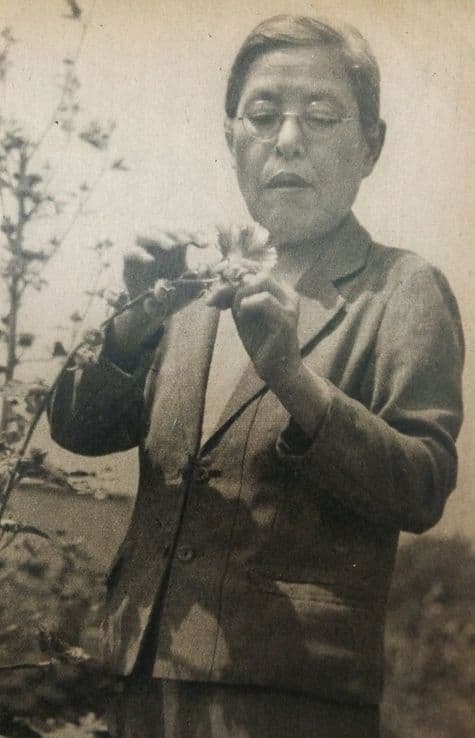
Two young visitors, on a discovery field trip, step through the door of an old Tokyo laboratory where a ninety-year-old lady awaits them. On the table: a microscope, notebooks full of drawings, and thin coal plates. Kono Yasui smiles at them and invites them to sit close by.
—What was it like the first time you were published abroad?
You know, my child, I was about thirty years old. I was studying a tiny fern that floats on water, Salvinia natans. Imagine a green leaf, minuscule, resting on a calm pond. I followed its entire life, from spore to adult plant. In 1911, a major English journal, Annals of Botany, accepted my study. I was the first woman from Japan published in a scientific journal of another country. My heart was beating fast. Few women entered a laboratory at that time. So seeing my work read on the other side of the world was like opening a window.
A tiny fern opened a window to the whole world for me.
—Did you go far away to study? Where was it?
Yes, my child. I went all the way to America, to the University of Chicago, in the 1910s. Imagine a very long boat trip, weeks at sea, without knowing what awaits you there. My Japan was changing fast at that time; they called it the Meiji era: we were discovering Western sciences, everything was moving very quickly. There, I learned to observe plant cells better. Then I came back, my head full of new ways of working. Traveling wasn't for pleasure. It was to bring back knowledge and share it at home.
I crossed the sea to bring back knowledge, not a souvenir.
—Is it true they asked you not to marry so you could go?
It's true, and that surprises you, doesn't it? In my time, the ministry hesitated to pay for a woman's studies abroad. So, to make it work, my research was registered under a strange name: “Science and Home Economics.” And I committed not to marry, to devote myself entirely to science. Imagine being asked to choose between family life and your dream, all by yourself. Boys didn't have that choice. I accepted. Science was my home.
They asked me to choose; boys didn't have to choose anything.
—Did you like being called “the learned lady”?
No, my child, not at all. Many wanted first to see a woman, a curiosity. People talked then about atarashii onna, the “new women,” those who studied and worked. People looked at them askance. I wanted my work, my drawings, my observations to be judged. Not my gender. Imagine you paint a magnificent picture, and they only talk about your hair or your dress. That would be annoying, wouldn't it? I wanted to be a scientist, plain and simple, like any other researcher bent over their microscope.
Judge my work, not the color of my dress.
—What was your day in the laboratory like?
I got up very early, my child. In the morning, I prepared my samples. With a device called a microtome, I cut plant slices so thin they were almost transparent. Then I stained them with special dyes, otherwise you couldn't see anything at all. In the afternoon, I spent hours bent over my microscope, that instrument that magnifies the very small. I counted chromosomes: they are tiny rods, hidden in the heart of cells, that carry the secrets of life. It was long, patient. But every detail mattered.
A slice so thin you could see through it: that's where science begins.
—How did you keep what you saw under the microscope?
Ah, good question! In my time, you couldn't easily take a picture of what you saw in the microscope. So I drew, my child. Every evening, I had a notebook, and I reproduced by hand, with the greatest care, every cell, every chromosome. Imagine having to copy a tiny piece of lace without missing a thread. My eyes and my hand were my only tools to preserve the memory of that invisible world. These drawings were later used to write my articles. A scientist, you know, must also know how to look well and show well.
Without photography, my pencil was my memory.
—Your great work was on coal? Why coal?
Yes! That surprises you, a botanist studying coal? But coal, pit coal, is ancient plants. Buried underground for millions of years, they slowly turned into black rock that burns. With my microscope, I looked in those pieces for traces of the cells of extinct plants. Imagine opening a stone and finding a sleeping forest inside. In 1927, this study earned me becoming the first Japanese rigaku hakushi, Doctor of Science. No woman in my country had obtained that title before me.
In a piece of coal, I looked for a sleeping forest.
—What did you eat, how did you live when you worked so much?
A very simple life, my child. I lived alone, in a modest apartment in Tokyo, very close to my laboratory. In the morning, a bowl of rice, a little fish, miso soup, green tea. Nothing excessive. Sometimes I wore a kimono, sometimes Western-style clothes, like educated women of my time. In the evening, I read journals from Europe and America to keep up with discoveries. My life revolved around my work, and that made me happy. I didn't need much to be well.
A bowl of rice, a microscope: I didn't need more.
—Did you teach for a long time? Did you like the students?
Oh yes, more than forty years! I taught at the Tokyo Higher Normal School for Girls, one of the few places where women could study science. Imagine rows of curious young girls, bent over their notebooks, to whom I passed on patience and the love of careful observation. It was as precious to me as my research. Every student I trained was a little door opening a bit wider. In 1949, the school became Ochanomizu University, and I retired. But my students continued the path.
Every student I trained was a door I opened a little wider.
—What is that scholarship you created for women?
Ah, that one, I am very proud of it, my child. With my friend Chika Kuroda, a chemist, the second Japanese woman to earn a Doctor of Science, we pooled our savings. All our little savings from a lifetime of work. We created a fund, a scholarship, to help young women who wanted to do research. You understand, the path had been so difficult for me. I didn't want others to hit the same walls. Giving a little money was giving a little freedom. It was my way of saying, “Go ahead, your turn.”
We gave our savings to open the door for others.
—If we could follow you for a day, what would surprise us the most?
Probably my silence, my child. Imagine a very quiet room, without any engine noise, just the creak of the microtome and the rustle of my pages. In my time, science demanded a lot of time and patience. No hurry. You would spend hours watching me count little rods, one by one, without ever getting tired. And you would see that a woman, with a microscope, a pencil, and perseverance, can discover things no one had seen. I lived to ninety, carried by that curiosity that never left me.
A microscope, a pencil, patience: that's enough to see the invisible.
This imaginary interview was generated by artificial intelligence from sources documented in Kono Yasui's profile. It dramatises what the figure might have said based on what we know about them, but does not constitute attested historical testimony. For primary sources and factual documentation, refer to the full profile.