Imaginary interview with Liliuokalani
by Charactorium · Liliuokalani (1838 — 1917) · Politics · 6 min read
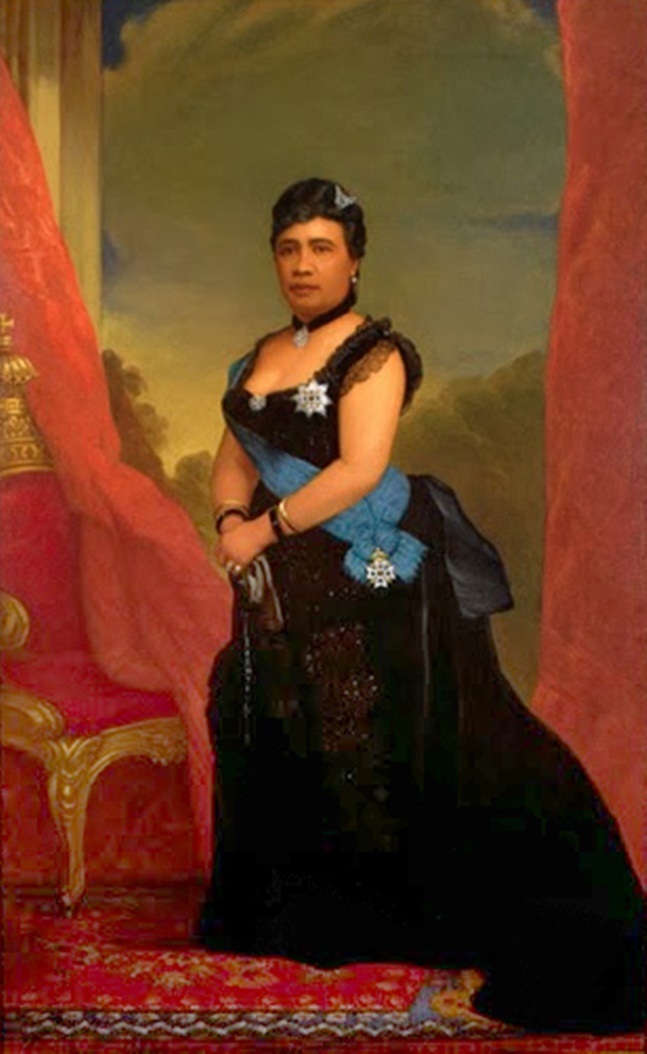
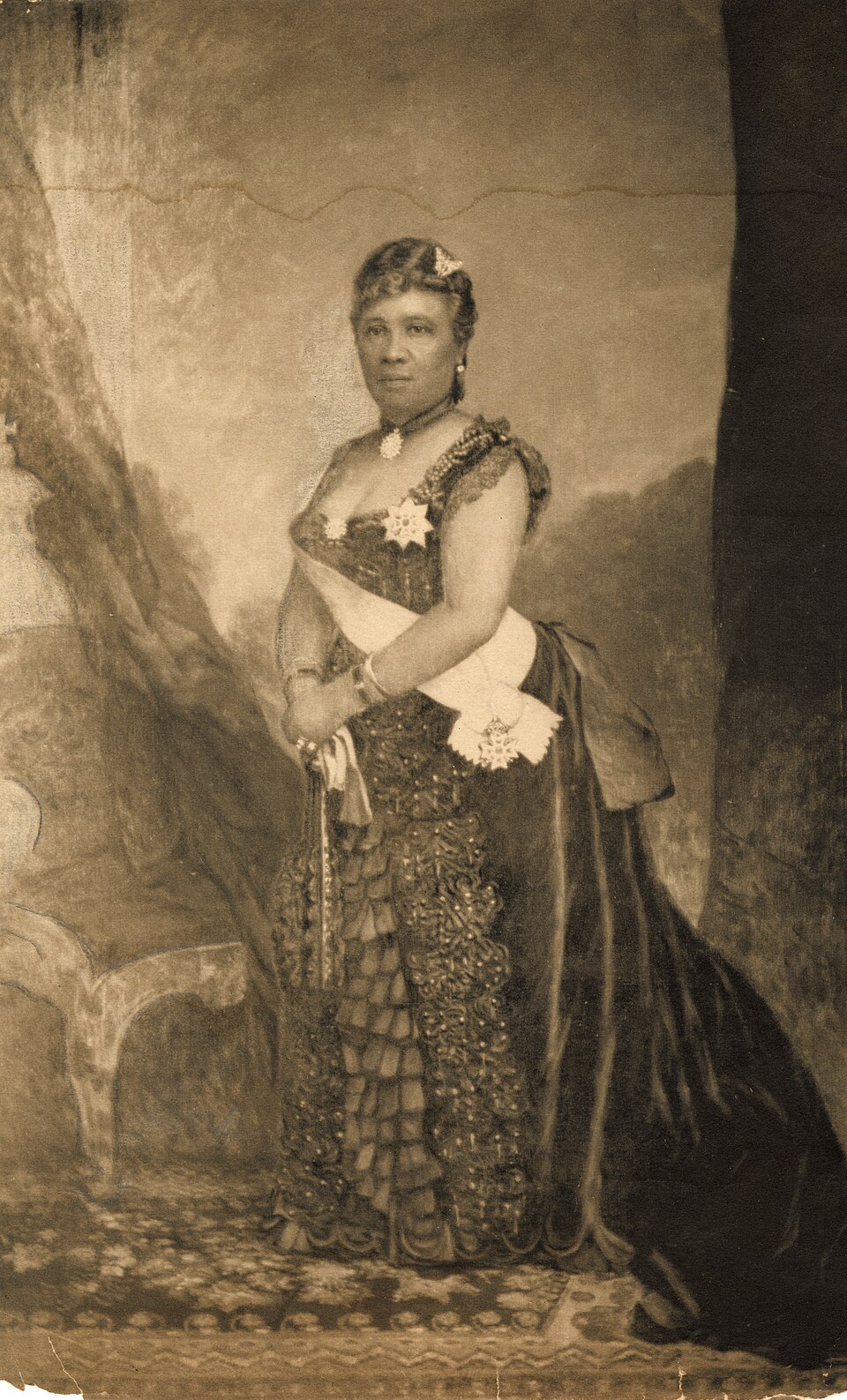
Honolulu, a late afternoon in 1916. On the veranda of Washington Place, an elderly lady in a dark dress receives us, a feather fan on her lap and a notebook of sheet music within reach. The kingdom she once ruled no longer exists, but her voice has yielded nothing.
—Even before your reign, how would you describe the Hawaiʻi in which you grew up?
People speak of paradise, but I saw a kingdom being nibbled away at the edges. As a child, in 1848, the Great Mahele carved up our communal lands into parcels that foreigners could buy — and they bought. The haole, those whites from the United States, planted sugarcane as far as the eye could see, and with sugar came their fortune, and with their fortune, their appetite to rule. We aliʻi inherited the mana, that sacred power conferred by lineage; they had only ledgers and contracts. The Reciprocity Treaty of 1875 sealed the deal: our sugar entered their country duty-free, and our planters grew so rich they already thought of it as their home. I saw native Hawaiian families lose their ancestral lands with a signature they could not read.
They had only ledgers and contracts; we had the sacred heritage of mana.
—What would you say about that so-called 'Bayonet Constitution' imposed on your brother?
The name says it all. In 1887, under threat of arms, my brother King Kalākaua was forced to sign a text that emptied the crown of its substance and reserved the vote for wealthy property owners — that is, almost exclusively the haole. A bayonet does not write a law; it extorts one. When I ascended the throne in 1891, my people begged me to give them back a voice, and I undertook to proclaim a new constitution to repair that humiliation. They accused me of tyranny! I, who only wanted to erase what had been wrested from us under duress. That proposal, which they brandished as a pretext, served them to prepare what came next. I had not realized how much more dangerous a queen can be, in their eyes, when she merely wants to do justice.
A bayonet does not write a law; it extorts one.
—Before politics, there was music. Do you remember the birth of Aloha ʻOe?
It was in 1878, during a ride across the hills of Oahu. I came upon a farewell between two young people — an embrace, a lingering look, that way lovers have of parting as if the world were about to end. The melody came to me on the way back, before the words. I wrote to my sister Likelike at the time that the melody came naturally, as if carried by the wind from the hills, because I wanted to capture that feeling of love and separation that lies at the heart of our people. I did not know then that this little song of parting would become the farewell of an entire kingdom. It is sung today from one ocean to another, and each time, it is a little bit of Hawaiʻi saying goodbye to what it once was.
I did not know that this song of parting would become the farewell of an entire kingdom.
—What were your evenings of composition like at court?
In the evening, when audiences and diplomatic correspondence finally fell silent, I gathered musicians and poets around me. It was my favorite hour. I would take up the ukulele or sit at the piano, and we would let the oli come — those unaccompanied chants that carry our genealogy and our gods. In this way I composed over a hundred and fifty pieces in my lifetime — my handwritten scores now rest in the state archives. For me, writing a song was not a princess's pastime: it was keeping alive a language the missionaries had wanted to silence, they who once banned the hula. My brother and I raised it again like a flag. Music, you see, was my first form of resistance, long before the petitions.
Music was my first form of resistance, long before the petitions.
—Let us come to January 1893. How did that day turn?
Everything happened in a few hours, and yet I had felt the storm brewing for weeks. A group of wealthy planters, those American businessmen of the Provisional Government, were only waiting for a signal. And the signal came in the form of Marines landed from the USS Boston, armed, under the pretext of protecting lives — their own, never ours. My capital, Honolulu, saw foreign soldiers take up positions opposite my palace. I had neither the army nor the desire to throw my people against rifles. That day I understood that they were not really overthrowing me: they were annexing in advance, stealing a kingdom while pretending legality. Iolani, that palace we had equipped with electricity before the White House itself, became the stage of our dispossession.
They were not overthrowing me: they were stealing a kingdom while pretending legality.
—Why did you choose to yield rather than fight?
Because a queen who loves her people does not lead them to slaughter to save her crown. I wrote my protest in terms I wanted unequivocal, and I wrote this: "I yield, under duress, to the superior force of the United States of America, whose minister plenipotentiary has caused the overthrow of the constitutional government of the Hawaiian Kingdom. I do so under pressure, to avoid any armed conflict." Understand the subtlety, for it was all my calculation: I was not yielding to those putschists, those men without title, but to the great Republic itself. I hoped that a people born of a revolution against injustice would, upon regaining its senses, repair mine. I placed my fate in the hands of Washington, persuaded that American honor would eventually speak louder than the greed of a few planters.
I was not yielding to those men without title, but to the great Republic itself.
—Two years later, you were a prisoner. What did that captivity in your own palace mean to you?
Imagine the irony: under house arrest in the very apartments where I had received ambassadors. In 1895, after the failure of a royalist uprising blamed on me, I was locked up for eight months at Iolani Palace. A queen turned prisoner under her own roof. But one can imprison a body, not a spirit that sings. I had my Hawaiian Bible and writing materials, and I clung to my Christian faith, true to the education I had received at the Royal School. I composed religious hymns in that room, like casting bottles into the sea. The silence of the corridors, once full of courtiers, was terrible — but it forced me into an inner work that the crown had never allowed me leisure to accomplish. Prison sometimes gives back to the soul what it takes from power.
One can imprison a body, not a spirit that sings.
—It was during this confinement that you translated the Kumulipo. Why that choice?
Because a people whose land and throne are taken must not, in addition, lose their beginning. The Kumulipo is our cosmogony, that poem of creation of two thousand verses that tells how the world and our lineage were born from the darkness. Translating it into English, from my captivity, was an act of conservation as much as defiance: let the haole know that we were not savages without history, but the heirs of a genealogy as ancient as theirs. Each verse I rendered into English was a stone I laid against oblivion. Later, I recorded our history in my memoirs, Hawaii's Story by Hawaii's Queen, so that our end would not be told only in the victors' words. They had taken a kingdom from me; I was saving a memory.
Each verse I translated was a stone laid against oblivion.
—In 1897, you brought a petition against annexation to Washington. How was that fight organized?
It was the most peaceful and most powerful of my acts. More than twenty-one thousand native Hawaiians — out of a population of barely forty thousand souls — affixed their names against the annexation treaty. Consider that proportion: nearly an entire people saying no with one voice, without a weapon. I went to Washington to carry those sheets to Congress, and the text was of a dignity I will not forget: we, citizens and native residents, respectfully asked that the treaty not be ratified. And we won a reprieve — the regular treaty failed. Alas, they bypassed our signatures by a simple joint resolution in 1898, taking advantage of their war with Spain. But no one can say that my people remained silent.
Nearly an entire people saying no with one voice, without a weapon.
—In retrospect, how would you like your struggle to be remembered?
I will not have seen my kingdom restored, I know that now. But I waged my war with ink, songs, and signatures, never with my people's blood — and that is a victory no Provisional Government can take from me. I bequeathed what little I had left to Hawaiian orphaned and needy children; that foundation will watch over them when I am gone. If I could imagine being read a century from now, I would like them first to hear Aloha ʻOe, then to ask why a queen who composed music ended up as a petitioner in Washington. The answer is in one word: sugar was worth more, in their eyes, than sovereignty. But a nation is not a plantation, and one can annex a land without ever possessing the soul of those born there.
One can annex a land without ever possessing the soul of those born there.
This imaginary interview was generated by artificial intelligence from sources documented in Liliuokalani's profile. It dramatises what the figure might have said based on what we know about them, but does not constitute attested historical testimony. For primary sources and factual documentation, refer to the full profile.