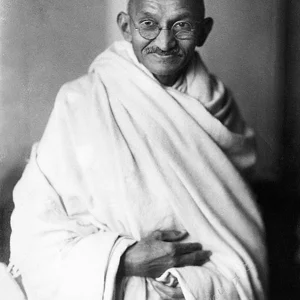

Indian political and spiritual leader (1869–1948), Gandhi led the movement for India's independence from British rule by advocating non-violence and civil disobedience. He became an iconic figure in the struggle for civil rights and the emancipation of colonized peoples.
Gandhi(1869 — 1948)
Mohandas Karamchand Gandhi
Inde
8 min read
Frequently asked questions
Famous Quotes
« Non-violence is the greatest force at the disposal of mankind. It is mightier than the mightiest weapon of destruction devised by the ingenuity of man.»
« I am prepared to die, but there is no cause for which I am prepared to kill.»
« A citizen cannot be the judge of his own obligations to his government.»
« In non-violence, the majority has a definite advantage over the minority.»
Key Facts
- 1893–1915: Stay in South Africa where Gandhi develops his philosophy of non-violence in response to racial discrimination
- 1920: Gandhi launches the Indian independence movement (Swaraj) based on civil disobedience and non-cooperation
- 1930: Salt March, a landmark act of peaceful protest against British salt taxation
- 1947: India gains independence and becomes a sovereign nation
- January 30, 1948: Assassination of Gandhi by a Hindu extremist
Works & Achievements
A foundational political pamphlet in which Gandhi criticises Western industrial civilisation and proposes an Indian path to self-rule based on tradition, simplicity, and non-violence.
An autobiographical account in which Gandhi traces his spiritual and political evolution, from his humble origins to leading the Indian independence movement.
A non-violent act of civil disobedience that became a global symbol of peaceful resistance; it broke the British monopoly on salt and galvanised the Indian independence movement.
A sweeping boycott movement targeting British institutions, schools, courts, and goods — Gandhi's first major nationwide campaign, which partially paralysed the colonial administration.
The final major resistance movement, launched during the Second World War to demand the immediate departure of the British, which led to Gandhi's last imprisonment.
The first large-scale application of non-violent resistance, developed by Gandhi to defend the rights of Indians in South Africa against the government's discriminatory laws.
Anecdotes
In 1930, Gandhi organized the Salt March, a 380-kilometer march to the Arabian Sea to protest the British tax on salt. He symbolically picked up a handful of salt on the beach at Dandi on April 6th, a simple gesture that triggered a massive civil disobedience movement across all of India.
Gandhi was thrown off a first-class train in South Africa in 1893, despite holding a valid ticket, because he was Indian. This humiliating incident at Pietermaritzburg station was often described by Gandhi himself as the founding moment of his political commitment and his struggle against discrimination.
Gandhi himself wore the cotton he spun each day on his spinning wheel, the charkha, a symbol of Indian economic self-sufficiency. He encouraged all his compatriots to spin their own cloth in order to boycott British goods and revive local craftsmanship, making the spinning wheel the emblem of the independence movement.
During his hunger strikes, Gandhi agreed to drink only water, sometimes flavored with a little lemon juice. One of his most famous strikes, in 1932, lasted six days and forced the British authorities to abandon a measure that would have separated the untouchables from other Hindus in elections.
Gandhi was assassinated on January 30, 1948 in Delhi by Nathuram Godse, a Hindu nationalist who blamed him for his benevolence toward Muslims. His last words were reportedly "Hey Ram" (O God), and his death plunged India into immense national mourning, echoed by an outpouring of emotion worldwide.
Primary Sources
I have no other ambition than to annihilate myself through absolute devotion to non-violence, truth, and purity.
We beg you, in the name of humanity, not to unleash a war that would reduce Europe to barbarism.
I want to purify my nation and myself through this march. We will march until the British withdraw the salt tax or imprison us all.
It is not without deep sadness that I contemplate the gulf that separates you from me. I salute in you not the representative of the Crown but the human being, and I invite you to listen to the voice of justice.
True civilization is that which awakens the noble instincts of man. If Indians imitate the English, it is their own ruin they are preparing.
Key Places
Gandhi's birthplace, where he was born on October 2, 1869. The family home, modest and white, is today a commemorative museum.
Community founded by Gandhi in 1917 on the banks of the Sabarmati River, which served as the base for his activist activities for many years. It was from here that the famous Salt March departed in 1930.
Small seaside beach where Gandhi arrived at the end of his Salt March on April 6, 1930, and symbolically picked up a handful of salt to defy British law.
Residence where Gandhi stayed and was assassinated on January 30, 1948. The garden where he was killed is today a national memorial called Gandhi Smriti.
Agricultural community founded by Gandhi in 1904 near Durban, the first experiment in his vision of a simple communal life based on manual labor and non-violence.
Typical Objects

Gandhi spun his own yarn every day on this small portable spinning wheel, a symbol of the boycott of British textile products and Indian economic self-sufficiency. The charkha appeared at the center of the Indian National Congress flag.

Gandhi used a simple bamboo staff to walk during his long activist marches, most notably the Salt March. This staff symbolized the strength of the humble in the face of the powerful.

A traditional Indian garment that Gandhi adopted in the 1920s as a sign of solidarity with the poorest peasants. He permanently gave up Western clothing to wear only this simple cotton loincloth, which he spun himself.

Gandhi's metal-rimmed glasses became one of his most recognizable attributes, a symbol of his clear-eyed vision and voluntary simplicity.

Gandhi made his own sandals, a skill he learned during his imprisonment in South Africa. He offered a pair to General Smuts who, moved by the gesture, returned them decades later, admitting he felt unworthy of wearing them.

Gandhi ate from a simple metal bowl, in keeping with his ideal of voluntary poverty and frugality. His diet, essentially vegetarian and often reduced to bare essentials, was inseparable from his spiritual philosophy.
School Curriculum
Vocabulary & Tags
Key Vocabulary
Tags
Concept
Daily Life
Morning
Gandhi generally rose before dawn, around 4 a.m., to pray and meditate in silence. He would then spend an hour spinning cotton on his charkha, a symbol of spiritual discipline as much as a political act. He walked barefoot within the ashram grounds, often surrounded by close companions and disciples.
Afternoon
Afternoons were devoted to reading correspondence (Gandhi received hundreds of letters per week), attending political meetings, and consulting with Congress leaders. He also made time for visitors — journalists and foreigners who came to question him about his philosophy and his struggle.
Evening
In the evening, Gandhi took part in collective interfaith prayers bringing together Hindus, Muslims, and Christians. He often held long conversations with those close to him on politics, spirituality, or the condition of the Untouchables. He went to bed early, after a frugal meal and a few pages of reading or writing.
Food
Gandhi had been a strict vegetarian since adolescence and practiced regular fasts for spiritual and political purposes. His daily diet often consisted of little more than goat's milk, fruit, raw vegetables, and rice. Throughout his life he refused to consume meat, alcohol, or tobacco.
Clothing
From the 1920s onward, Gandhi wore nothing but a simple white cotton dhoti that he spun himself, with no shirt or shoes, even during his travels to Europe. This radical sartorial choice was a political act signifying his solidarity with India's poorest peasants. Winston Churchill dismissively nicknamed him 'that half-naked fakir'.
Housing
Gandhi lived in communal ashrams — communities where residents farmed the land, spun cotton, and lived simply. His personal cell was tiny, undecorated, with a mat for sleeping, a spinning wheel, and a few books. He refused all material privilege, even when received by major world leaders.
Historical Timeline
Period Vocabulary
Visual Style
Esthétique documentaire aux tons ocre et blanc poussiéreux, opposant la sobriété de l'ashram indien à la puissance architecturale de l'empire britannique.
Sound Ambience
Ambiance sonore d'un ashram indien au petit matin, mêlant prières, bruit du rouet, nature rurale et rumeurs d'une Inde sous domination coloniale.
Liens externes & ressources
Références
Œuvres
Hind Swaraj (Le Gouvernement indien)
1909
Autobiographie ou mes expériences de vérité
1927
La Marche du Sel (Dandi March)
1930
Campagne de non-coopération
1920-1922
Mouvement Quit India (Quittez l'Inde)
1942
Satyagraha en Afrique du Sud
1906-1914