Imaginary interview with Louis IX (Saint Louis)
by Charactorium · Louis IX (Saint Louis) (1214 — 1270) · Politics · 7 min read
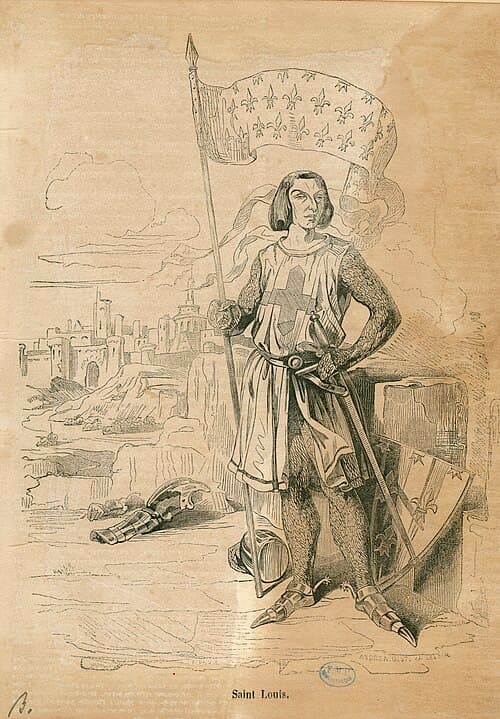
Vincennes, a spring morning. Beneath the foliage of a great oak, a man in a gray wool robe listens to the complaints of the humble before turning to his visitor. This is Louis, ninth of that name, King of France by the grace of God — he agrees to answer, his voice calm, his hands still cold from the holy water of Lauds.
—You are said to be accessible to all your subjects. How did you dispense justice on a daily basis?
Come see for yourself: I sit at the foot of an oak, here in the forest of Vincennes, and have my people sit around me. And whoever has a dispute may step forward freely, without a usher to push him back, be he a knight or a poor widow. Justice is not a favor the king sells; it is the duty God entrusts to him on the day of his coronation at Reims. My baillis, my provosts, I kept them on a short leash: by my ordinance of 1254, none of them may accept gift or present from anyone under their jurisdiction, neither for themselves, nor for their wives, nor for their children. For a judge who takes money with one hand cannot hold the scales straight with the other.
A judge who takes money with one hand cannot hold the scales straight with the other.
—Why did you devote so much care to correcting your own officers rather than expanding your kingdom?
Because a kingdom is worth what those who administer it in the prince's name are worth. What good are vast lands if the peasant is squeezed by a greedy bailli and the widow robbed by a lying sergeant? I sent investigators throughout the provinces — they are called royal investigators — to hear the complaints of the lowly against the powerful, and to redress wrongs done in my name. My Great Ordinance of 1254, I wanted it as much moral as legal: that my officers swear, that they render accounts, that they fear God before fearing the king. Expanding the kingdom is the matter of a battle; governing it with righteousness is the matter of a lifetime. And on the day I appear before the sovereign Judge, I will not be asked how many towns I have taken, but how many poor I have left oppressed.
—You paid more for a relic than for the chapel built to house it. Tell us about this acquisition.
In 1239, the Emperor of Constantinople, Baldwin II, pressed by his debts, offered me what Christendom holds most precious: the crown of thorns that my Savior wore during His Passion. I gave one hundred thirty-five thousand livres tournois for it — yes, more than the chapel itself later cost, and I do not blush for it. A stone is but a stone; but the blood of Christ touched those thorns. When it was brought to me, I walked barefoot to meet it, in a simple tunic, and I carried it on my shoulders. To house it worthily, I had the Sainte-Chapelle built on the Île de la Cité, all glass and light, in that new style called Rayonnant Gothic. One enters it as into a golden reliquary that God has filled with sunlight.
A stone is but a stone; but the blood of Christ touched those thorns.
—What does this chapel of light in the heart of Paris mean to you?
Enter the Sainte-Chapelle on a clear morning, and you will understand without my speaking. The walls disappear, only the glass remains — six hundred meters and more of stained glass telling the whole of sacred history, from Creation to the Passion. The master masons dared what no one had dared: to make stone rest on so little, so that the relic might bathe in a radiance that seems to come from Heaven itself. It is not only a setting for the crown of thorns; it tells every Christian and every foreign ambassador that the crown of France guards the treasures of Christendom. The king comes to pray there like the least of his subjects. For I have always thought that a prince should build first for God, and that stone raised to His glory is worth more than all palaces raised to our own.
—Let us speak of Egypt. Do you remember the moment you fell into enemy hands?
The Tuesday after mid-Lent, in the year 1250. I wrote it myself to my barons of France: we were taken prisoner, and the greater part of my army captured or killed. Mansourah, on Egyptian soil — a name that returns to me like a fever. The Nile's flood, the dysentery that ravaged my knights, and the Mamluks closing in on us. I was bound, I, the King of France. My jailers pressed me, threatened to torture me to extract more. I answered them that my person was not to be haggled over like cloth in the market: a king may pay ransom, he cannot sell his honor. I negotiated myself, and was freed for four hundred thousand livres tournois. God had humbled me; I had to receive that humiliation as a lesson.
A king may pay ransom, he cannot sell his honor.
—How does a defeated and captive king preserve his dignity before his jailers?
By remembering that he has first a Master in Heaven. When you are chained at Mansourah, stripped of your army, the temptation is great to yield to terror or rage. But I had learned, in the prayer of Lauds repeated every dawn, that the Lord tests those He loves. I wrote to my barons to pray God for us and for those who had died in His service — for the dead mattered more to me than my own deliverance. Before the Mamluks, I kept the same face as before my court: neither supplication nor bravado. My ransom of four hundred thousand livres, I paid to the last penny, and I kept my word on everything I had sworn, where others would have used cunning. For the word of a Christian king must hold before the infidel as before the pope.
—You had defeated the English at Taillebourg, yet you ceded lands to them. Why this peace?
In 1242, at Taillebourg, I had indeed tamed Henry III of England on the field. I could have pursued him, humiliated him, wrested more from him. But consider: Henry was my kinsman, a Christian like me, and every war between us was an open wound in the side of Christendom, blood spilled that rejoiced the infidel. So, by the Treaty of Paris of 1259, I preferred to leave him certain lands in the Southwest — and in return, he did me homage and recognized the suzerainty of the French crown. My counselors grumbled that one does not give back what the sword has won. I answered them that a peace sealed by an oath of homage is better than a victory that must be defended every generation. Glory passes; concord between Christian princes endures.
A peace sealed by an oath is better than a victory that must be defended every generation.
—Did this pursuit of peace earn you reproach among your barons?
Many times. I was judged too soft toward Henry III, too quick to forgive, too scrupulous in keeping my word where cunning would have better served the kingdom. But I do not govern to please the barons; I govern to answer before God for the peace of my people. The same spirit guided me southward: by the Treaty of Corbeil, the same year, I settled our Pyrenean borders with the King of Aragon, renouncing old claims to establish a sure boundary. A prince who cherishes his rights to the point of stubbornness sows war for his grandsons. I wanted, as far as it depended on me, to live in peace with all my Christian neighbors — so as to keep the sword for the only war that matters, that of the Holy Land.
—Beneath the blue mantle strewn with lilies, it is said, you wore something quite different. What did your royal garment conceal?
The fleur-de-lys mantle of azure and gold, I put on for ceremonial days, for the people need to see the majesty that God lends to their king. But beneath the finery, against my skin, I wear the hairshirt — that rough cloth of horsehair that bites the flesh and reminds me at every moment that this body is but dust. In daily life, I avoid overly showy ornaments; a gray cloth, a simple coarse robe suffice. Every Friday, I ask my confessor to give me the discipline, in memory of my Savior's Passion. I say this neither to be admired nor imitated — humility that shows itself is no longer humility. The king must appear magnificent in the eyes of men, and remain poor in the eyes of God.
The king must appear magnificent in the eyes of men, and remain poor in the eyes of God.
—They say you served the poor at your own table. What drove you to do this?
Christ washed the feet of His disciples; who am I to despise what He honored? So I seat the poor, the infirm, sometimes lepers from whom the court averts its eyes, at my table, and I sometimes serve them with my own hands. My fasts are frequent, my diet austere — I fear overly delicate dishes, for a mouth accustomed to luxury quickly forgets the hungry. I also founded in Paris, around 1260, the hospice of the Quinze-Vingts, to shelter three hundred blind people, many of whom had lost their sight in the service of the Cross. This charity is not only tenderness of heart: it proclaims that the king's power comes from God and must return to Him. In the evening, after Compline, I converse with the mendicant friars, Franciscans or Dominicans, about what pleases Heaven.
—You are setting out for the East again despite all that Egypt cost you. What do you still hope for from the crusade?
They say to me: you have known Mansourah, defeat, chains, ransom — why take up the cross again? And I answer that the crusade is not a matter of profit to be abandoned after a loss. I made a vow to serve the deliverance of the Holy Places, and a vow made to God is not taken back like a bet. My strength is waning, I feel it; my body is worn by the fevers brought back from the Nile. But if it pleases the Lord that I die on the way, on some African shore, I hold that death sweeter than ending old in tepidity. Before leaving, I left my son Philip my teachings: to love God with all his heart, to flee sin, to render justice. May the crown of France remain with him, and may my soul go where I hope.
A vow made to God is not taken back like a bet.


This imaginary interview was generated by artificial intelligence from sources documented in Louis IX (Saint Louis)'s profile. It dramatises what the figure might have said based on what we know about them, but does not constitute attested historical testimony. For primary sources and factual documentation, refer to the full profile.