Kids interview Louis IX (Saint Louis)
by Charactorium · Louis IX (Saint Louis) (1214 — 1270) · Politics · 4 min read
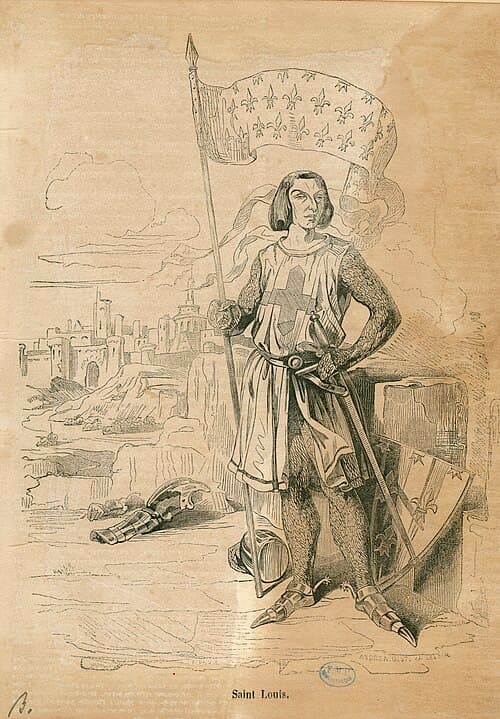
Two young visitors, on a school field trip in the heart of Paris, pushed open the door of a grand chapel with dazzling stained glass. There, a king dressed in a blue mantle awaited them, with a gentle smile. He motioned for them to sit near him: he had so many things to tell them.
—Is it true that you used to dispense justice sitting under a tree?
Yes, my child, it's absolutely true! When I was at Vincennes, after my meal, I would go sit at the foot of a great oak tree in the forest. Imagine: no palace, no guards to keep people away. Just a king under a tree. Anyone could come to me. A peasant, a widow, a merchant angry with his neighbor. They would tell me their problem, and I would settle it right there, in person. My friend Joinville, who wrote down everything I did, often spoke of it. For me, a king who hides from his people is not truly a king.
A king who hides from his people is not truly a king.
—And weren't people afraid to come speak to a king?
A little intimidated, yes! But I wanted them to dare. You know, in my time, many lords judged their own peasants themselves, and often very badly. I wanted equal justice for all. That's why in 1254 I issued a great ordinance — a law of the king valid everywhere. I forbade my officers from accepting any gift to sway a judgment. Imagine a judge who cannot be bought: that was new, and it reassured the humblest. Justice must never be sold, not even for a purse full of gold.
Justice must never be sold.
—Why did you bother your own servants with these rules?
Good question! My officers were called bailiffs: they administered my lands, dispensed justice, and collected taxes in my name. The trouble was that some took advantage of people. They demanded gifts, turned a blind eye for a gold coin. Imagine someone who speaks in the king's name but lies and steals: that makes the whole kingdom unjust. So in my Great Ordinance of 1254, I wrote in black and white that they could accept nothing, neither for themselves, nor for their wives, nor for their children. A king must first clean his own house.
A king must first clean his own house.
—They say you paid a super expensive crown. What was it?
Ah, you've touched on my greatest treasure! In 1239, I bought a relic — that is, a very ancient sacred object — from the emperor of Constantinople. It was said to be the crown of thorns worn by Christ. I paid a fortune: 135,000 livres, a sum to make your head spin. Imagine all the gold needed to build ten castles: that was the price. For me, possessing such an object was to link my kingdom directly to heaven. A crown of thorns for a king, you see the image? My true power came from that.
A crown of thorns for a king: that was where my true power came from.
—And the beautiful chapel with the stained glass, was that to store the crown?
Exactly! I could not keep such a sacred relic in an ordinary chest. So I had the Sainte-Chapelle built, on the island in the middle of Paris, between 1242 and 1248. Imagine entering there on a sunny day: the walls seem to disappear, there is almost nothing but colored glass, over 600 square meters of stained glass. Light falls on you like a rain of jewels. This style is called Rayonnant Gothic, because the stone becomes as light as lace. And the funniest part? The chapel cost far less than the crown it housed!
The stone became as light as lace.
—Is it true you were taken prisoner during a war?
Alas, yes, my child. I had gone on a crusade — a military expedition to the Holy Land, called for by the pope. In 1250, in Egypt, near a town called Mansourah, my army was crushed. I was captured. Imagine: a king of France, in chains, in the hands of his enemies, sick and exhausted. I even wrote a letter to my barons telling them to pray for us and for the dead. It was the darkest day of my life. But I did not weep before my jailers: a king sometimes falls, but he never collapses.
A king sometimes falls, but he never collapses.
—Weren't you too scared when they threatened you?
Fear was there, of course. My guards, the Mamluks, threatened to harm me if I didn't pay more. But I kept my calm and said no. You know, when you tremble inside, the most important thing is not to show it. I negotiated my own release: 400,000 livres tournois, a huge ransom. Imagine having to empty an entire royal treasury to buy back your own freedom. I held firm because giving in to panic would have been losing twice. Fear, you feel it; but it must obey us, never the other way around.
Fear, you feel it; but it must obey us.
—What did you eat, you, a king? Lots of good things?
One might think so! My guests had magnificent banquets. But I ate simply. I often fasted, meaning I deprived myself of food on certain days, as the Church required. I avoided overly refined dishes. And you know what I loved above all? Inviting the poor and the sick to my table, and serving them myself, with my own hands. Imagine a king bringing bread to a beggar. It surprised many people. For me, the higher you are placed, the smaller you must make yourself.
The higher you are placed, the smaller you must make yourself.
—And did you always wear the beautiful blue mantle?
Only for great ceremonies, my child! That blue mantle strewn with golden fleurs-de-lis was the garb of the king of France. But in daily life, I wore very simple gray clothes, of coarse, rough fabric. And now I will tell you a secret: under my clothes, I secretly wore a hairshirt. It is a prickly undergarment, made of horsehair, that scratches the skin. It was worn to remind oneself that life is not made only of pleasures. No one saw it. Outwardly, the king shone; underneath, the man remembered to be humble.
Outwardly, the king shone; underneath, the man remembered to be humble.
—Were you proud of everything you had changed in the kingdom?
Proud is a dangerous word for a Christian! But I believe I left a more just kingdom. I had reformed my officers, built up a great court of justice in Paris where one could appeal. I also founded a hospital, the Quinze-Vingts, to house three hundred blind people — many were wounded crusaders. And believe it or not, it still exists today! Before dying, I wrote advice for my son Philip: to love God, to love justice, to protect the weak. A king's true treasure is not his castles. It is the good things that outlive him.
A king's true treasure is the good things that outlive him.



This imaginary interview was generated by artificial intelligence from sources documented in Louis IX (Saint Louis)'s profile. It dramatises what the figure might have said based on what we know about them, but does not constitute attested historical testimony. For primary sources and factual documentation, refer to the full profile.