Imaginary dialogue between Jean de Joinville and Louis IX (Saint Louis)
by Charactorium · Louis IX (Saint Louis) (1214 — 1270) · Politics · 6 min read
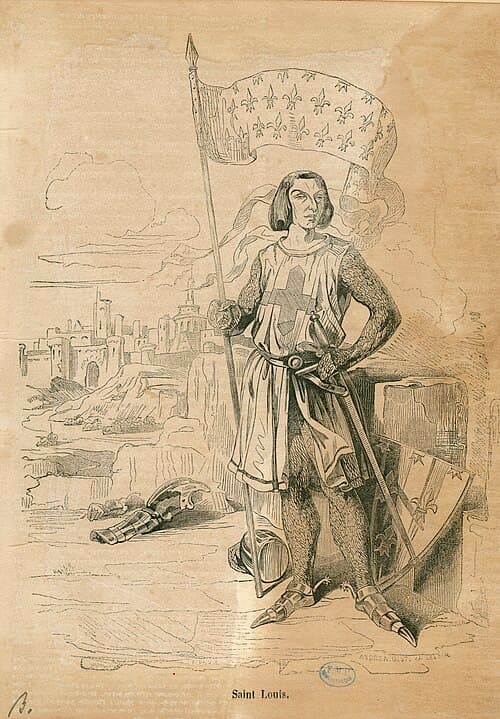
It is at the foot of the great oak of Vincennes, on an afternoon in the year 1267, that I find my king, sitting on the grass as was his custom, without cushion or canopy. The light filters through the leaves and falls upon the gray cloth of his worn tunic. For nearly twenty years I have served him and accompanied him, since the crusade in Egypt where we were taken prisoner together. I come this day, not as seneschal but as a friend, to gather from his lips what I wish to preserve for those who will come after.
—Sire, how many times have I seen you, right here under this oak, listening to the humblest peasant? Why do you hold so firmly to judging in this way, out in the open?
You know better than anyone, Joinville, you who sat around me with the others. A king who hides behind his bailiffs hears only what people want him to hear. Here, the poor man and the rich man come to me without a usher or a gift to slip into a hand. For that is the evil I sought to cut through with my great ordinance: that none of my officers should accept a gift from anyone subject to their justice. Justice is not a commodity. God made me king to render it uprightly, not to sell it. Under this tree, I am only a man answering for his office before a greater judge than himself.
Justice is not a commodity.
—You have greatly reformed your bailiffs and provosts. Do you believe, my king, that a man can truly correct those who serve him far away?
One does not reform a kingdom with a single edict, Jean; I am not so naive. But I sent investigators through the provinces to hear complaints against my officers, and I dismissed those who oppressed the people in my name. A bailiff who robs the poor robs the king, and the king who closes his eyes robs God. You have seen me grow impatient with slowness, sometimes; but I prefer a kingdom governed slowly with righteousness than blindly with haste. My father and grandfather left me a crown; I want to return it to my son more just than I received it. That, I believe, is the only treasure a prince should amass.
A bailiff who robs the poor robs the king, and the king who closes his eyes robs God.
—Sire, it is whispered that you paid more for the crown of thorns than for the chapel built to house it. Was this expense never reproached to you?
It was reproached to me, yes, and I still hear it. One hundred thirty-five thousand livres to Emperor Baldwin of Constantinople, for a crown of braided reeds — what madness, some counselors said. But understand me well: what is gold worth compared to the thorns that pierced Our Lord's brow? I wanted France to be the guardian of this treasure, and Paris to become a new Jerusalem. The Sainte-Chapelle, I wanted it all of glass and light, so that the faithful who enter might think themselves transported to heaven. Stone and stained glass cost less than the relic, it is true; but it is not the casket that gives the price, it is what it guards.
What is gold worth compared to the thorns that pierced Our Lord's brow?
—When you received this relic, it is said that you carried it yourself, barefoot. What did you feel that day, my king?
It was the most beautiful day ever granted me, Joinville. I took off my shoes and my royal mantle, and I carried the reliquary on my shoulders with my brother Robert, in my shirt, through the crowd all the way to Notre-Dame. The king was nothing that day but a poor pilgrim under a sacred burden. I felt the weight of that wood on my neck as a grace. The people wept as we passed. You see, a king is never so great as when he makes himself small before God. The crown of France on my head weighed less than that crown of thorns in my arms. I believe that day my people understood which master their king obeyed.
A king is never so great as when he makes himself small before God.
—Sire, we were taken together at Mansourah, in that year 1250. When your jailers threatened to torture you, where did that calm come from that so struck me?
You were ill then, Jean, burning with fever, and I feared more for you than for myself. Where did that calm come from? From the fact that I had already placed everything in God's hands. A man who expects nothing from this world cannot be made to tremble by threats. They spoke to me of the bernicle, that device that breaks legs; I answered that I was their prisoner, that they could do with my body what they wished, but not with my soul. I refused to surrender a single one of the Christians' fortresses, for they were not mine to give. Four hundred thousand livres for my ransom, and the city of Damietta: that is what I yielded. The rest I kept.
They could do with my body what they wished, but not with my soul.
—After this defeat, many urged you to return to France. Why did you remain yet another four years in the Holy Land, my king?
You remember the council I held, where nearly all wanted to return. My own brother argued for France. But I rose and said that if I left, the kingdom of Jerusalem would be lost, and all those Christian prisoners still in Saracen hands would be abandoned. How could I return to enjoy my throne while leaving them to rot in chains? I stayed to rebuild the walls of Acre, Caesarea, and Jaffa, and to ransom the captives one by one. They thought me stubborn; I was merely faithful. A crusade is not measured by a battle won or lost, but by what one has held to the end. I only returned when my mother died, when France truly called me back.
They thought me stubborn; I was merely faithful.
—Sire, you know I have always spoken frankly to you. This hairshirt, these disciplines your confessor gives you on Fridays — is this not too much for a king?
You told me to my face, yes, and you remember my answer when you asked if I would wash the feet of the poor: you made a face, Joinville! You thought it beneath a king. But know that I wear this hairshirt not to be seen — I long hid it under my clothes — but so that my flesh may not forget it is mortal. A king is flattered from morning to night; he needs a secret pain to keep him humble. I had to stop the hairshirt and the discipline, for my body weakened and the physician forbade them. I do not ask anyone to imitate me. Each bears his penance according to the strength God gives him.
He needs a secret pain to keep him humble.
—I have seen you serve lepers at your own table, my king. Many at court shudder at it. What do you seek among these wretches?
The face of Christ, Jean, nothing less. When I wash the feet of a poor man or bring bread to a leper who no longer has fingers to hold it, I serve Him who said that what you do to the least of these, you do to Him. The court shudders, I know; you yourself have confessed to me that you would rather commit thirty mortal sins than touch a leper. But I tell you there is no leprosy worse than that of the soul. I founded the Quinze-Vingts for three hundred blind people, many of them blinded returning from the East. A king who has hands only for holding the scepter is only half a king. These poor are my lords as much as I am theirs.
There is no leprosy worse than that of the soul.
—Sire, you sometimes speak of your son Philip as a man to whom to pass on more than a crown. What would you most want to leave him?
More than the crown, Joinville, I want to leave him a rule of life. I have begun to write down for him what my heart cries out: that he love God with all his strength, for without that no one can be saved; that he prefer to suffer any torment rather than commit a mortal sin. That he be upright in justice, even against himself, and that he side with the poor against the rich until the truth is known. A father does not only bequeath lands and a title; he bequeaths a way of fearing God and loving his people. If Philip keeps these teachings, he will reign better than I. That is the only inheritance that is lost neither in war nor in the game of succession.
A father does not only bequeath lands and a title; he bequeaths a way of fearing God and loving his people.
—It is said that you are thinking of taking up the cross again, despite your health. My king, must you really leave again, when the kingdom needs you so much here?
I know what you think, Jean, and I know you will not take up the cross again — you have made that clear, preferring to serve your poor people of Champagne who are plundered in your absence. You are not wrong in worldly terms. But a debt remains: the Holy Land bleeds, and I swore before God long ago. My body is worn, I feel it, and perhaps I will not see France again. What does it matter, if I die in the service of Our Lord? One does not serve God halfway, nor according to one's comfort. If I stay here to grow old in my palace while the Holy Places call, what will I answer on the last day? Pray for me, my friend, as you did back there in Egypt, when all seemed lost.
One does not serve God halfway, nor according to one's comfort.



This imaginary interview was generated by artificial intelligence from sources documented in Louis IX (Saint Louis)'s profile. It dramatises what the figure might have said based on what we know about them, but does not constitute attested historical testimony. For primary sources and factual documentation, refer to the full profile.