Imaginary interview with Melusine
by Charactorium · Melusine · Mythology · 6 min read
At dusk, near a fountain in the forest of Coulombiers, a lady of water agrees to appear. Her gown trails on the moss, and one can guess, beneath the hem, something that is not quite a foot. She speaks low, as one speaks when one has long kept a secret.
—How did Raymond meet you, that evening in Poitou?
He was riding desperately, the poor man, fleeing blood he had accidentally shed while hunting. It was near the fountain of Coulombiers that he found me, at the hour when the water turns black and the fairies become visible. I was waiting for him, you see, for we creatures of the wave know how to recognize those whom destiny brings to us. I spoke to him gently, I offered him fortune and lineage, and I asked only one thing: that he never seek to see me on Saturday. Men think they choose; in truth, they accept. He accepted, as one drinks from a spring without measuring its depth.
Men think they choose; in truth, they accept.
—Why this prohibition of Saturday, precisely?
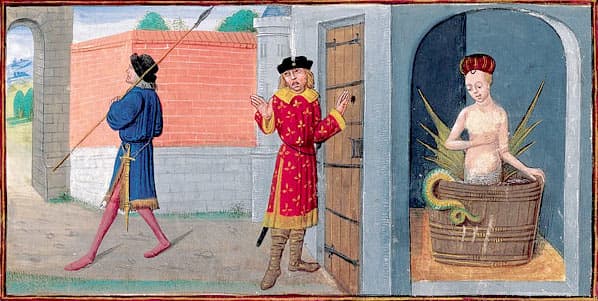
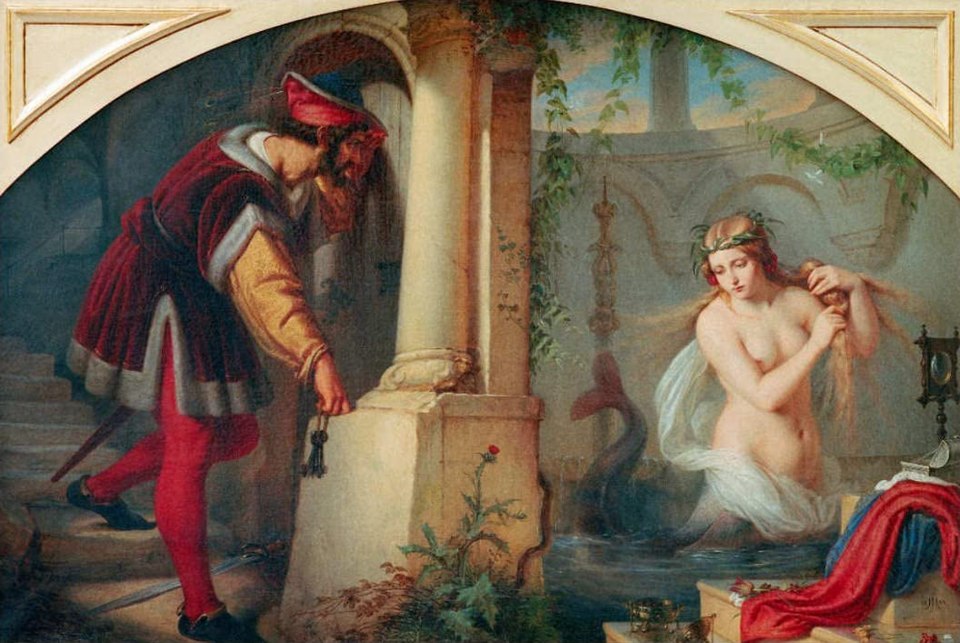
Saturday is my day of truth, the day when my nature reclaims its rights despite myself. From my waist to my face, I remain woman; but below, my body lengthens into a serpent's tail long and thick, and I bathe alone in a tub of hot water, returning to the element from which I come. It was not a shame I hid, it was a law. A curse placed upon me by my own mother, for an ancient fault that the living need not know. As long as Raymond respected the pact, water and earth coexisted peacefully in our home. The taboo was not a woman's whim: it was the dike that held back two worlds.
The taboo was not a woman's whim: it was the dike that held back two worlds.
—What happened the day he broke his promise?
He had been whispered to that I was betraying him, that my absences hid a lover. Jealousy is a blade sharper than any knight's sword. He came, one Saturday, to pierce the door of my bath with a blade. Through that narrow opening, he saw me as I am, half-serpent in the steaming water. I knew it at once, from a chill that ran down my spine. I could have forgiven him that stolen glance; but when, later, in his anger before the court, he called me "serpent" out loud, then the pact was broken beyond repair. A secret kept, you survive; a secret shouted, you vanish.
A secret kept, you survive; a secret shouted, you vanish.
—Do you remember the moment of your departure?
I will remember it until the end of time, for that moment has no end for me. I climbed onto the window ledge, and my whole body yielded to wave and air: I became a winged serpent, immense, and I flew three times around the towers of Lusignan, uttering a cry that no wall could contain. My sons were sleeping; I brushed them with my gaze, no longer able to touch them with my woman's hands. Since then, they say, I return to howl on the ramparts when a lord of my race is about to die. One does not leave what one has built: one haunts it.
One does not leave what one has built: one haunts it.
—What would you say of this dwelling, the castle of Lusignan, which is entirely attributed to you?
I raised it in a single night, stone upon stone, while Poitou slept. By morning, where there had been only a heath, stood a fortress with walls so high that shepherds thought it a dream. It was not vanity: a dynasty without a foundation is a name carried by the wind. I gave the Lusignans a rock, moats, a chapel, and soon the surrounding country became rich and powerful. Men build in a hundred years what I build before dawn, because I know the language of stone as well as that of water. Everything you see that is lasting in this world has often been laid by hands that dare not be named.
A dynasty without a foundation is a name carried by the wind.
—Did your contemporaries truly believe that you had raised these walls by magic?
Believing is a big word for people who saw the fortress and found no other explanation. A fountain where a fairy appears, a castle risen in a night, a lady never seen on Saturday: put these signs together, and the legend builds itself as surely as the keep. I let it happen, for the marvelous serves those who inspire it. A lord whose ancestress moved stones by enchantment inspires more fear than a man born of a simple marriage. The walls of Parthenay as well as those of Lusignan still bear, they say, the mark of my passing. The prodigy is a mortar that holds better than lime.
The prodigy is a mortar that holds better than lime.
—How do you explain your close bond with water and metamorphosis?
I come from the wave, from those still waters said to communicate with the Isle of Avalon and the fairy realms. Water is my first garment and my final dwelling. It is near a fountain that men meet me, it is in the bath that my truth is revealed, and it is in the form of a water serpent that I flee. The mirror of a basin shows me as I truly am, where the mirrors of the court reflect only a lady in her gown. Metamorphosis is not only a punishment: it is the reminder that I never fully belong to dry land. One does not marry a river without it overflowing one day.
One does not marry a river without it overflowing one day.
—Why did you let Raymond see you one day, when everything rested on that secret?
I did not let him: he forced it. But you touch upon a truth I do not like to tell. Every double creature desires, deep down, to be seen whole. In my fairy form, adorned with my gown and my lady's headdresses, I was loved for half of myself. The serpent's tail that beat the hot water on Saturday was the other half, the one that no one was to cherish. Perhaps I, unknowingly, hoped that he would love me even there. Fairies too know that hunger to be recognized as they are. That is why, when the gaze came, I felt as much relief as terror.
Every double creature desires, deep down, to be seen whole.
—What became of the ten children you gave to Raymond?
Ten sons, yes, and each marked by a strange sign at birth — an extra tooth, an oversized ear, a red eye — as if my nature surfaced in their flesh. They swarmed far beyond Poitou. My descendants reigned as far as Cyprus and bore arms in the Holy Land, where crusaders built kingdoms. For generations, the lords of my race loudly claimed to have a fairy for an ancestress. Madness? Calculation, rather: a semi-divine ancestry is worth more than a long parchment of titles. I gave this dynasty more than lands: I gave it a bloodline that no one would ever dare mock its origin.
A semi-divine ancestry is worth more than a long parchment of titles.
—How did your story reach the men who wrote it down?
For a long time, I lived only in mouths. Jongleurs and trouvères sang my geste from castle to castle, and each voice added its stone to my legend as I added to my walls. Long before I was laid on parchment, my name was already whispered near the fountains of Poitou. Then came a clerk named Jean d'Arras, who gathered these scattered rumors and made of them a prose romance, orderly, to please high lords. Another, Couldrette, turned it into verse shortly after. They thought they fixed me; they only gave me a thousand paper dwellings. A legend put in a book dies no more, but it also ceases to change.
They thought they fixed me; they only gave me a thousand paper dwellings.
—How do you feel about being thus frozen in a manuscript, you who are made of movement?
A mixture that the living know little of. As long as I passed from voice to voice, I was free: now a beneficent fairy, now a terrible serpent, according to the heart of the singer. The romance of Jean d'Arras gave me a fixed form, beautiful no doubt, but fixed. The marvelous loves shadow and variation; the book, however, demands a single truth. And yet, without these pages, who would still speak my name? I am like water put in a vase: preserved, but deprived of current. If I could imagine being read still centuries hence, I would wish that one not forget the cry on the towers — for it is in the cry, not in the ink, that I am wholly myself.
I am like water put in a vase: preserved, but deprived of current.
This imaginary interview was generated by artificial intelligence from sources documented in Melusine's profile. It dramatises what the figure might have said based on what we know about them, but does not constitute attested historical testimony. For primary sources and factual documentation, refer to the full profile.