Kids interview Melusine
by Charactorium · Melusine · Mythology · 5 min read
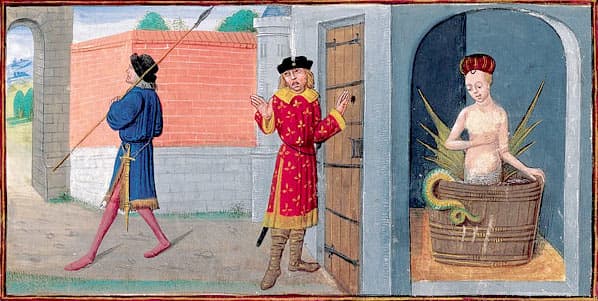
Two young visitors, on a school field trip in the heart of Poitou, stop near an old fountain. The water shimmers, and a lady emerges, beautiful and mysterious. It is Melusine, the fairy builder, who agrees to tell them her story.
—Is it true you built an entire castle in a single night?
Yes, my child, and I'll tell you how. In my time, building a fortress took years: hundreds of men, stones hauled by oxen, walls raised slowly. I, thanks to my fairy powers, raised the chastel de Lusignan before dawn. Imagine a bare hill in the evening, and by morning, stone towers touching the sky. I had the moats dug, the ramparts raised, the fortifications carved. In no time, the whole land became rich and powerful. That was the cradle of my family.
A bare hill in the evening, and by morning towers that touch the sky.
—Why was that particular castle in Poitou so important to you?
You know, a castle in the Middle Ages isn't just a pile of stones. It's a shelter, a granary, a protection against raiders. Poitou was a green land, crossed by forests and rivers. By placing Lusignan in the middle, I gave my lineage an anchor point. Imagine a big family home, but tall as a cliff, with a chapel and huge halls. People came to take shelter beneath my walls. Building, for me, was protecting. And protecting was loving.
Building, for me, was protecting. And protecting was loving.
—I heard there was a secret on Saturdays. What was it?
Ah, my Saturday secret... When I married my knight Raymond, I made him promise only one thing: never to see me on that day. One day a week, I locked myself away alone. He swore, and we were happy for a long time. But a promise is as fragile as glass. Have you ever wanted to look at something you were forbidden to? He did too. And what he was hiding concerned only me. As long as he kept his oath, our happiness held. That was all I asked: a little trust.
A promise is as fragile as glass.
—And what happened to you on Saturdays, when you were alone?
Here is my true nature, my child, and do not be afraid. Every Saturday, I changed into a dual creature: woman to the navel, and below a long serpent's tail, thick and powerful. I bathed in a tub of hot water. Water, you see, is my world. A fairy like me is born from springs and rivers. Imagine a large stone bath, steam rising, and the reflection of a lady who is no longer quite a lady. It wasn't a monster. It was simply me, otherwise.
It wasn't a monster. It was simply me, otherwise.
—Did it hurt, transforming like that?
It wasn't my body that suffered, my child, it was my heart. The word for it, in my time, is the curse: a spell cast on me even before I met Raymond. A metamorphosis, you see, is when a body changes shape by magic. I became half-woman, half-serpent. The worst wasn't the tail or the scales. It was having to hide from the one I loved. Imagine keeping a secret so heavy that you lock yourself away for an entire day to protect it. That is what I bore.
It wasn't my body that suffered, it was my heart.
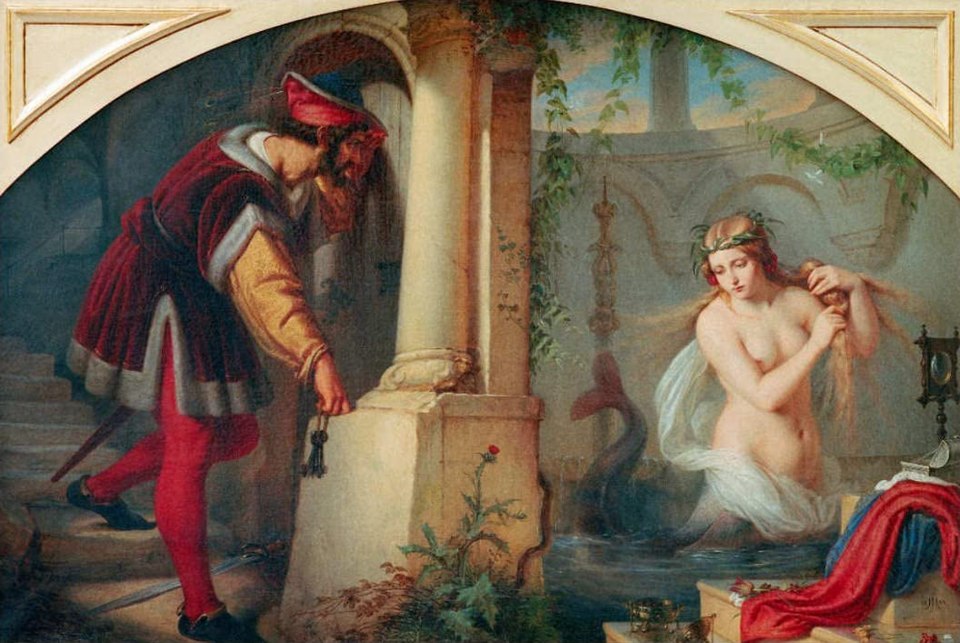
—And one day Raymond looked anyway? What happened?
Yes. One Saturday, curiosity got the better of him. He pierced a hole in the door and saw me in my bath, my serpent's tail undulating in the water. The pact was broken. At that moment, I said nothing — perhaps we could still save ourselves. But later, before the court, he betrayed me out loud. Then I had no choice. My body became covered in scales, wings sprouted, and I flew out the window with a cry. I became entirely the creature he had seen. Broken trust cannot be mended.
Broken trust cannot be mended.
—Did you have children? Were they a bit fairy too?
I had ten children, my child, and I loved them so much. They were human, raised like the sons of great lords. Some bore a small strange mark on their face — a sign of their fairy mother. From these ten sons was born the dynasty of the Lusignans. A dynasty is a succession of people from the same family who pass on power, generation after generation. My boys became brave lords. Imagine a river that springs from a single source: me, the fountain, and them, all the branches of the river flowing far away.
Me the fountain, and them all the branches of the river flowing far away.
—And later, real nobles claimed they were descended from you?
Yes, and that still touches me. For centuries, great families claimed to be my descendants. The Lusignans ruled not only over Poitou, but as far as Cyprus and the Holy Land, there, towards the Orient of the Crusades. Having a fairy for an ancestress, you see, gave prestige: you were not an ordinary lord, you came from semi-divine blood. Imagine a child proud to say that their great-grandmother was magical. That is why my name has endured: I was the mythical mother of an entire lineage.
Having a fairy for an ancestress is like no other coat of arms.
—Before books, how did people know your story?
By voice, my child, by voice! Long before I was written down, storytellers went from village to castle. They were called jongleurs and trouvères. In the evening, by the fire, they sang my legend. Imagine a great hall, torches, and everyone falling silent to hear the story of the serpent fairy. These tales passed from mouth to ear, changing a little each time. A legend is that: a transmitted story that mixes truth and wonder. I lived entire generations just in people's memory.
I lived entire generations just in people's memory.
—And the first real book about you, when did it come?
In 1393, a man named Jean d'Arras put my legend down in writing, in French prose. It was the Roman de Mélusine. Imagine a monk bent over a parchment, pen dipped in ink, writing word for word the story that had been told for so long. His book became the reference version, copied dozens of times. Later, a poet called Couldrette put it into verse. Thanks to them, I was no longer at risk of being forgotten. The voice flies away, my child, but the ink remains.
The voice flies away, but the ink remains.
—So you left forever? Were you never seen again?
For the living, yes, I left. When I flew away from Lusignan in my winged serpent form, I left the world of men. But they say I returned at night, circling my towers, watching over my sleeping children. They said my cry announced the death of the lords of my lineage. I was no longer a lady of flesh, but I had not stopped loving. Imagine a mother who can no longer hold her children, but still watches, invisible, from the sky. That is what I became: a presence.
I was no longer a lady of flesh, but I had not stopped loving.
This imaginary interview was generated by artificial intelligence from sources documented in Melusine's profile. It dramatises what the figure might have said based on what we know about them, but does not constitute attested historical testimony. For primary sources and factual documentation, refer to the full profile.