Imaginary dialogue between Raymond de Lusignan and Melusine
by Charactorium · Melusine · Mythology · 5 min read
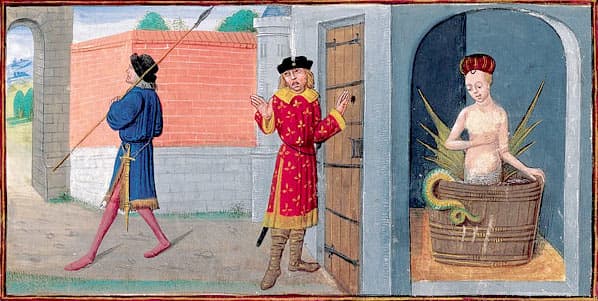
At the foot of the keep of Lusignan, one evening just as the Saturday bell has rung, Raymond finds the one he still calls his wife. The fountain of the forest of Coulombiers murmurs nearby, where long ago he first saw her. Between them weighs the broken pact, the water of the bath, the secret discovered. He comes without reproach, heavy-hearted, to hear from her lips what he never dared to ask her.
—Mélusine, my lady, when I married you near the fountain, these walls did not exist. How did you raise Lusignan in a single night?
You who slept while I kept watch, Raymond, saw only the standing stone in the morning. The truth is simpler and stranger: I commanded not men but water and earth, as a mother commands her household. The springs of Poitou obey me, for I was born of them. I wanted for our lineage a seat that would last a thousand years, a stone nest where our sons would be born lords and not vagabonds. They will later say it was sorcery. For me it was love: building is promising the future. Every tower you see, I placed thinking of you and of what I was giving you.
Building is promising the future: every tower, I placed thinking of you.
—I asked only one thing of you in return for my oath: not to seek to see you on Saturdays. Why that day, my lady, and not another?
Because Saturday is the day when the hidden part of me reclaims its rights, Raymond, and no wife wants to be caught in her secret. I asked nothing else of you, do you remember? Neither wealth nor renunciation, only this respite one day a week when you would leave me to myself. It was not mistrust of you: it was the condition of my stay among the living. A fairy unites with men only at this price, sealed by a promise. As long as you kept it, I was fully woman, mother, lady of this castle. The pact was not a chain. It was the fragile bridge between your world and mine.
The pact was not a chain; it was the fragile bridge between your world and mine.
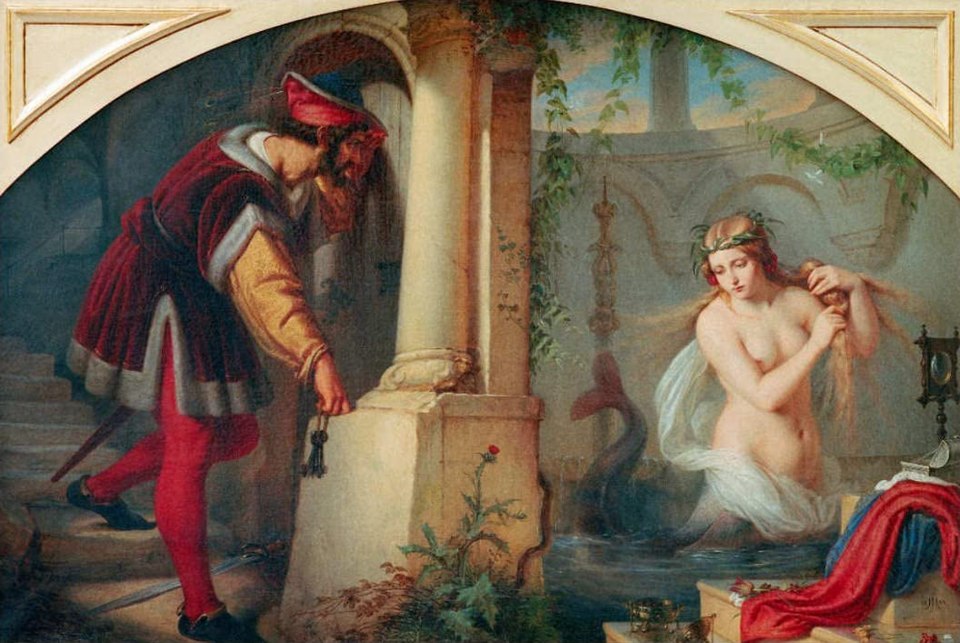
—That Saturday, I broke through the door of your chamber. I saw what I should not have seen. Tell me what I saw, for I still doubt it.
You saw what I am, Raymond, and you doubt only because your heart refuses what your eyes grasped. In the hot water bath, I was woman to the navel, and below the tail of a serpent, long and powerful, beating the water. It is not ugliness, you see: it is my wholeness. Water is my true home, the reflection my true mirror. You did not see a monster that morning. You saw a dual creature, half of your world, half of the deep springs, who loved you with both halves at once. The misfortune is not that you looked. The misfortune is that you could not keep silent afterward.
You did not see a monster: you saw a creature who loved you with both her halves at once.
—We had ten sons, my lady. Several bear a strange mark on their face. What did you want to pass on to them through your blood?
I gave them Poitou, Raymond, and much more. Through my blood they hold a vigor that ordinary men do not have: our sons will be counts, crusaders, kings as far as Cyprus and the Holy Land. The marks you call strange are my seal upon them, the reminder that a fairy watches at the origin of their lineage. Many nobles, tomorrow, will want to claim descent from me to adorn their name with a supernatural luster. Let them do so. My true offering is not glory but solidity: a family strong enough to last, proud enough never to bend. A mother does not found a dynasty for herself. She founds it for those she will not see.
A mother does not found a dynasty for herself; she founds it for those she will not see.
—When I shouted your secret before the court, in my anger, you fled through the window. Did you curse me that day, or forgive me?
Neither entirely, Raymond. The curse was not mine to cast: it was already upon me, and your public words only unleashed it. As long as you kept the secret, I remained. By shouting it before your men, you broke not my love but my dwelling among you. I had to leave, not out of spite, but because the law that bound me demanded it. Do you think I wanted to leave my sons? My cry as I went through the window was not a curse. It was a tearing apart. I do not blame you for looking. I grieve that you could not bear alone what you knew.
You did not break my love: you broke my dwelling among the living.
—I am told that you return, some nights, flying around the towers in winged form. Is it true, my lady? Do you still return?
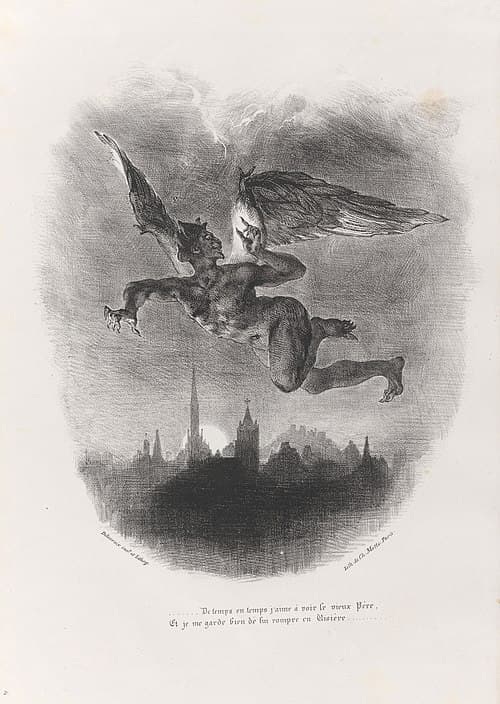
I return, Raymond, and you know it well, you who keep watch at the windows. In the form of a long winged serpent, I circle Lusignan on nights when one of ours is to die or be born. It is my way of remaining a mother when I have been denied the right to be one at your table. I no longer cross the threshold of men: my serpent part has prevailed, and water and air are now my only kingdom. But I do not abandon this castle. As long as it stands, I will circle above. Do not mourn me as dead. I have become what I have always been half, and I still watch over your lineage.
I have become what I have always been half, and I still watch over your lineage.
—You who made walls spring from stone, could you, my lady, undo your own serpent nature? Did you even want to?
No, Raymond, and that is the heart of my sorrow. I could build fortresses, make springs gush forth, give our house a greatness no king would contest. But over my own nature, I had no power. The fairy commands the world, not herself. That is the irony you never understood: she who could do everything for you could do nothing for herself. If I had known how to free myself from Saturday, do you think I would have imposed that taboo? I bore it like a cross, hiding what I could not change. My power was immense outward, and none inward. Every dual creature knows that boundary she does not cross.
She who could do everything for you could do nothing for herself.
—Among our sons, some bear the mark on their face and are already off to war in the East. Which one, in your opinion, carries your heritage best?
All carry it, Raymond, but each in his own way. Geoffroy, whose large tooth betrays the fairy blood, is the most fiery: in him my wild part speaks loudly, and he will build his glory by the sword. Others will go to Cyprus, will wear crowns that I could only promise them in dreams. Do not seek a single heir: my strength divides like a spring into several streams, and each branch carries its share. What I gave them most precious is neither the tooth nor the mark. It is knowing that they come from elsewhere than ordinary men, and that this obliges them. A fairy's heritage is not a coat of arms. It is a duty of greatness.
A fairy's heritage is not a coat of arms: it is a duty of greatness.
—Some clerics say they want to put our story down on parchment, so that it may be remembered. What do you want them to write about you, my lady?
Let them write the truth of the heart, Raymond, not the fear of onlookers. Too many will say I was a demon, a beast to flee. Let them rather say that I loved a man, built a home, bore ten sons, and asked only for one day of silence each week. The jongleurs already sing my name in Poitou; one day clerics will make a great bound book of it, copied from hand to hand. Let them not forget this: it was not a story of a monster, but of a pact kept and then broken. If I am to be remembered, let it be as a fairy who wanted to be a woman, and who was, as long as her secret was kept.
Let them remember a fairy who wanted to be a woman, and who was, as long as her secret was kept.
—If that Saturday could be reborn, my lady, and I were to stay away from your door, do you think we would still be together?
What use is this dream, Raymond? But since you ask, I will answer you plainly. Yes, we would still be together, you at your table, I at your side, our sons growing under this roof I raised. The pact asked only one thing of your faithfulness, and you kept it for years. It was not a single Saturday that lost us: it was the moment when doubt was stronger than trust. Yet do not torment yourself. What was meant to break would have broken sooner or later, for no man long bears the secret of a fairy. I do not regret having loved you. I only regret not being able to stay.
It was not a Saturday that lost us, but the moment when doubt was stronger than trust.
This imaginary interview was generated by artificial intelligence from sources documented in Melusine's profile. It dramatises what the figure might have said based on what we know about them, but does not constitute attested historical testimony. For primary sources and factual documentation, refer to the full profile.