Imaginary dialogue between Gilles Deleuze and Michel Foucault
by Charactorium · Michel Foucault (1926 — 1984) · Philosophy · 6 min read
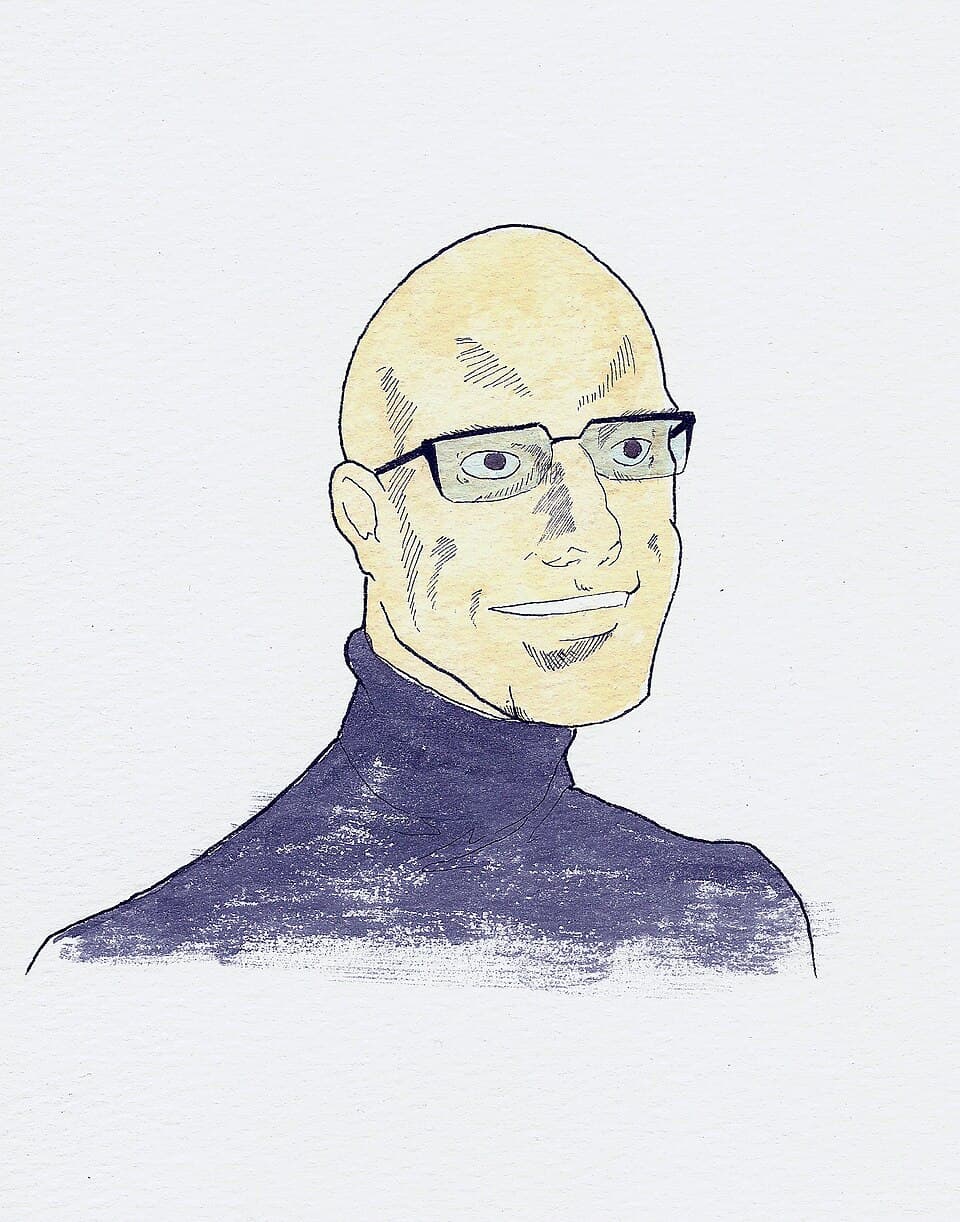
It is at La Palette, on the Rue de Seine, on a gray autumn afternoon in 1977, that Gilles Deleuze meets his friend Michel Foucault over two strong coffees and an already full ashtray. The light falls obliquely on the manuscripts Foucault has placed between them, covered in that tight handwriting Deleuze knows well. They have known each other since their school days, occupied prisons together through the GIP, and reshaped the world in these same brasseries. This time, Deleuze has not come to discuss a book, but to push his friend to reveal what lies behind the shaved head and round glasses.
—Michel, do you remember that day at Vincennes, in 1969, when you climbed onto the roof, cobblestone in hand? What made you go up there?
You who were one of us in those years, Gilles, you know it wasn't a theatrical stunt. Vincennes was a university born of May '68, open, rebellious, and they came to evict us as they would evict squatters. I climbed up because a thought that remains seated while its students are being beaten is no longer thought — it's politeness. I have always hated the idea of the philosopher as spectator, who comments on the struggle from his window. The cobblestone I threw that day was the same hand that wrote about institutions — prison, school, hospital. Two years later, we founded the GIP together: it wasn't about speaking on behalf of prisoners, but giving them back their voice. Theory and the rooftop, you see, were the same gesture.
A thought that remains seated while its students are being beaten is no longer thought — it's politeness.
—When we set up the GIP in 1971, many thought we would speak for the prisoners. Why did you always refuse that role?
Because that is precisely the trap of power, Gilles: deciding who has the right to speak the truth, and about whom. For centuries, people have spoken about the mad, the sick, the criminal — never are they allowed to speak. The intellectual dreams of being a voice for the voiceless, and in doing so, silences them a second time, more politely. The GIP had no doctrine to impose: we circulated questionnaires in prisons, collected what prisoners themselves wrote about their daily lives — the cold, the searches, the arbitrariness. Our role was not to represent but to create the conditions for speech to emerge. That is concrete engagement: not bringing truth from above, but disturbing the monopoly of those who decide what can be said.
The intellectual dreams of being a voice for the voiceless, and in doing so, silences them a second time.
—In Discipline and Punish, you make Bentham's Panopticon the figure of everything. Explain to me why this tower and this ring obsess you so much.
Because the Panopticon is not just one prison among others; it is a diagram. Imagine: a ring-shaped building, and at the center a tower with large windows opening onto the cells. The guard can see without being seen; the inmate knows he may be observed, but can never be sure. And here is the masterstroke: he ends up watching himself. That is what struck me — the most effective power is not the one that strikes, but the one that lodges itself in everyone's head. The barracks, the school, the workshop, the hospital all reproduce this principle. We live in a disciplinary society that no longer needs chains because it has installed surveillance inside us. Panopticism, you see, is the moment when the prison spills beyond its walls.
The most effective power is not the one that strikes, but the one that lodges itself in everyone's head.
—You went to see Attica prison in the United States after the uprising. What did that trip change in your conviction about confinement?
Attica confirmed something I suspected while writing Discipline and Punish: the prison does not fail, it succeeds perfectly. For two centuries we have been told it must correct, rehabilitate, make better — and for two centuries it produces recidivists. We conclude it is a failure. But what if its real function were not to eliminate crime, but to manage it, to produce a useful, monitorable delinquency, isolated from the rest of the people? In front of those immense walls of Attica, in front of that machine for sorting bodies, I understood that confinement is first and foremost an instrument of social control, not a remedy. The question is no longer 'how to reform the prison?' but 'what exactly is the purpose of its succeeding so well at failing?'.
The prison does not fail, it succeeds perfectly.
—With The Order of Things, you announce that man is a recent invention, and perhaps soon to disappear. Provocation, or serious business?
Serious business indeed, Gilles, even if the phrase caused an outcry. What I wanted to show is that 'man' as an object of knowledge — the one studied by biology, economics, linguistics — has not always existed. Before the end of the eighteenth century, there was simply no place for him in the order of knowledge. Each era has its subterranean configuration, what I call an episteme, which silently decides what can be thought, said, known. Man was born from a certain fold in our episteme, like a face drawn in the sand at the edge of the sea. And if the arrangements that brought him forth were to come undone, then yes, he could disappear. This is not a morbid prophecy: it is a way of reminding us that nothing we take for granted is eternal.
Man was born from a certain fold in our knowledge, like a face drawn in the sand.
—You spend your afternoons at the National Library, filling thousands of index cards. How is this archival work philosophy, and not just erudition?
Because I do not look in the archives for what the great authors thought, but for what an era made it possible to say. That is what I call archaeology: digging through the layers of discourse to uncover the hidden rules that allowed people to speak of madness, disease, crime in a certain way at a certain time and not before. The scholar accumulates facts; I track thresholds, ruptures, the moment when something unthinkable suddenly becomes obvious. My index cards — those thousands of little papers covered in writing — are the shards of a ground I am patiently clearing. Later, with Nietzsche in mind, I called this genealogy: not seeking noble origins, but recovering the power relations, accidents, and conflicts from which our most seemingly peaceful forms of knowledge were born.
The scholar accumulates facts; I track thresholds, the moment when the unthinkable suddenly becomes obvious.
—Every winter, your chair at the Collège de France overflows; people pack the corridors. Yet you refuse to be recorded. Why this intransigence?
Because living thought must not be fixed, Gilles. When I step up to that chair in the History of Systems of Thought, to which I was elected in 1970, I am not reciting finished knowledge: I am searching in front of those hundreds of people, I make mistakes, I backtrack, I advance a step. It is an open laboratory, not a sermon. Recording it would turn an essay into a monument, giving tentative explorations the authority of the definitive. These lectures serve me to explore what my books have not yet digested — the way power, since the eighteenth century, no longer merely threatens death but takes charge of life itself: birth, health, populations. That is what I call biopolitics. Before the audience, these ideas are still burning; on a tape, they would already be cold.
Before the audience these ideas are still burning; on a tape, they would already be cold.
—You talk about biopolitics, governmentality. So for you, power is no longer that of the sovereign who cuts off heads?
No, and that is the whole shift. The old power was that of the sovereign: to make die or let live, the raised sword. Modern power does the opposite — it makes live and lets die. It concerns itself with birth rates, hygiene, epidemics, longevity; it manages populations like a resource. That is biopower. And it is exercised less and less by brute constraint, more and more by what I call governmentality: the art of conducting conduct, shaping behaviors until each person governs themselves. Power is not a thing one possesses, Gilles; it is a relation that circulates, that passes through you, through me, through the doctor, through the statistician. It is everywhere precisely because it does not come from a single place.
The old power made die or let live; modern power makes live and lets die.
—It all began with your thesis on madness, in 1961. What led you from confined madmen to the sex we never stop talking about?
A single thread, in truth: the question of how a society draws the line between the normal and what it rejects. With the History of Madness, I showed how the classical age locked away the madman, silenced him, made him the reverse of reason. With The Birth of the Clinic, I followed the medical gaze arrogating the right to speak the truth about the sick body. And sex? People think our era has repressed it, stifled it. But the opposite is true: for three centuries, we have ceaselessly incited it to discourse — confession, medicine, psychiatry, pedagogy, everything pushes us to speak about it, to confess it, to classify it. The madness that is silenced and the sexuality that is made to speak belong to the same dispositif: those sets of laws, institutions, and knowledges that produce both power and truth.
The madness that is silenced and the sexuality that is made to speak belong to the same dispositif.


This imaginary interview was generated by artificial intelligence from sources documented in Michel Foucault's profile. It dramatises what the figure might have said based on what we know about them, but does not constitute attested historical testimony. For primary sources and factual documentation, refer to the full profile.